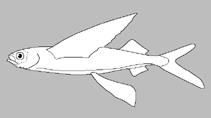
Hirundichthys indicus

Hirundichthys indicus Shakhovskoy & Parin, 2013

Lägg till din observation i Fish Watcher
Native range | All suitable habitat | Point map | Year 2050
This map was computer-generated and has not yet been reviewed.
Hirundichthys indicus   AquaMaps   Data sources: GBIF OBIS
Ladda upp din foton och Videor
Google image
Image of Hirundichthys indicus
No image available for this species;
drawing shows typical species in Exocoetidae.

Klassificering / Namn Populärnamn | synonymer | Catalog of Fishes(Släkte, Arter) | ITIS | CoL | WoRMS | Cloffa

> Beloniformes (Needle fishes) > Exocoetidae (Flyingfishes)
Etymology: Hirundichthys: latin, hirundo = swift; 1300 + Greek, ichthys = fish (Ref. 45335)indicus: Named for its occurrence in the Indian Ocean.

Taxonomic Remarks
Subspecies Hirundichthys indicus orientalis is elevated to a valid species according to Shakhovskoy, 2018 (Ref. 119460). A species record will be created for this species in the next web update. The two species differ in pelvic fin coloration in adults: Hirundichthys indicus distributed on the waters of the western and central parts (from the west coast of Africa to the meridian of 96° E, and from 15° S to the northern Arabian Sea, the southern parts of the Bay of Bengal (but does not enter the coastal waters, only at its outlet) and the Andaman Sea; not found in the western part of Arabian Sea, the Red Sea, the Gulf of Oman and the Persian Gulf). Hirundichthys orientalis distributed on the waters of the eastern parts - from the 100° E meridian, early stages of development seemingly can be transported by the Southern Equatorial Current westward up to 90° E.

Miljö: miljö / Klimatzon / djupintervall / distributionsområde Ekologi

marina pelagic-oceanic; djupintervall 0 - ? m. Tropical

Utbredning Territorier | FAO områden | Ekosystem | Förekomster | Prickkarta | Utplanteringar | Faunafri

Indian Ocean: widely distributed in western and central open ocean, from East Africa to the meridian of 96° E, and from 15° S to the northern Arabian Sea, southern Bay of Bengal (but does not enter the coastal water, only at its outlet), Andaman Sea, but not in Red Sea, Gulf of Oman, Persian Gulf, western Arabian Sea,and northern Bay of Bengal.

Storlek / Vikt / Ålder

Könsmognad: Lm ?  range ? - ? cm
Max length : 19.2 cm SL hane/ej könsbestämd; (Ref. 93339)

Kort beskrivning Bestämningsnycklar | Morfologi | Morfometri

H. indicus indicus differs from H. indicus orientalis by the absence of a dark spot on the ventral fins in specimens larger than 15.1 cm (usually the spot is absent already in fishes larger than 13.5 cm), as well as by having some less number of predorsal scales: 26-35 (modally 28-30) (Ref. 93339).
Body shape (shape guide): elongated.

Biologi     Ordlista (t.ex. epibenthic)

Caught in surface waters over the depths 390-7219 m, usually 2000-6000 m (mean 4129 m) (Ref. 93339). Juveniles of this species under 10.0 cm SL were caught in all seasons, indicating a year-round spawning of this species, with a highly pronounced peak in the summer and autumn months. Mature fishes appear at 16.0 cm SL or more (Ref. 93339).

Livscykel och parningsbeteende Könsmognad | Reproduktion | Lek | Ägg | Fekunditet | Larver

Huvudreferens Ladda upp dina referenser | referenser | Koordinator : Parin, Nikolay V. | Medarbetare

Shakhovskoy, I.B. and N.V. Parin, 2013. A review of flying fishes of the subgenus Hirundichthys (genus Hirundichthys, Exocoetidae). 1. Oceanic species: H. speculiger, H. indicus sp. nova. J. Ichthyol. 53(2):117-145. (Ref. 93339)

Status på IUCN:s rödlista (Ref. 130435: Version 2025-2 (Global))


CITES

Not Evaluated

CMS (Ref. 116361)

Not Evaluated

Hot mot människor

  Harmless


Mänskliga användningsområden

FAO - Publication: search | FishSource |

Ytterligare information

Trofisk ekologi
Livsmedelsartiklar (preys)
Födosammansättning
Födointag
Matransoner
Predatorer
Ekologi
Ekologi
Populationsdynamik
Tillväxtparametrar
Max. åldrar / storlekar
Längd-vikt rel.
Längd-längd rel.
Längd-frekvenser
Massakonvertering
Rekrytering
Abundans
Livscykel
Reproduktion
Könsmognad
Mognad/Gills rel.
Fekunditet
Lek
Lekande aggregat
Ägg
Utveckling av ägg
Larver
Larvdynamik
Utbredning
Territorier
FAO områden
Ekosystem
Förekomster
Utplanteringar
BRUVS - Videor
Anatomi
Gälyta
Hjärna
Otolit
Fysiologi
Kroppssammansättning
Näringsämnen
Syreförbrukning
Typ av simning
Simhastighet
Visuella pigment
Ljud från fisk
Sjukdomar & Parasiter
Toxicitet (LC50)
Genetik
Genom
Genetik
Heterozygositet
Ärftlighet
Genetisk mångfald
Människorelaterad
Vattenbrukssystem
Vattenbruksprofiler
Avelslinjer
Ciguatera-fall
Frimärken, mynt, diverse.
Uppsökande verksamhet
Medarbetare
Taxonomi
Populärnamn
synonymer
Morfologi
Morfometri
Bilder
referenser
referenser

Verktyg

Särskilda rapporter

Ladda ner XML

Internet-källor

AFORO (otoliths) | Aquatic Commons | BHL | Cloffa | Websites from users | Check FishWatcher | CISTI | Catalog of Fishes: Släkte, Arter | DiscoverLife | ECOTOX | FAO - Publication: search | Faunafri | Fishipedia | Fishtrace | GloBI | Google Books | Google Scholar | Google | IGFA World Record | OneZoom | Open Tree of Life | Otolith Atlas of Taiwan Fishes | PubMed | Reef Life Survey | Socotra Atlas | TreeBase | Tree of Life | Wikipedia: Go, sök | World Records Freshwater Fishing | Zoobank | Zoologiskt register

Uppskattningar baserade på modeller

Önskad temperatur (Ref. 123201): 1.2 - 2.1, mean 1.6 °C (based on 4530 cells).
Index för fylogenetisk mångfald (Ref. 82804):  PD50 = 0.5002   [Uniqueness, from 0.5 = low to 2.0 = high].
Bayesian length-weight: a=0.00646 (0.00293 - 0.01422), b=3.04 (2.85 - 3.23), in cm total length, based on LWR estimates for this (Sub)family-body shape (Ref. 93245).
Trofisk nivå (Ref. 69278):  3.0   ±0.1 se; based on size and trophs of closest relatives
Resiliens (Ref. 120179):  Hög, lägsta populationsfördubblingstid mindre än 15 månader (Preliminary K or Fecundity.).
Sårbarhet i fisket (Ref. 59153):  Low vulnerability (13 of 100). 🛈