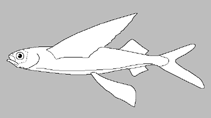
Hirundichthys indicus

Hirundichthys indicus Shakhovskoy & Parin, 2013

Ajouter votre observation dans Fish Watcher
Native range | All suitable habitat | Point map | Year 2050
This map was computer-generated and has not yet been reviewed.
Hirundichthys indicus   AquaMaps   Data sources: GBIF OBIS
Envoyez vos Photos et vidéos
Images Google
Image of Hirundichthys indicus
No image available for this species;
drawing shows typical species in Exocoetidae.

Classification / Noms Noms communs | Synonymes | Catalog of Fishes(Genre, Espèce) | ITIS | CoL | WoRMS | Cloffa

> Beloniformes (Needle fishes) > Exocoetidae (Flyingfishes)
Etymology: Hirundichthys: latin, hirundo = swift; 1300 + Greek, ichthys = fish (Ref. 45335)indicus: Named for its occurrence in the Indian Ocean.

Taxonomic Remarks
Subspecies Hirundichthys indicus orientalis is elevated to a valid species according to Shakhovskoy, 2018 (Ref. 119460). A species record will be created for this species in the next web update. The two species differ in pelvic fin coloration in adults: Hirundichthys indicus distributed on the waters of the western and central parts (from the west coast of Africa to the meridian of 96° E, and from 15° S to the northern Arabian Sea, the southern parts of the Bay of Bengal (but does not enter the coastal waters, only at its outlet) and the Andaman Sea; not found in the western part of Arabian Sea, the Red Sea, the Gulf of Oman and the Persian Gulf). Hirundichthys orientalis distributed on the waters of the eastern parts - from the 100° E meridian, early stages of development seemingly can be transported by the Southern Equatorial Current westward up to 90° E.

Environnement : milieu / zone climatique / profondeur / gamme de distribution Écologie

marin pelagic-oceanic; profondeur 0 - ? m. Tropical

Distribution Territoires | Zones FAO | Écosystèmes | Occurrences | Carte par point | Introductions | Faunafri

Indian Ocean: widely distributed in western and central open ocean, from East Africa to the meridian of 96° E, and from 15° S to the northern Arabian Sea, southern Bay of Bengal (but does not enter the coastal water, only at its outlet), Andaman Sea, but not in Red Sea, Gulf of Oman, Persian Gulf, western Arabian Sea,and northern Bay of Bengal.

Taille / Poids / Âge

Maturité: Lm ?  range ? - ? cm
Max length : 19.2 cm SL mâle / non sexé; (Ref. 93339)

Description synthétique Clés d'identification | Morphologie | Morphométrie

H. indicus indicus differs from H. indicus orientalis by the absence of a dark spot on the ventral fins in specimens larger than 15.1 cm (usually the spot is absent already in fishes larger than 13.5 cm), as well as by having some less number of predorsal scales: 26-35 (modally 28-30) (Ref. 93339).
Body shape (shape guide): elongated.

Biologie     Glossaire (ex. epibenthic)

Caught in surface waters over the depths 390-7219 m, usually 2000-6000 m (mean 4129 m) (Ref. 93339). Juveniles of this species under 10.0 cm SL were caught in all seasons, indicating a year-round spawning of this species, with a highly pronounced peak in the summer and autumn months. Mature fishes appear at 16.0 cm SL or more (Ref. 93339).

Cycle de vie et comportement reproducteur Maturité | Reproduction | Frai | Œufs | Fécondité | Larves

Référence principale Téléchargez vos références | Références | Coordinateur : Parin, Nikolay V. | Collaborateurs

Shakhovskoy, I.B. and N.V. Parin, 2013. A review of flying fishes of the subgenus Hirundichthys (genus Hirundichthys, Exocoetidae). 1. Oceanic species: H. speculiger, H. indicus sp. nova. J. Ichthyol. 53(2):117-145. (Ref. 93339)

Statut dans la liste rouge de l'IUCN (Ref. 130435: Version 2025-2 (Global))


CITES

Not Evaluated

CMS (Ref. 116361)

Not Evaluated

Menace pour l'homme

  Harmless


Utilisations par l'homme

FAO - Publication: search | FishSource |

Plus d'informations

Écologie trophique
Aliments (proies)
Composition du régime alimentaire
Consommation alimentaire
Rations alimentaires
Prédateurs
Écologie
Écologie
Dynamique des populations
Paramètres de croissance
Âges / tailles maximales
Longueur-poids rel.
Rel. longueur-longueur.
Fréquences de longueurs
Conversion de masse
Recrutement
Abondance
Cycle de vie
Reproduction
Maturité
Maturité/épines rel.
Fécondité
Frai
Agrégats de frai
Œufs
Développement de l'œuf
Larves
Dynamique des populations larvaires
Distribution
Territoires
Zones FAO
Écosystèmes
Occurrences
Introductions
BRUVS - Vidéos
Anatomie
Surface branchiale
Cerveau
Otolithe
Physiologie
Composition corporelle
Nutriments
Consommation d'oxygène
Type de natation
Vitesse de nage
Pigments visuels
Son de poisson
Maladies et parasites
Toxicité (CL50)
Génétique
génôme
Génétique
Hétérozygotie
Héritabilité
Diversité génétique
Liées à l'homme
Systèmes d'aquaculture
Profils d'aquaculture
Souches
Cas de ciguatera
Timbres, pièces de monnaie, divers
Sensibilisation
Collaborateurs
Taxonomie
Noms communs
Synonymes
Morphologie
Morphométrie
Images
Références
Références

Outils

Articles particuliers

Télécharger en XML

Sources Internet

AFORO (otoliths) | Aquatic Commons | BHL | Cloffa | Websites from users | FishWatcher | CISTI | Catalog of Fishes: Genre, Espèce | DiscoverLife | ECOTOX | FAO - Publication: search | Faunafri | Fishipedia | Fishtrace | GloBI | Google Books | Google Scholar | Google | IGFA World Record | OneZoom | Open Tree of Life | Otolith Atlas of Taiwan Fishes | PubMed | Reef Life Survey | Socotra Atlas | TreeBase | Arbre de Vie | Wikipedia: aller à, chercher | World Records Freshwater Fishing | Zoobank | Zoological Record

Estimations basées sur des modèles

Température préférée (Réf. 123201): 1.2 - 2.1, mean 1.6 °C (based on 4530 cells).
Indice de diversité phylogénétique (Réf. 82804):  PD50 = 0.5002   [Uniqueness, from 0.5 = low to 2.0 = high].
Bayesian length-weight: a=0.00646 (0.00293 - 0.01422), b=3.04 (2.85 - 3.23), in cm total length, based on LWR estimates for this (Sub)family-body shape (Ref. 93245).
Niveau trophique (Réf. 69278):  3.0   ±0.1 se; based on size and trophs of closest relatives
Résilience (Réf. 120179):  Haut, temps minimum de doublement de population inférieur à 15 mois (Preliminary K or Fecundity.).
Vulnérabilité de la pêche (Ref. 59153):  Low vulnerability (13 of 100). 🛈