Hirundichthys indicus

Hirundichthys indicus Shakhovskoy & Parin, 2013

Aggiungete la vostra osservazione in Fish Watcher
Native range | All suitable habitat | Point map | Year 2050
This map was computer-generated and has not yet been reviewed.
Hirundichthys indicus   AquaMaps   Data sources: GBIF OBIS
Carica il tuo foto e Video
Google image
Image of Hirundichthys indicus
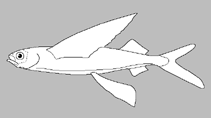
No image available for this species;
drawing shows typical species in Exocoetidae.

Classificazione / Nomi Nomi Comuni | Sinonimi | Catalog of Fishes(Genere, Specie) | ITIS | CoL | WoRMS | Cloffa

> Beloniformes (Needle fishes) > Exocoetidae (Flyingfishes)
Etymology: Hirundichthys: latin, hirundo = swift; 1300 + Greek, ichthys = fish (Ref. 45335)indicus: Named for its occurrence in the Indian Ocean.

Taxonomic Remarks
Subspecies Hirundichthys indicus orientalis is elevated to a valid species according to Shakhovskoy, 2018 (Ref. 119460). A species record will be created for this species in the next web update. The two species differ in pelvic fin coloration in adults: Hirundichthys indicus distributed on the waters of the western and central parts (from the west coast of Africa to the meridian of 96° E, and from 15° S to the northern Arabian Sea, the southern parts of the Bay of Bengal (but does not enter the coastal waters, only at its outlet) and the Andaman Sea; not found in the western part of Arabian Sea, the Red Sea, the Gulf of Oman and the Persian Gulf). Hirundichthys orientalis distributed on the waters of the eastern parts - from the 100° E meridian, early stages of development seemingly can be transported by the Southern Equatorial Current westward up to 90° E.

Ambiente: milieu / zona climatica / distribuzione batimetrica / gamma di distribuzione Ecologia

marino pelagic-oceanic; distribuzione batimetrica 0 - ? m. Tropical

Distribuzione Territories | Aree FAO | Ecosistemi | Presenze | Mappa dei ritrovamenti | Introduzioni | Faunafri

Indian Ocean: widely distributed in western and central open ocean, from East Africa to the meridian of 96° E, and from 15° S to the northern Arabian Sea, southern Bay of Bengal (but does not enter the coastal water, only at its outlet), Andaman Sea, but not in Red Sea, Gulf of Oman, Persian Gulf, western Arabian Sea,and northern Bay of Bengal.

Dimensione / Peso / Età

Maturità: Lm ?  range ? - ? cm
Max length : 19.2 cm SL maschio/sesso non determinato; (Ref. 93339)

Breve descrizione Chiavi di identificazione | Morfologia | Morfometria

H. indicus indicus differs from H. indicus orientalis by the absence of a dark spot on the ventral fins in specimens larger than 15.1 cm (usually the spot is absent already in fishes larger than 13.5 cm), as well as by having some less number of predorsal scales: 26-35 (modally 28-30) (Ref. 93339).
Body shape (shape guide): elongated.

Biologia     Glossario (es. epibenthic)

Caught in surface waters over the depths 390-7219 m, usually 2000-6000 m (mean 4129 m) (Ref. 93339). Juveniles of this species under 10.0 cm SL were caught in all seasons, indicating a year-round spawning of this species, with a highly pronounced peak in the summer and autumn months. Mature fishes appear at 16.0 cm SL or more (Ref. 93339).

Ciclo vitale e comportamento di accoppiamento Maturità | Riproduzione | Deposizione | Uova | Fecondità | Larve

Riferimento principale Caricare le referenze | Bibliografia | Coordinatore : Parin, Nikolay V. | Collaboratori

Shakhovskoy, I.B. and N.V. Parin, 2013. A review of flying fishes of the subgenus Hirundichthys (genus Hirundichthys, Exocoetidae). 1. Oceanic species: H. speculiger, H. indicus sp. nova. J. Ichthyol. 53(2):117-145. (Ref. 93339)

Stato della Lista Rossa IUCN (Ref. 130435: Version 2025-2 (Global))


CITES

Not Evaluated

CMS (Ref. 116361)

Not Evaluated

Minaccia per l'uomo

  Harmless


Usi umani

FAO - Publication: search | FishSource |

Informazioni ulteriori

Ecologia trofica
Articoli alimentari (prede)
Alimentazione
Consumo di cibo
Razioni alimentari
Predatori
Ecologia
Ecologia
Dinamica della popolazione
Parametri di crescita
Età massima / dimensioni massime
Rapporto lunghezza-peso.
Lunghezza-lunghezza rel.
Lunghezza-frequenze
Conversione di massa
Reclutamento
Abbondanza
Ciclo di vita
Riproduzione
Maturità
Maturità/Gli occhielli sono relativi.
Fecondità
Deposizione
Aggregazioni riproduttive
Uova
Sviluppo delle uova
Larve
Dinamica popolazioni larvali
Distribuzione
Territories
Aree FAO
Ecosistemi
Presenze
Introduzioni
BRUVS - Video
Anatomia
Area branchiale
Cervello
Otolite
Fisiologia
Composizione corporea
Nutrienti
Consumo di ossigeno
Tipo di nuoto
Velocità di nuoto
Pigmenti visivi
Suono del pesce
Malattie e parassiti
Tossicità (LC50)
Genetica
Genome
Genetica
Eterozigosi
Ereditarietà
Diversità genetica
Legato all'uomo
Sistemi di acquacoltura
Profili di acquacoltura
Varietà
Casi di Ciguatera
Francobolli, monete, materiale vario.
Raggiungimento
Collaboratori
Tassonomia
Nomi Comuni
Sinonimi
Morfologia
Morfometria
Immagini
Bibliografia
Bibliografia

Strumenti

Rapporti speciali

Scarica XML

Fonti Internet

AFORO (otoliths) | Aquatic Commons | BHL | Cloffa | Websites from users | Check FishWatcher | CISTI | Catalog of Fishes: Genere, Specie | DiscoverLife | ECOTOX | FAO - Publication: search | Faunafri | Fishipedia | Fishtrace | GloBI | Google Books | Google Scholar | Google | IGFA World Record | OneZoom | Open Tree of Life | Otolith Atlas of Taiwan Fishes | PubMed | Reef Life Survey | Socotra Atlas | TreeBase | Tree of Life | Wikipedia: Go, ricerca | World Records Freshwater Fishing | Zoobank | Record zoologico

Stime basate su modelli

Temperatura preferita (Fonte Biblio. 123201): 1.2 - 2.1, mean 1.6 °C (based on 4530 cells).
Indice di diversità filogenetica (Fonte Biblio. 82804):  PD50 = 0.5002   [Uniqueness, from 0.5 = low to 2.0 = high].
Bayesian length-weight: a=0.00646 (0.00293 - 0.01422), b=3.04 (2.85 - 3.23), in cm total length, based on LWR estimates for this (Sub)family-body shape (Ref. 93245).
Livello trofico (Fonte Biblio. 69278):  3.0   ±0.1 se; based on size and trophs of closest relatives
Resilienza (Fonte Biblio. 120179):  Alto, tempo minimo di raddoppiamento della popolazione meno di 15 mesi (Preliminary K or Fecundity.).
Vulnerabilità della pesca (Ref. 59153):  Low vulnerability (13 of 100). 🛈