Hirundichthys indicus

Hirundichthys indicus Shakhovskoy & Parin, 2013

Adicionar sua observação em Fish Watcher
Native range | All suitable habitat | Point map | Year 2050
This map was computer-generated and has not yet been reviewed.
Hirundichthys indicus   AquaMaps   Data sources: GBIF OBIS
Carregue seu(sua) Fotos e vídeos
Imagem do Google
Image of Hirundichthys indicus
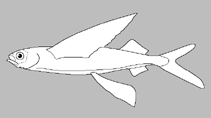
No image available for this species;
drawing shows typical species in Exocoetidae.

Classificação / Nomes Nomes comuns | Sinônimos | Catalog of Fishes(Gênero, Espécies) | ITIS | CoL | WoRMS | Cloffa

> Beloniformes (Needle fishes) > Exocoetidae (Flyingfishes)
Etymology: Hirundichthys: latin, hirundo = swift; 1300 + Greek, ichthys = fish (Ref. 45335)indicus: Named for its occurrence in the Indian Ocean.

Taxonomic Remarks
Subspecies Hirundichthys indicus orientalis is elevated to a valid species according to Shakhovskoy, 2018 (Ref. 119460). A species record will be created for this species in the next web update. The two species differ in pelvic fin coloration in adults: Hirundichthys indicus distributed on the waters of the western and central parts (from the west coast of Africa to the meridian of 96° E, and from 15° S to the northern Arabian Sea, the southern parts of the Bay of Bengal (but does not enter the coastal waters, only at its outlet) and the Andaman Sea; not found in the western part of Arabian Sea, the Red Sea, the Gulf of Oman and the Persian Gulf). Hirundichthys orientalis distributed on the waters of the eastern parts - from the 100° E meridian, early stages of development seemingly can be transported by the Southern Equatorial Current westward up to 90° E.

Meio ambiente: milieu / Zona climática / intervalo de profundidade / faixa de distribuição Ecologia

marinhas pelagic-oceanic; intervalo de profundidade 0 - ? m. Tropical

Distribuição Territórios | Áreas da FAO | Ecossistemas | Ocorrências | Mapa de pontos | Introduções | Faunafri

Indian Ocean: widely distributed in western and central open ocean, from East Africa to the meridian of 96° E, and from 15° S to the northern Arabian Sea, southern Bay of Bengal (but does not enter the coastal water, only at its outlet), Andaman Sea, but not in Red Sea, Gulf of Oman, Persian Gulf, western Arabian Sea,and northern Bay of Bengal.

Tamanho / Peso / Idade

Maturidade: Lm ?  range ? - ? cm
Max length : 19.2 cm SL macho/indeterminado; (Ref. 93339)

Descrição suscinta Chaves de identificação | Morfologia | Morfometria

H. indicus indicus differs from H. indicus orientalis by the absence of a dark spot on the ventral fins in specimens larger than 15.1 cm (usually the spot is absent already in fishes larger than 13.5 cm), as well as by having some less number of predorsal scales: 26-35 (modally 28-30) (Ref. 93339).
Body shape (shape guide): elongated.

Biologia     Glossário (p.ex. epibenthic)

Caught in surface waters over the depths 390-7219 m, usually 2000-6000 m (mean 4129 m) (Ref. 93339). Juveniles of this species under 10.0 cm SL were caught in all seasons, indicating a year-round spawning of this species, with a highly pronounced peak in the summer and autumn months. Mature fishes appear at 16.0 cm SL or more (Ref. 93339).

Ciclo de vida ou comportamento de acasalamento Maturidade | Reprodução | Desova | Ovos | Fecundidade | Larvas

Referência principal Carregar suas referências | Referências | Coordenador : Parin, Nikolay V. | Colaboradores

Shakhovskoy, I.B. and N.V. Parin, 2013. A review of flying fishes of the subgenus Hirundichthys (genus Hirundichthys, Exocoetidae). 1. Oceanic species: H. speculiger, H. indicus sp. nova. J. Ichthyol. 53(2):117-145. (Ref. 93339)

Status na Lista Vermelha da UICN (Ref. 130435: Version 2025-2 (Global))


CITES

Not Evaluated

CMS (Ref. 116361)

Not Evaluated

Ameaça para os humanos

  Harmless


Uso pelos humanos

FAO - Publication: search | FishSource |

Mais informação

Ecologia Trófica
Itens alimentares (presas)
Composição da dieta
Consumo alimentar
Rações alimentares
Predadores
Ecologia
Ecologia
Dinâmica populacional
Parâmetros de crescimento
Idade máxima / tamanhos
Relação comprimento-peso.
Relação comprimento-comprimento.
Frequências de comprimento
Conversão de massa
Recrutamento
Abundância
Ciclo de vida
Reprodução
Maturidade
Maturidade/Rel. das guelras
Fecundidade
Desova
Agregações de desova
Ovos
Desenvolvimento dos ovos
Larvas
Dinâmica larval
Distribuição
Territórios
Áreas da FAO
Ecossistemas
Ocorrências
Introduções
BRUVS - Vídeos
Anatomia
Área branquial
Cérebro
Otólito
Fisiologia
Composição corporal
Nutrientes
Consumo de oxigênio
Tipo de natação
Velocidade de natação
Pigmentos visuais
Som de peixe
Doenças e Parasitas
Toxicidade (LC50s)
Genética
genoma
Genética
Heterozigosidade
Hereditariedade
Diversidade genética
Relacionado a humanos
Sistemas de aquicultura
Perfis para aquacultura
Estirpes
Casos de Ciguatera
Selos, moedas, diversos.
Divulgação
Colaboradores
Taxonomia
Nomes comuns
Sinônimos
Morfologia
Morfometria
Fotos
Referências
Referências

Ferramentas

Relatórios especiais

Baixar XML

Fontes da internet

AFORO (otoliths) | Aquatic Commons | BHL | Cloffa | Websites from users | Checar Observador de Peixes (FishWatcher) | CISTI | Catalog of Fishes: Gênero, Espécies | DiscoverLife | ECOTOX | FAO - Publication: search | Faunafri | Fishipedia | Fishtrace | GloBI | Google Books | Google Scholar | Google | IGFA World Record | OneZoom | Open Tree of Life | Otolith Atlas of Taiwan Fishes | PubMed | Reef Life Survey | Socotra Atlas | TreeBase | Árvore da vida | Wikipedia: Ir para, procura | World Records Freshwater Fishing | Zoobank | Registro zoológico

Estimativas baseadas em modelos

Temperatura preferida (Ref. 123201): 1.2 - 2.1, mean 1.6 °C (based on 4530 cells).
Índice de diversidade filogenética (Ref. 82804):  PD50 = 0.5002   [Uniqueness, from 0.5 = low to 2.0 = high].
Bayesian length-weight: a=0.00646 (0.00293 - 0.01422), b=3.04 (2.85 - 3.23), in cm total length, based on LWR estimates for this (Sub)family-body shape (Ref. 93245).
Nível Trófico (Ref. 69278):  3.0   ±0.1 se; based on size and trophs of closest relatives
Resiliência (Ref. 120179):  Elevada, tempo mínimo de duplicação da população menor que 15 meses (Preliminary K or Fecundity.).
Vulnerabilidade da pesca (Ref. 59153):  Low vulnerability (13 of 100). 🛈