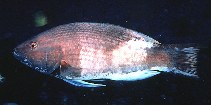
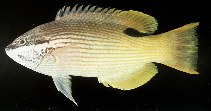
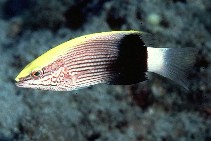
Bodianus albotaeniatus

Bodianus albotaeniatus (Valenciennes, 1839)

Hochladen Photos und videos
Bilder | Google Bild

Klassifizierung / Names Namen | Synonyme | Catalog of Fishes(Gattung, Arten) | ITIS | CoL | WoRMS | Cloffa

> Eupercaria/misc (Various families in series Eupercaria) > Labridae (Wrasses) > Hypsigenyinae
Etymology: Bodianus: Bodianus after Bodiano or Pudiano, from the Portuguese pudor, meaning modesty (Jordan & Evermann, 1896)albotaeniatus: Name formed from the Latin adjective albus meaning white, and Latin noun taenia for fillet or ribbon, apparently referring to un large ruban nacre (= broad pearly ribbon) extending from below the eye to the membranous lobe of the opercle mentioned in the original description. This pearly ribbon refers to the white expanse below the dark cephalic stripe intersecting the eye ventrally in adults of moderate size (Ref. 75973).
More on author: Valenciennes.

Umwelt: Milieu / Klimazone / Tiefenbereich / Verbreitungsgebiet Ökologie

seewasser riff-verbunden. Tropical

Verbreitung Territorien | FAO Gebiete | Ökosysteme | Vorkommen | Punkt Karte | Einführungen | Faunafri

Eastern Central Pacific: restricted to the Hawaiin Is. and Johnston I.

Größe / Gewicht / Alter

Geschlechtsreife: Lm ?  range ? - ? cm
Max length : 32.8 cm SL Männchen/unbestimmt; (Ref. 75973)

Biologie     Fachlexikon (Englisch) (z.B. epibenthic)

Lebenszyklus und Paarungsverhalten Geschlechtsreife | Fortpflanzung | Ablaichen | Eier | Fruchtbarkeit | Larven

Oviparous, distinct pairing during breeding (Ref. 205).

Hauptreferenz Laden Sie Ihre Referenzen hoch | Referenzen | Koordinator : Westneat, Mark | Partner

Parenti, P. and J.E. Randall, 2011. Checklist of the species of the families Labridae and Scaridae: an update. Smithian Bull. 13:29-44. (Ref. 88079)

IUCN Rote Liste Status (Ref. 130435: Version 2025-2 (Global))

  nicht bedroht (LC) ; Date assessed: 25 March 2009

CITES

Not Evaluated

CMS (Ref. 116361)

Not Evaluated

Bedrohung für Menschen

  Harmless


Nutzung durch Menschen

FAO - Publication: search | FishSource |

Mehr Information

Trophische Ökologie
Lebensmittel (Beutetiere)
Nahrungszusammensetzung
Nahrungsaufnahme
Lebensmittelrationen
Räuber
Ökologie
Ökologie
Populationsdynamik
Wachstumsparameter
Max. Alter/Größen
Länge-Gewicht-Rel.
Länge-Länge-Verhältnis.
Längenhäufigkeiten
Massenkonvertierung
Rekrutierung
Dichte
Lebenszyklus
Fortpflanzung
Geschlechtsreife
Reifung/Kiemen rel.
Fruchtbarkeit
Ablaichen
Laichaggregationen
Eier
Eientwicklung
Larven
Larven Pop.Dyn.
Verbreitung
Territorien
FAO Gebiete
Ökosysteme
Vorkommen
Einführungen
BRUVS - Videos
Anatomie
Kiemenoberfläche
Gehirn
Otolith
Physiologie
Körperliche Zusammensetzung
Nährstoffe
Sauerstoffverbrauch
Schwimmart
Schwimmgeschwindigkeit
Visuelle Pigmente
Fischgeräusche
Krankheiten und Parasiten
Toxizität (LC50s)
Genetik
Genom
Genetik
Heterozygotie
Vererbbarkeit
Genetische Vielfalt
Menschenbezogen
Aquakultur-Systeme
Aquakultur Profile
Zuchtlinien
Ciguatera-Fälle
Briefmarken, Münzen, Verschiedenes.
Aufsuchen
Partner
Taxonomie
Namen
Synonyme
Morphologie
Morphometrie
Bilder
Referenzen
Referenzen

Tools

Zusatzinformationen

Download XML

Internet Quellen

AFORO (otoliths) | Aquatic Commons | BHL | Cloffa | Websites from users | FishWatcher Einträge suchen | CISTI | Catalog of Fishes: Gattung, Arten | DiscoverLife | ECOTOX | FAO - Publication: search | Faunafri | Fishipedia | Fishtrace | GloBI | Google Books | Google Scholar | Google | IGFA World Record | OneZoom | Open Tree of Life | Otolith Atlas of Taiwan Fishes | PubMed | Reef Life Survey | Socotra Atlas | TreeBase | Tree of Life | Wikipedia: Gehe zu, Suchen | World Records Freshwater Fishing | Zoologischer Rekord

Schätzungen auf der Grundlage von Modellen

Phylogenetischer Diversitätsindex (Ref. 82804):  PD50 = 0.5000   [Uniqueness, from 0.5 = low to 2.0 = high].
Bayesian length-weight: a=0.01047 (0.00493 - 0.02225), b=3.08 (2.90 - 3.26), in cm total length, based on LWR estimates for this Genus-body shape (Ref. 93245).
Trophische Ebene (Ref. 69278):  3.5   ±0.5 se; based on size and trophs of closest relatives
Widerstandsfähigkeit (Ref. 120179):  mittel, Verdopplung der Population dauert 1,4 - 4,4 Jahre. (Preliminary K or Fecundity.).
Anfälligkeit der Fischerei (Ref. 59153):  Low to moderate vulnerability (30 of 100). 🛈
Nährstoffe (Ref. 124155):  Calcium = 43.8 [26.7, 73.1] mg/100g; Iron = 0.543 [0.325, 0.970] mg/100g; Protein = 18.6 [15.7, 20.8] %; Omega3 = 0.163 [0.108, 0.242] g/100g; Selenium = 35 [21, 60] μg/100g; VitaminA = 120 [38, 438] μg/100g; Zinc = 1.23 [0.88, 1.90] mg/100g (wet weight);