



Konia eisentrauti (Trewavas, 1962)
Konye
Ladda upp din foton och Videor
Bilder | Google image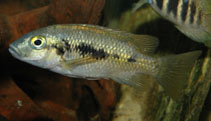 Konia eisentrauti
Bild av Albering, J.
Bilder | Google image
Bild av Albering, J.
Klassificering / Namn Populärnamn | synonymer | Catalog of Fishes(Släkte, Arter) | ITIS | CoL | WoRMS | Cloffa
> Cichliformes (Cichlids, convict blennies) > Cichlidae (Cichlids) > Pseudocrenilabrinae
Etymology: Konia: Greek, konia, as = ash, sand (Ref. 45335).
Eponymy: Professor Dr Martin Eisentraut (1902–1994) was a German zoologist and collector. [...] (Ref. 128868), visit book page.
More on author: Trewavas.
Etymology: Konia: Greek, konia, as = ash, sand (Ref. 45335).
Eponymy: Professor Dr Martin Eisentraut (1902–1994) was a German zoologist and collector. [...] (Ref. 128868), visit book page.
More on author: Trewavas.
Miljö: miljö / Klimatzon / djupintervall / distributionsområde Ekologi
; sötvatten bentopelagisk. Tropical; 25°C - 27°C (Ref. 13614); 10°N - 3°N
Utbredning Territorier | FAO områden | Ekosystem | Förekomster | Prickkarta | Utplanteringar | Faunafri
Africa: endemic to Lake Barombi-Mbo, Cameroon (Ref. 81260).
Storlek / Vikt / Ålder
Kort beskrivning Bestämningsnycklar | Morfologi | Morfometri
Taggstrålar i ryggfenan (totalt) : 15 - 16; Mjukstrålar i ryggfenan (totalt) : 10 - 11; Taggstrålar i analfenan: 3; Mjukstrålar i analfenan: 8 - 9; Ryggkotor: 29. Diagnosis: profile of the snout evenly decurved, descending to a nearly horizontal mouth; narrow interorbital space (24-27% head length)(Ref. 53940, 53949). Lower jaw not, or only slightly inclined from the horizontal; lower pharyngeal jaw only slightly longer than wide (Ref. 81260). Dentigerous area of lower pharyngeal bone longer than anterior blade in young and of characteristic shape, with a narrow anterior apical portion (Ref. 53949). Blade of lower pharyngeal bone 0.7-0.95 times median length of toothed area; 3 regular rows of teeth; upper series of black blotches parallel to dorsal outline; black band of uneven width extending from opercular spot to anterior part of caudal peduncle; posterior end of caudal peduncle with vertical blotch meeting its fellow over top; fins colorless; tilapia mark absent (Ref. 53940).
Body shape (shape guide): fusiform / normal.
Body shape (shape guide): fusiform / normal.
Feeds on algae, small insects and fish eggs (Ref. 52307). Also kleptoparasite of freshwater crabs (Ref. 53950). Ovophilic mouthbrooder with both sexes as possible incubator; from aquarium observations: a few days prior to spawning, both partners remain close together for much of the time; the genital papilla of the female is clearly visible immediately before spawning and is much broader and larger than the male's; females are normally more successful than males when it comes to brooding the fry; when mouthbrooding, which ends about 3 weeks post-spawning, the specimens are relatively shy and prefer to lie silently near the bottom in secluded areas; once free swimming, juveniles normally do not return to the parent's mouth again (Ref. 52307).
Livscykel och parningsbeteende Könsmognad | Reproduktion | Lek | Ägg | Fekunditet | Larver
Male or female carries the egg in the mouth (Ref. 52307, Ref. 13614). A few days prior to spawning, both partners remain close together for much of the time; the genital papilla of the female is clearly visible immediately before spawning and is much broader and larger then the male's; females normally more succesfull in brooding the fry; specimens are relatively shy and prefer to lie silently near the bottom in secluded areas when mouthbrooding, which ends about three weeks post-spawning; once free swimming, the fry normally does not return to the parent's mouth (Ref. 52307).
Huvudreferens
Ladda upp dina referenser | referenser | Koordinator : Kullander, Sven O. | Medarbetare
Lamboj, A., 2004. The cichlid fishes of Western Africa. Birgit Schmettkamp Verlag, Bornheim, Germany. 255 p. (Ref. 52307)
Status på IUCN:s rödlista (Ref. 130435: Version 2025-2 (Global))
Critically Endangered (CR) (B1ab(iii)+2ab(iii)); Date assessed: 16 February 2009
CITES
Not Evaluated
Hot mot människor
Harmless
Mänskliga användningsområden
FAO - Publication: search | FishSource |
Ytterligare information
Populationsdynamik
Tillväxtparametrar
Max. åldrar / storlekar
Längd-vikt rel.
Längd-längd rel.
Längd-frekvenser
Massakonvertering
Rekrytering
Abundans
Tillväxtparametrar
Max. åldrar / storlekar
Längd-vikt rel.
Längd-längd rel.
Längd-frekvenser
Massakonvertering
Rekrytering
Abundans
Livscykel
Reproduktion
Könsmognad
Mognad/Gills rel.
Fekunditet
Lek
Lekande aggregat
Ägg
Utveckling av ägg
Larver
Larvdynamik
Reproduktion
Könsmognad
Mognad/Gills rel.
Fekunditet
Lek
Lekande aggregat
Ägg
Utveckling av ägg
Larver
Larvdynamik
Anatomi
Gälyta
Hjärna
Otolit
Gälyta
Hjärna
Otolit
Fysiologi
Kroppssammansättning
Näringsämnen
Syreförbrukning
Typ av simning
Simhastighet
Visuella pigment
Ljud från fisk
Sjukdomar & Parasiter
Toxicitet (LC50)
Kroppssammansättning
Näringsämnen
Syreförbrukning
Typ av simning
Simhastighet
Visuella pigment
Ljud från fisk
Sjukdomar & Parasiter
Toxicitet (LC50)
Genetik
Genom
Genetik
Heterozygositet
Ärftlighet
Genetisk mångfald
Genom
Genetik
Heterozygositet
Ärftlighet
Genetisk mångfald
Människorelaterad
Vattenbrukssystem
Vattenbruksprofiler
Avelslinjer
Ciguatera-fall
Frimärken, mynt, diverse.
Vattenbrukssystem
Vattenbruksprofiler
Avelslinjer
Ciguatera-fall
Frimärken, mynt, diverse.
Verktyg
Organisk frågesport | E-bok | Fälthandbok | Bestämningsnycklar | Längdfördelnings-verktyg | Livshistorie-verktyg | Prickkarta |
Fångst-MSY |
Särskilda rapporter
Kontrollera för underhåll av akvarium | Kontrollera om det finns faktablad om arter | Kontrollera om det finns faktablad om vattenbruk
Ladda ner XML
Internet-källor
AFORO (otoliths) | Aquatic Commons | BHL | Cloffa | Websites from users | Check FishWatcher | CISTI | Catalog of Fishes: Släkte, Arter | DiscoverLife | ECOTOX | FAO - Publication: search | Faunafri | Fishipedia | Fishtrace | GloBI | Google Books | Google Scholar | Google | IGFA World Record | OneZoom | Open Tree of Life | Otolith Atlas of Taiwan Fishes | Offentliga akvarier | PubMed | Reef Life Survey | Socotra Atlas | TreeBase | Tree of Life | Wikipedia: Go, sök | World Records Freshwater Fishing | Zoologiskt register
Uppskattningar baserade på modeller
Index för fylogenetisk mångfald (Ref. 82804): PD50 = 0.7500 [Uniqueness, from 0.5 = low to 2.0 = high].
Bayesian length-weight: a=0.01445 (0.00671 - 0.03113), b=2.99 (2.82 - 3.16), in cm total length, based on LWR estimates for this (Sub)family-body shape (Ref. 93245).
Trofisk nivå (Ref. 69278): 3.6 ±0.45 se; based on food items.
Resiliens (Ref. 120179): Hög, lägsta populationsfördubblingstid mindre än 15 månader (Preliminary K or Fecundity.).