



Konia eisentrauti (Trewavas, 1962)
Konye
Uploaden van uw Foto's en video's
Afbeeldingen | Google afbeelding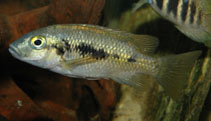 Konia eisentrauti
Afbeelding van Albering, J.
Afbeeldingen | Google afbeelding
Afbeelding van Albering, J.
Classificatie / Namen Lokale namen | Synoniemen | Catalog of Fishes(Genus, Soort(en)) | ITIS | CoL | WoRMS | Cloffa
> Cichliformes (Cichlids, convict blennies) > Cichlidae (Cichlids) > Pseudocrenilabrinae
Etymology: Konia: Greek, konia, as = ash, sand (Ref. 45335).
Eponymy: Professor Dr Martin Eisentraut (1902–1994) was a German zoologist and collector. [...] (Ref. 128868), visit book page.
More on author: Trewavas.
Etymology: Konia: Greek, konia, as = ash, sand (Ref. 45335).
Eponymy: Professor Dr Martin Eisentraut (1902–1994) was a German zoologist and collector. [...] (Ref. 128868), visit book page.
More on author: Trewavas.
Milieu: milieu / Klimaatzone / Diepte / verspreidingsgebied Ecologie
; zoet water benthopelagisch. Tropical; 25°C - 27°C (Ref. 13614); 10°N - 3°N
Verspreiding Gebieden | FAO regio's | Ecosystemen | Voorkomen | Verspreidingskaart | Introducties | Faunafri
Africa: endemic to Lake Barombi-Mbo, Cameroon (Ref. 81260).
Grootte / Gewicht / Leeftijd
Korte beschrijving Determinatiesleutels | Morfologie | Morfometrie
Dorsale stekels (totaal) : 15 - 16; Dorsale zachte stralen (totaal) : 10 - 11; Anale stekels: 3; Anale zachte stralen: 8 - 9; Wervels: 29. Diagnosis: profile of the snout evenly decurved, descending to a nearly horizontal mouth; narrow interorbital space (24-27% head length)(Ref. 53940, 53949). Lower jaw not, or only slightly inclined from the horizontal; lower pharyngeal jaw only slightly longer than wide (Ref. 81260). Dentigerous area of lower pharyngeal bone longer than anterior blade in young and of characteristic shape, with a narrow anterior apical portion (Ref. 53949). Blade of lower pharyngeal bone 0.7-0.95 times median length of toothed area; 3 regular rows of teeth; upper series of black blotches parallel to dorsal outline; black band of uneven width extending from opercular spot to anterior part of caudal peduncle; posterior end of caudal peduncle with vertical blotch meeting its fellow over top; fins colorless; tilapia mark absent (Ref. 53940).
Body shape (shape guide): fusiform / normal.
Body shape (shape guide): fusiform / normal.
Feeds on algae, small insects and fish eggs (Ref. 52307). Also kleptoparasite of freshwater crabs (Ref. 53950). Ovophilic mouthbrooder with both sexes as possible incubator; from aquarium observations: a few days prior to spawning, both partners remain close together for much of the time; the genital papilla of the female is clearly visible immediately before spawning and is much broader and larger than the male's; females are normally more successful than males when it comes to brooding the fry; when mouthbrooding, which ends about 3 weeks post-spawning, the specimens are relatively shy and prefer to lie silently near the bottom in secluded areas; once free swimming, juveniles normally do not return to the parent's mouth again (Ref. 52307).
Levenscyclus en paargedrag Maturiteit | Voortplanting | Paaien | Eieren | Fecunditeit | Larven
Male or female carries the egg in the mouth (Ref. 52307, Ref. 13614). A few days prior to spawning, both partners remain close together for much of the time; the genital papilla of the female is clearly visible immediately before spawning and is much broader and larger then the male's; females normally more succesfull in brooding the fry; specimens are relatively shy and prefer to lie silently near the bottom in secluded areas when mouthbrooding, which ends about three weeks post-spawning; once free swimming, the fry normally does not return to the parent's mouth (Ref. 52307).
Hoofdreferentie
Upload uw referenties | Referenties | Coördinator : Kullander, Sven O. | Medewerkers
Lamboj, A., 2004. The cichlid fishes of Western Africa. Birgit Schmettkamp Verlag, Bornheim, Germany. 255 p. (Ref. 52307)
Status op de Rode Lijst van het IUCN (Ref. 130435: Version 2025-2 (Global))
Ernstig bedreigd (CR) (B1ab(iii)+2ab(iii)); Date assessed: 16 February 2009
CITES
Not Evaluated
Gevaar voor de mens
Harmless
Gebruik door de mens
FAO - Publication: search | FishSource |
Meer informatie
Trofische ecologie
Voedsel (prooien)
Dieetsamenstelling
Voedselconsumptie
Voedselrantsoenen
Predatoren
Voedsel (prooien)
Dieetsamenstelling
Voedselconsumptie
Voedselrantsoenen
Predatoren
Populatiedynamica
Groeiparameters
Max. leeftijden / maten
Lengte-gewicht rel.
Lengte-lengte rel.
Lengtefrequenties
Massaconversie
Rekrutering
Abundantie
Groeiparameters
Max. leeftijden / maten
Lengte-gewicht rel.
Lengte-lengte rel.
Lengtefrequenties
Massaconversie
Rekrutering
Abundantie
Levenscyclus
Voortplanting
Maturiteit
Rijpheid/kieuwen rel.
Fecunditeit
Paaien
Paaibestanden
Eieren
Ontwikkeling van de eieren
Larven
Larvale populatiedynamiek
Voortplanting
Maturiteit
Rijpheid/kieuwen rel.
Fecunditeit
Paaien
Paaibestanden
Eieren
Ontwikkeling van de eieren
Larven
Larvale populatiedynamiek
Anatomie
Kieuwoppervlak
Hersenen
Otoliet
Kieuwoppervlak
Hersenen
Otoliet
Fysiologie
Lichaamssamenstelling
Voedingsstoffen
Zuurstofverbruik
Type zwemmen
Zwemsnelheid
Visuele pigmenten
Vis geluid
Ziekten en parasieten
Toxiciteit (LC50)
Lichaamssamenstelling
Voedingsstoffen
Zuurstofverbruik
Type zwemmen
Zwemsnelheid
Visuele pigmenten
Vis geluid
Ziekten en parasieten
Toxiciteit (LC50)
Genetica
genoom
Genetica
Heterozygositeit
Erfelijkheid
Genetische diversiteit
genoom
Genetica
Heterozygositeit
Erfelijkheid
Genetische diversiteit
Menselijk gerelateerd
Aquacultuursystemen
Aquacultuurprofielen
Kweeklijnen
Ciguatera gevallen
Postzegels, munten, diversen.
Aquacultuursystemen
Aquacultuurprofielen
Kweeklijnen
Ciguatera gevallen
Postzegels, munten, diversen.
Tools
Biologische quiz | E-boek | Veldgids | Determinatiesleutels | Lengtefrequentie Tool | Levenscyclus tool | Verspreidingskaart |
Vangst-MSY |
Speciale rapporten
Bekijk gegevens voor het houden in een aquarium | Bekijk Fact Sheets voor de soort | Bekijk Aquacultuur Fact Sheets
Download XML
Internetbronnen
AFORO (otoliths) | Aquatic Commons | BHL | Cloffa | Websites from users | Bekijk FishWatcher | CISTI | Catalog of Fishes: Genus, Soort(en) | DiscoverLife | ECOTOX | FAO - Publication: search | Faunafri | Fishipedia | Fishtrace | GloBI | Google Books | Google Scholar | Google | IGFA World Record | OneZoom | Open Tree of Life | Otolith Atlas of Taiwan Fishes | Publieke aquaria | PubMed | Reef Life Survey | Socotra Atlas | TreeBase | Tree of Life | Wikipedia: ga naar, zoek | World Records Freshwater Fishing | Zoological Record
Schattingen op basis van modellen
Fylogenetische diversiteitsindex (Ref. 82804): PD50 = 0.7500 [Uniqueness, from 0.5 = low to 2.0 = high].
Bayesian length-weight: a=0.01445 (0.00671 - 0.03113), b=2.99 (2.82 - 3.16), in cm total length, based on LWR estimates for this (Sub)family-body shape (Ref. 93245).
Trofisch niveau (Ref. 69278): 3.6 ±0.45 se; based on food items.
Weerstandsvermogen (Ref. 120179): Hoog, minimale populatieverdubbelingstijd minder dan 15 maanden (Preliminary K or Fecundity.).