-

- Über diese Seite
- Sprachen
- Rückmeldungen der Nutzer
- Zitat
- Uploads
-
Verwandte Arten
- Arten in
Haemulon - Arten in
Haemulidae - - Klassifizierung -
- Haemulinae
- Haemulidae
- Eupercaria/misc
- Teleostei
- Chordata
- Animalia
- Arten in
-



Haemulon maculicauda (Gill, 1862)
Spottail grunt
Beobachtung melden im Fish Watcher
| Native range | All suitable habitat | Point map | Year 2050 |

|
| This map was computer-generated and has not yet been reviewed. |
| Haemulon maculicauda AquaMaps Data sources: GBIF OBIS |
Klassifizierung / Names Namen | Synonyme | Catalog of Fishes(Gattung, Arten) | ITIS | CoL | WoRMS | Cloffa
> Eupercaria/misc (Various families in series Eupercaria) > Haemulidae (Grunts) > Haemulinae
Etymology: Haemulon: Greek, haimaleos = bloody (Ref. 45335).
More on author: Gill.
Etymology: Haemulon: Greek, haimaleos = bloody (Ref. 45335).
More on author: Gill.
Umwelt: Milieu / Klimazone / Tiefenbereich / Verbreitungsgebiet Ökologie
seewasser riff-verbunden. Tropical; 38°N - 4°N
Verbreitung Territorien | FAO Gebiete | Ökosysteme | Vorkommen | Punkt Karte | Einführungen | Faunafri
Eastern Pacific: Baja California, Mexico to Colombia.
Größe / Gewicht / Alter
Geschlechtsreife: Lm ? range ? - ? cm
Max length : 30.0 cm TL Männchen/unbestimmt; (Ref. 9114); common length : 25.0 cm TL Männchen/unbestimmt; (Ref. 9114); max. veröff. Gewicht: 557.00 g (Ref. 40926)
Max length : 30.0 cm TL Männchen/unbestimmt; (Ref. 9114); common length : 25.0 cm TL Männchen/unbestimmt; (Ref. 9114); max. veröff. Gewicht: 557.00 g (Ref. 40926)
Kurzbeschreibung Bestimmungsschlüssel | Morphologie | Morphometrie
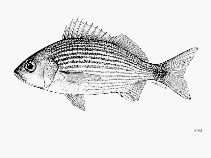
Body oblong, compressed, and deep (depth contained 2.2 to 2.7 times in standard length); mouth large and terminal, its posterior end located at the same level as the anterior edge of the pupil; first gill arch with 22 to 39 gill rakers; dorsal fin notched, with 12 to 14 spines and 14 to 17 soft rays (XII-XIV, 14-17); second anal spine slightly longer and stronger than third; scale series above lateral line is parallel to it; body dark brown; each scale bearing a pearly blue spot, the spots appearing to form lines following the scale series; fins yellowish; caudal peduncle with a large spot (Ref. 55763).
Body shape (shape guide): short and / or deep.
Body shape (shape guide): short and / or deep.
Found in schools around coastal reefs during the day, dispersing over sandy bottoms at night (Ref. 9114). Marketed fresh (Ref. 9114).
Lebenszyklus und Paarungsverhalten Geschlechtsreife | Fortpflanzung | Ablaichen | Eier | Fruchtbarkeit | Larven
Oviparous, distinct pairing during breeding (Ref. 205).
Hauptreferenz
Laden Sie Ihre Referenzen hoch | Referenzen | Koordinator | Partner
McKay, R.J. and M. Schneider, 1995. Haemulidae. Burros, corocoros, chulas, gallinazos, roncos. p. 1136-1173. In W. Fischer, F. Krupp, W. Schneider, C. Sommer, K.E. Carpenter and V. Niem (eds.) Guia FAO para Identification de Especies para lo Fines de la Pesca. Pacifico Centro-Oriental. 3 Vols. FAO, Rome. (Ref. 9114)
IUCN Rote Liste Status (Ref. 130435: Version 2025-2)
nicht bedroht (LC) ; Date assessed: 25 May 2007
CITES
Not Evaluated
Bedrohung für Menschen
Harmless
Nutzung durch Menschen
Fischereien: weniger kommerziell
FAO - Publication: search | FishSource |
Mehr Information
Trophische Ökologie
Lebensmittel (Beutetiere)
Nahrungszusammensetzung
Nahrungsaufnahme
Lebensmittelrationen
Räuber
Lebensmittel (Beutetiere)
Nahrungszusammensetzung
Nahrungsaufnahme
Lebensmittelrationen
Räuber
Populationsdynamik
Wachstumsparameter
Max. Alter/Größen
Länge-Gewicht-Rel.
Länge-Länge-Verhältnis.
Längenhäufigkeiten
Massenkonvertierung
Rekrutierung
Dichte
Wachstumsparameter
Max. Alter/Größen
Länge-Gewicht-Rel.
Länge-Länge-Verhältnis.
Längenhäufigkeiten
Massenkonvertierung
Rekrutierung
Dichte
Lebenszyklus
Fortpflanzung
Geschlechtsreife
Reifung/Kiemen rel.
Fruchtbarkeit
Ablaichen
Laichaggregationen
Eier
Eientwicklung
Larven
Larven Pop.Dyn.
Fortpflanzung
Geschlechtsreife
Reifung/Kiemen rel.
Fruchtbarkeit
Ablaichen
Laichaggregationen
Eier
Eientwicklung
Larven
Larven Pop.Dyn.
Anatomie
Kiemenoberfläche
Gehirn
Otolith
Kiemenoberfläche
Gehirn
Otolith
Physiologie
Körperliche Zusammensetzung
Nährstoffe
Sauerstoffverbrauch
Schwimmart
Schwimmgeschwindigkeit
Visuelle Pigmente
Fischgeräusche
Krankheiten und Parasiten
Toxizität (LC50s)
Körperliche Zusammensetzung
Nährstoffe
Sauerstoffverbrauch
Schwimmart
Schwimmgeschwindigkeit
Visuelle Pigmente
Fischgeräusche
Krankheiten und Parasiten
Toxizität (LC50s)
Menschenbezogen
Aquakultur-Systeme
Aquakultur Profile
Zuchtlinien
Ciguatera-Fälle
Briefmarken, Münzen, Verschiedenes.
Aquakultur-Systeme
Aquakultur Profile
Zuchtlinien
Ciguatera-Fälle
Briefmarken, Münzen, Verschiedenes.
Tools
Bio-Quiz | E-Book | Feldführer | Längenhäufigkeits Tool | Lebensdaten Tool | Punkt Karte |
Catch-MSY |
Zusatzinformationen
Download XML
Zusammenfassung | Punktdaten | Namen | Photos
Internet Quellen
AFORO (otoliths) | Aquatic Commons | BHL | Cloffa | Websites from users | FishWatcher Einträge suchen | CISTI | Catalog of Fishes: Gattung, Arten | DiscoverLife | ECOTOX | FAO - Publication: search | Faunafri | Fishipedia | Fishtrace | GloBI | Google Books | Google Scholar | Google | IGFA World Record | OneZoom | Open Tree of Life | Otolith Atlas of Taiwan Fishes | PubMed | Reef Life Survey | Socotra Atlas | TreeBase | Tree of Life | Wikipedia: Gehe zu, Suchen | World Records Freshwater Fishing | Zoologischer Rekord
Schätzungen auf der Grundlage von Modellen
Bevorzugte Temperatur (Ref. 123201): 22.3 - 29.1, mean 27.9 °C (based on 178 cells).
Phylogenetischer Diversitätsindex (Ref. 82804): PD50 = 0.5000 [Uniqueness, from 0.5 = low to 2.0 = high].
Bayesian length-weight: a=0.01380 (0.00778 - 0.02449), b=3.03 (2.88 - 3.18), in cm total length, based on LWR estimates for this species & Genus-body shape (Ref. 93245).
Trophische Ebene (Ref. 69278): 4.2 ±0.73 se; based on food items.
Generation time: 9.2 ( na - na) years. Estimated as median ln(3)/K based on 1 growth studies.
Widerstandsfähigkeit (Ref. 120179): niedrig, Verdopplung der Population dauert 4,5 - 14 Jahre. (K=0.12).
Nährstoffe (Ref. 124155): Calcium = 34.9 [14.9, 72.7] mg/100g; Iron = 0.54 [0.26, 1.05] mg/100g; Protein = 18.7 [16.7, 20.7] %; Omega3 = 0.106 [0.049, 0.202] g/100g; Selenium = 27 [13, 57] μg/100g; VitaminA = 153 [39, 572] μg/100g; Zinc = 0.975 [0.604, 1.500] mg/100g (wet weight);