



Sube tu fotos y Vídeos
Google image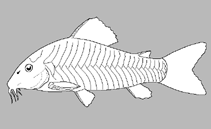 No image available for this species;
drawing shows typical species in Callichthyidae.
Google image
drawing shows typical species in Callichthyidae.
Clasificación / Nombres Nombres comunes | Sinónimos | Catalog of Fishes(Género, Especie) | ITIS | CoL | WoRMS | Cloffa
> Siluriformes (Catfishes) > Callichthyidae (Callichthyid armored catfishes) > Corydoradinae
Etymology: Aspidoras: Greek, aspis, -idos = shield + Greek, dora = skin (Ref. 45335); azaghal: The epithet ‘azaghal’ refers to a fictional character Azaghâl, the king of the Broadbeam Dwarves, one of the seven dwarf clans, and Lord of the dwarven realm of Belegost in the Blue Mountains during Middle Earth's First Age. The name is a double allusion: first about the region where the species was found, Terra do Meio, freely translated as ‘Middle Earth’ in English (fictional world of Tolkien's legendarium), and second by the fact that the new species occurs in a mountainous region and presents a relatively small size, which are both typical features of the fictional dwarves; noun in apposition.
Eponymy: Azaghâl was a king of the Dwarves in Tolkien’s Middle Earth stories. [...] (Ref. 128868), visit book page.
Etymology: Aspidoras: Greek, aspis, -idos = shield + Greek, dora = skin (Ref. 45335); azaghal: The epithet ‘azaghal’ refers to a fictional character Azaghâl, the king of the Broadbeam Dwarves, one of the seven dwarf clans, and Lord of the dwarven realm of Belegost in the Blue Mountains during Middle Earth's First Age. The name is a double allusion: first about the region where the species was found, Terra do Meio, freely translated as ‘Middle Earth’ in English (fictional world of Tolkien's legendarium), and second by the fact that the new species occurs in a mountainous region and presents a relatively small size, which are both typical features of the fictional dwarves; noun in apposition.
Eponymy: Azaghâl was a king of the Dwarves in Tolkien’s Middle Earth stories. [...] (Ref. 128868), visit book page.
Entorno: milieu / zona climática / rango de profundidad / gama de distribución Ecología
; agua dulce demersal. Tropical
Distribución Territorios | Áreas FAO | Ecosistemas | Ocurrencias, apariciones | Mapa de puntos | Introducciones | Faunafri
South America: Brazil,
Tamaño / Peso / Edad
Descripción breve Claves de identificación | Morfología | Morfometría
This species is distinguished from its congeners by the following characters: absence of the median foramen at the dorsal-fin spine base; absence of the first dorsal-fin element, the spinelet; parieto-supraoccipital fontanel located medially on bone; lacks a longitudinal dark brown or black stripe along flank midline and ventral surface of trunk covered by relatively small irregular and/or roundish platelets; inner laminar expansion of infraorbital 1 well developed; with relatively wide frontal bone, its width equal to half of entire length; poorly developed serrations on posterior margin of the pectoral-fin spine (Ref. 123754).
Body shape (shape guide): elongated; Cross section: oval.
Body shape (shape guide): elongated; Cross section: oval.
The streams where this species was found were narrow (less than 2.0 m width) to moderately large (up to 20 m width), with low riffles alternating with smoothly running stretches; where the substrate was composed by white silica sand stretches mixed with pebbles, rock slabs and ledges, as well as large rocks of up to 2.0 m diameter; some coarse litter patches and submerged macrophyte banks found close to the margins and in backwaters. The banks were covered by thick riparian vegetation composed by trees, palms (mostly the buriti Mauritia flexuosa, Arecaceae) and herbaceous plants dominated by Spatiphyllum sp. (Araceae) in some stretches; the water clear to yellowish and relatively cold (24-25°C). The species was found in abundance in the main streams of the upper area of Serra do Pardo ridge, occupying moderate- to fast-flowing and shallow (less than 1 m deep) stretches. Individuals in groups (up to a dozen) were observed actively foraging during the day by sifting food particles amidst the upper layer of the sand substrate in shallow areas close to the margins. Associated fishes found sharing the streams were Callichthys callichthys and one species each of Laimosemion, Synbranchus, Astyanax and Characidium, all still unidentified and possibly new to science. The presence of a large waterfall of nearly 30 m height in the type locality may possibly be a barrier to the fish fauna inhabiting the lower portions of the Igarapé do Pontal basin, to which the streams of the upper portions of the Serra do Pardo are connected, which may explain the apparently depauperate local fish fauna (Ref. 123754).
Ciclo vital y comportamiento de apareamiento Madurez | Reproducción | Puesta | Huevos | Fecundidad | Larva
Referencia principal
Suba sus referencias | Referencias | Coordinador : Reis, Roberto E. | Colaboradores
Tencatt, L.F.C., M.R. Britto, I.J.H. Isbrücker and C.S. Pavanelli, 2022. Taxonomy of the armored catfish genus Aspidoras (Siluriformes: Callichthyidae) revisited, with the description of a new species. Neotropical Ichthyology 20(3):1-159. (Ref. 129024)
CITES
Not Evaluated
Amenaza para el ser humano
Harmless
Usos humanos
FAO - Publication: search | FishSource |
Más información
Ecología Trófica
Alimentos (presas)
Composición de la dieta
consumo de alimento
Raciones de comida
Despredadores
Alimentos (presas)
Composición de la dieta
consumo de alimento
Raciones de comida
Despredadores
Ecología
Ecología
Ecología
Dinámica de la población
Coeficiente del crecimiento para
Edades / tallas máximas
Longitud-peso rel.
Longitud-longitud rel.
Longitud-frecuencias
Conversión de masas
Reclutamiento
Abundancia
Coeficiente del crecimiento para
Edades / tallas máximas
Longitud-peso rel.
Longitud-longitud rel.
Longitud-frecuencias
Conversión de masas
Reclutamiento
Abundancia
Ciclo de vida
Reproducción
Madurez
Madurez/Gills rel.
Fecundidad
Puesta
Agregaciones de desove
Huevos
Desarrollo de los huevos
Larva
Dinámica larvaria
Reproducción
Madurez
Madurez/Gills rel.
Fecundidad
Puesta
Agregaciones de desove
Huevos
Desarrollo de los huevos
Larva
Dinámica larvaria
Distribución
Territorios
Áreas FAO
Ecosistemas
Ocurrencias, apariciones
Introducciones
BRUVS - Vídeos
Territorios
Áreas FAO
Ecosistemas
Ocurrencias, apariciones
Introducciones
BRUVS - Vídeos
Anatomía
Superficie branquial
Cerebro
Otolito
Superficie branquial
Cerebro
Otolito
Fisiología
Composición corporal
Nutrientes
Consumo del oxígeno
Tipo de natación
Velocidad de natación
Pigmentos visuales
Sonido de peces
Enfermedades y parásitos
Toxicidad (CL50)
Composición corporal
Nutrientes
Consumo del oxígeno
Tipo de natación
Velocidad de natación
Pigmentos visuales
Sonido de peces
Enfermedades y parásitos
Toxicidad (CL50)
Genética
Genoma
Genética
Heterocigosidad
heritabilidad
Diversidad genética
Genoma
Genética
Heterocigosidad
heritabilidad
Diversidad genética
Relacionados con el ser humano
Sistemas de acuicultura
Perfiles de acuicultura
Razas
Ciguatera cases
Sellos, monedas, varios
Sistemas de acuicultura
Perfiles de acuicultura
Razas
Ciguatera cases
Sellos, monedas, varios
Herramientas
Libro electrónico | Guía de campo | Asistente para frecuencias de tallas | Herramienta de ciclo de vida | Mapa de puntos |
Catch-MSY |
Informes especiales
Comprobar el mantenimiento del acuario | Buscar fichas sobre especies | Consulte las hojas informativas sobre acuicultura
Descargar XML
Fuentes de Internet
AFORO (otoliths) | Aquatic Commons | BHL | Cloffa | Websites from users | Check FishWatcher | CISTI | Catalog of Fishes: Género, Especie | DiscoverLife | ECOTOX | FAO - Publication: search | Faunafri | Fishipedia | Fishtrace | GloBI | Google Books | Google Scholar | Google | IGFA World Record | OneZoom | Open Tree of Life | Otolith Atlas of Taiwan Fishes | PubMed | Reef Life Survey | Socotra Atlas | TreeBase | Árbol de la vida | Wikipedia: Go, búsqueda | World Records Freshwater Fishing | Zoobank | Expediente Zoológico
Estimaciones basadas en modelos
Índice de diversidad filogenética (Referencia 82804): PD50 = 0.5000 [Uniqueness, from 0.5 = low to 2.0 = high].
Bayesian length-weight: a=0.00741 (0.00287 - 0.01912), b=3.14 (2.92 - 3.36), in cm total length, based on LWR estimates for this (Sub)family-body shape (Ref. 93245).
Nivel trófico (Referencia 69278): 3.0 ±0.3 se; based on size and trophs of closest relatives
Resiliencia (Referencia 120179): Alto, población duplicada en un tiempo mínimo inferior a 15 meses (Preliminary K or Fecundity.).