



Carica il tuo foto e Video
Google image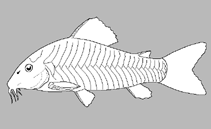 No image available for this species;
drawing shows typical species in Callichthyidae.
Google image
drawing shows typical species in Callichthyidae.
Classificazione / Nomi Nomi Comuni | Sinonimi | Catalog of Fishes(Genere, Specie) | ITIS | CoL | WoRMS | Cloffa
> Siluriformes (Catfishes) > Callichthyidae (Callichthyid armored catfishes) > Corydoradinae
Etymology: Aspidoras: Greek, aspis, -idos = shield + Greek, dora = skin (Ref. 45335); azaghal: The epithet ‘azaghal’ refers to a fictional character Azaghâl, the king of the Broadbeam Dwarves, one of the seven dwarf clans, and Lord of the dwarven realm of Belegost in the Blue Mountains during Middle Earth's First Age. The name is a double allusion: first about the region where the species was found, Terra do Meio, freely translated as ‘Middle Earth’ in English (fictional world of Tolkien's legendarium), and second by the fact that the new species occurs in a mountainous region and presents a relatively small size, which are both typical features of the fictional dwarves; noun in apposition.
Eponymy: Azaghâl was a king of the Dwarves in Tolkien’s Middle Earth stories. [...] (Ref. 128868), visit book page.
Etymology: Aspidoras: Greek, aspis, -idos = shield + Greek, dora = skin (Ref. 45335); azaghal: The epithet ‘azaghal’ refers to a fictional character Azaghâl, the king of the Broadbeam Dwarves, one of the seven dwarf clans, and Lord of the dwarven realm of Belegost in the Blue Mountains during Middle Earth's First Age. The name is a double allusion: first about the region where the species was found, Terra do Meio, freely translated as ‘Middle Earth’ in English (fictional world of Tolkien's legendarium), and second by the fact that the new species occurs in a mountainous region and presents a relatively small size, which are both typical features of the fictional dwarves; noun in apposition.
Eponymy: Azaghâl was a king of the Dwarves in Tolkien’s Middle Earth stories. [...] (Ref. 128868), visit book page.
Ambiente: milieu / zona climatica / distribuzione batimetrica / gamma di distribuzione Ecologia
; acqua dolce demersale. Tropical
Distribuzione Territories | Aree FAO | Ecosistemi | Presenze | Mappa dei ritrovamenti | Introduzioni | Faunafri
South America: Brazil,
Dimensione / Peso / Età
Breve descrizione Chiavi di identificazione | Morfologia | Morfometria
This species is distinguished from its congeners by the following characters: absence of the median foramen at the dorsal-fin spine base; absence of the first dorsal-fin element, the spinelet; parieto-supraoccipital fontanel located medially on bone; lacks a longitudinal dark brown or black stripe along flank midline and ventral surface of trunk covered by relatively small irregular and/or roundish platelets; inner laminar expansion of infraorbital 1 well developed; with relatively wide frontal bone, its width equal to half of entire length; poorly developed serrations on posterior margin of the pectoral-fin spine (Ref. 123754).
Body shape (shape guide): elongated; Cross section: oval.
Body shape (shape guide): elongated; Cross section: oval.
The streams where this species was found were narrow (less than 2.0 m width) to moderately large (up to 20 m width), with low riffles alternating with smoothly running stretches; where the substrate was composed by white silica sand stretches mixed with pebbles, rock slabs and ledges, as well as large rocks of up to 2.0 m diameter; some coarse litter patches and submerged macrophyte banks found close to the margins and in backwaters. The banks were covered by thick riparian vegetation composed by trees, palms (mostly the buriti Mauritia flexuosa, Arecaceae) and herbaceous plants dominated by Spatiphyllum sp. (Araceae) in some stretches; the water clear to yellowish and relatively cold (24-25°C). The species was found in abundance in the main streams of the upper area of Serra do Pardo ridge, occupying moderate- to fast-flowing and shallow (less than 1 m deep) stretches. Individuals in groups (up to a dozen) were observed actively foraging during the day by sifting food particles amidst the upper layer of the sand substrate in shallow areas close to the margins. Associated fishes found sharing the streams were Callichthys callichthys and one species each of Laimosemion, Synbranchus, Astyanax and Characidium, all still unidentified and possibly new to science. The presence of a large waterfall of nearly 30 m height in the type locality may possibly be a barrier to the fish fauna inhabiting the lower portions of the Igarapé do Pontal basin, to which the streams of the upper portions of the Serra do Pardo are connected, which may explain the apparently depauperate local fish fauna (Ref. 123754).
Ciclo vitale e comportamento di accoppiamento Maturità | Riproduzione | Deposizione | Uova | Fecondità | Larve
Riferimento principale
Caricare le referenze | Bibliografia | Coordinatore : Reis, Roberto E. | Collaboratori
Tencatt, L.F.C., M.R. Britto, I.J.H. Isbrücker and C.S. Pavanelli, 2022. Taxonomy of the armored catfish genus Aspidoras (Siluriformes: Callichthyidae) revisited, with the description of a new species. Neotropical Ichthyology 20(3):1-159. (Ref. 129024)
CITES
Not Evaluated
Minaccia per l'uomo
Harmless
Usi umani
FAO - Publication: search | FishSource |
Informazioni ulteriori
Ecologia trofica
Articoli alimentari (prede)
Alimentazione
Consumo di cibo
Razioni alimentari
Predatori
Articoli alimentari (prede)
Alimentazione
Consumo di cibo
Razioni alimentari
Predatori
Ecologia
Ecologia
Ecologia
Dinamica della popolazione
Parametri di crescita
Età massima / dimensioni massime
Rapporto lunghezza-peso.
Lunghezza-lunghezza rel.
Lunghezza-frequenze
Conversione di massa
Reclutamento
Abbondanza
Parametri di crescita
Età massima / dimensioni massime
Rapporto lunghezza-peso.
Lunghezza-lunghezza rel.
Lunghezza-frequenze
Conversione di massa
Reclutamento
Abbondanza
Ciclo di vita
Riproduzione
Maturità
Maturità/Gli occhielli sono relativi.
Fecondità
Deposizione
Aggregazioni riproduttive
Uova
Sviluppo delle uova
Larve
Dinamica popolazioni larvali
Riproduzione
Maturità
Maturità/Gli occhielli sono relativi.
Fecondità
Deposizione
Aggregazioni riproduttive
Uova
Sviluppo delle uova
Larve
Dinamica popolazioni larvali
Anatomia
Area branchiale
Cervello
Otolite
Area branchiale
Cervello
Otolite
Fisiologia
Composizione corporea
Nutrienti
Consumo di ossigeno
Tipo di nuoto
Velocità di nuoto
Pigmenti visivi
Suono del pesce
Malattie e parassiti
Tossicità (LC50)
Composizione corporea
Nutrienti
Consumo di ossigeno
Tipo di nuoto
Velocità di nuoto
Pigmenti visivi
Suono del pesce
Malattie e parassiti
Tossicità (LC50)
Genetica
Genome
Genetica
Eterozigosi
Ereditarietà
Diversità genetica
Genome
Genetica
Eterozigosi
Ereditarietà
Diversità genetica
Legato all'uomo
Sistemi di acquacoltura
Profili di acquacoltura
Varietà
Casi di Ciguatera
Francobolli, monete, materiale vario.
Sistemi di acquacoltura
Profili di acquacoltura
Varietà
Casi di Ciguatera
Francobolli, monete, materiale vario.
Strumenti
Libro elettronico | Giuda pratica | Generatore frequenze di lunghezza | Strumento Parametri Biologici | Mappa dei ritrovamenti |
Cattura-MSY |
Rapporti speciali
Controllo della manutenzione dell'acquario | Verificare la presenza di schede informative sulle specie | Verifica delle schede informative sull'acquacoltura
Scarica XML
Fonti Internet
AFORO (otoliths) | Aquatic Commons | BHL | Cloffa | Websites from users | Check FishWatcher | CISTI | Catalog of Fishes: Genere, Specie | DiscoverLife | ECOTOX | FAO - Publication: search | Faunafri | Fishipedia | Fishtrace | GloBI | Google Books | Google Scholar | Google | IGFA World Record | OneZoom | Open Tree of Life | Otolith Atlas of Taiwan Fishes | PubMed | Reef Life Survey | Socotra Atlas | TreeBase | Tree of Life | Wikipedia: Go, ricerca | World Records Freshwater Fishing | Zoobank | Record zoologico
Stime basate su modelli
Indice di diversità filogenetica (Fonte Biblio. 82804): PD50 = 0.5000 [Uniqueness, from 0.5 = low to 2.0 = high].
Bayesian length-weight: a=0.00741 (0.00287 - 0.01912), b=3.14 (2.92 - 3.36), in cm total length, based on LWR estimates for this (Sub)family-body shape (Ref. 93245).
Livello trofico (Fonte Biblio. 69278): 3.0 ±0.3 se; based on size and trophs of closest relatives
Resilienza (Fonte Biblio. 120179): Alto, tempo minimo di raddoppiamento della popolazione meno di 15 mesi (Preliminary K or Fecundity.).