



Envoyez vos Photos et vidéos
Images Google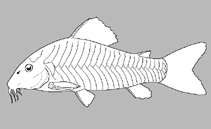 No image available for this species;
drawing shows typical species in Callichthyidae.
Images Google
drawing shows typical species in Callichthyidae.
Classification / Noms Noms communs | Synonymes | Catalog of Fishes(Genre, Espèce) | ITIS | CoL | WoRMS | Cloffa
> Siluriformes (Catfishes) > Callichthyidae (Callichthyid armored catfishes) > Corydoradinae
Etymology: Aspidoras: Greek, aspis, -idos = shield + Greek, dora = skin (Ref. 45335); azaghal: The epithet ‘azaghal’ refers to a fictional character Azaghâl, the king of the Broadbeam Dwarves, one of the seven dwarf clans, and Lord of the dwarven realm of Belegost in the Blue Mountains during Middle Earth's First Age. The name is a double allusion: first about the region where the species was found, Terra do Meio, freely translated as ‘Middle Earth’ in English (fictional world of Tolkien's legendarium), and second by the fact that the new species occurs in a mountainous region and presents a relatively small size, which are both typical features of the fictional dwarves; noun in apposition.
Eponymy: Azaghâl was a king of the Dwarves in Tolkien’s Middle Earth stories. [...] (Ref. 128868), visit book page.
Etymology: Aspidoras: Greek, aspis, -idos = shield + Greek, dora = skin (Ref. 45335); azaghal: The epithet ‘azaghal’ refers to a fictional character Azaghâl, the king of the Broadbeam Dwarves, one of the seven dwarf clans, and Lord of the dwarven realm of Belegost in the Blue Mountains during Middle Earth's First Age. The name is a double allusion: first about the region where the species was found, Terra do Meio, freely translated as ‘Middle Earth’ in English (fictional world of Tolkien's legendarium), and second by the fact that the new species occurs in a mountainous region and presents a relatively small size, which are both typical features of the fictional dwarves; noun in apposition.
Eponymy: Azaghâl was a king of the Dwarves in Tolkien’s Middle Earth stories. [...] (Ref. 128868), visit book page.
Environnement : milieu / zone climatique / profondeur / gamme de distribution Écologie
; eau douce démersal. Tropical
Distribution Territoires | Zones FAO | Écosystèmes | Occurrences | Carte par point | Introductions | Faunafri
South America: Brazil,
Taille / Poids / Âge
Description synthétique Clés d'identification | Morphologie | Morphométrie
This species is distinguished from its congeners by the following characters: absence of the median foramen at the dorsal-fin spine base; absence of the first dorsal-fin element, the spinelet; parieto-supraoccipital fontanel located medially on bone; lacks a longitudinal dark brown or black stripe along flank midline and ventral surface of trunk covered by relatively small irregular and/or roundish platelets; inner laminar expansion of infraorbital 1 well developed; with relatively wide frontal bone, its width equal to half of entire length; poorly developed serrations on posterior margin of the pectoral-fin spine (Ref. 123754).
Body shape (shape guide): elongated; Cross section: oval.
Body shape (shape guide): elongated; Cross section: oval.
The streams where this species was found were narrow (less than 2.0 m width) to moderately large (up to 20 m width), with low riffles alternating with smoothly running stretches; where the substrate was composed by white silica sand stretches mixed with pebbles, rock slabs and ledges, as well as large rocks of up to 2.0 m diameter; some coarse litter patches and submerged macrophyte banks found close to the margins and in backwaters. The banks were covered by thick riparian vegetation composed by trees, palms (mostly the buriti Mauritia flexuosa, Arecaceae) and herbaceous plants dominated by Spatiphyllum sp. (Araceae) in some stretches; the water clear to yellowish and relatively cold (24-25°C). The species was found in abundance in the main streams of the upper area of Serra do Pardo ridge, occupying moderate- to fast-flowing and shallow (less than 1 m deep) stretches. Individuals in groups (up to a dozen) were observed actively foraging during the day by sifting food particles amidst the upper layer of the sand substrate in shallow areas close to the margins. Associated fishes found sharing the streams were Callichthys callichthys and one species each of Laimosemion, Synbranchus, Astyanax and Characidium, all still unidentified and possibly new to science. The presence of a large waterfall of nearly 30 m height in the type locality may possibly be a barrier to the fish fauna inhabiting the lower portions of the Igarapé do Pontal basin, to which the streams of the upper portions of the Serra do Pardo are connected, which may explain the apparently depauperate local fish fauna (Ref. 123754).
Cycle de vie et comportement reproducteur Maturité | Reproduction | Frai | Œufs | Fécondité | Larves
Référence principale
Téléchargez vos références | Références | Coordinateur : Reis, Roberto E. | Collaborateurs
Tencatt, L.F.C., M.R. Britto, I.J.H. Isbrücker and C.S. Pavanelli, 2022. Taxonomy of the armored catfish genus Aspidoras (Siluriformes: Callichthyidae) revisited, with the description of a new species. Neotropical Ichthyology 20(3):1-159. (Ref. 129024)
CITES
Not Evaluated
Menace pour l'homme
Harmless
Utilisations par l'homme
FAO - Publication: search | FishSource |
Plus d'informations
Écologie trophique
Aliments (proies)
Composition du régime alimentaire
Consommation alimentaire
Rations alimentaires
Prédateurs
Aliments (proies)
Composition du régime alimentaire
Consommation alimentaire
Rations alimentaires
Prédateurs
Écologie
Écologie
Écologie
Dynamique des populations
Paramètres de croissance
Âges / tailles maximales
Longueur-poids rel.
Rel. longueur-longueur.
Fréquences de longueurs
Conversion de masse
Recrutement
Abondance
Paramètres de croissance
Âges / tailles maximales
Longueur-poids rel.
Rel. longueur-longueur.
Fréquences de longueurs
Conversion de masse
Recrutement
Abondance
Cycle de vie
Reproduction
Maturité
Maturité/épines rel.
Fécondité
Frai
Agrégats de frai
Œufs
Développement de l'œuf
Larves
Dynamique des populations larvaires
Reproduction
Maturité
Maturité/épines rel.
Fécondité
Frai
Agrégats de frai
Œufs
Développement de l'œuf
Larves
Dynamique des populations larvaires
Anatomie
Surface branchiale
Cerveau
Otolithe
Surface branchiale
Cerveau
Otolithe
Physiologie
Composition corporelle
Nutriments
Consommation d'oxygène
Type de natation
Vitesse de nage
Pigments visuels
Son de poisson
Maladies et parasites
Toxicité (CL50)
Composition corporelle
Nutriments
Consommation d'oxygène
Type de natation
Vitesse de nage
Pigments visuels
Son de poisson
Maladies et parasites
Toxicité (CL50)
Génétique
génôme
Génétique
Hétérozygotie
Héritabilité
Diversité génétique
génôme
Génétique
Hétérozygotie
Héritabilité
Diversité génétique
Liées à l'homme
Systèmes d'aquaculture
Profils d'aquaculture
Souches
Cas de ciguatera
Timbres, pièces de monnaie, divers
Systèmes d'aquaculture
Profils d'aquaculture
Souches
Cas de ciguatera
Timbres, pièces de monnaie, divers
Outils
E-book | Guide de terrain | Générateur de fréquences de longueur | Outil de dynamique de population | Carte par point |
Capture-MSY |
Articles particuliers
Télécharger en XML
Sources Internet
AFORO (otoliths) | Aquatic Commons | BHL | Cloffa | Websites from users | FishWatcher | CISTI | Catalog of Fishes: Genre, Espèce | DiscoverLife | ECOTOX | FAO - Publication: search | Faunafri | Fishipedia | Fishtrace | GloBI | Google Books | Google Scholar | Google | IGFA World Record | OneZoom | Open Tree of Life | Otolith Atlas of Taiwan Fishes | PubMed | Reef Life Survey | Socotra Atlas | TreeBase | Arbre de Vie | Wikipedia: aller à, chercher | World Records Freshwater Fishing | Zoobank | Zoological Record
Estimations basées sur des modèles
Indice de diversité phylogénétique (Réf. 82804): PD50 = 0.5000 [Uniqueness, from 0.5 = low to 2.0 = high].
Bayesian length-weight: a=0.00741 (0.00287 - 0.01912), b=3.14 (2.92 - 3.36), in cm total length, based on LWR estimates for this (Sub)family-body shape (Ref. 93245).
Niveau trophique (Réf. 69278): 3.0 ±0.3 se; based on size and trophs of closest relatives
Résilience (Réf. 120179): Haut, temps minimum de doublement de population inférieur à 15 mois (Preliminary K or Fecundity.).