



Ladda upp din foton och Videor
Google image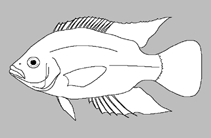 No image available for this species;
drawing shows typical species in Cichlidae.
Google image
drawing shows typical species in Cichlidae.
Klassificering / Namn Populärnamn | synonymer | Catalog of Fishes(Släkte, Arter) | ITIS | CoL | WoRMS | Cloffa
> Cichliformes (Cichlids, convict blennies) > Cichlidae (Cichlids) > Pseudocrenilabrinae
Etymology: Haplochromis: Greek, Haploos = single + Greek, chromis = a fish, perhaps a perch (Ref. 45335); pappenheimi: Specific name in honour of Paul Pappenheim (1878-1945), at that time curator of fishes at the Museum für Naturkunde in Berlin, who co-authored the book in which the description appeared (Ref. 128938).
Eponymy: Professor Dr Eugen Julius Adolph Paul Pappenheim (1878–1945) was a German zoologist who was Curator of Fishes, Königliche Zoologische Museum, Berlin. [...] (Ref. 128868), visit book page.
More on author: Boulenger.
Etymology: Haplochromis: Greek, Haploos = single + Greek, chromis = a fish, perhaps a perch (Ref. 45335); pappenheimi: Specific name in honour of Paul Pappenheim (1878-1945), at that time curator of fishes at the Museum für Naturkunde in Berlin, who co-authored the book in which the description appeared (Ref. 128938).
Eponymy: Professor Dr Eugen Julius Adolph Paul Pappenheim (1878–1945) was a German zoologist who was Curator of Fishes, Königliche Zoologische Museum, Berlin. [...] (Ref. 128868), visit book page.
More on author: Boulenger.
Miljö: miljö / Klimatzon / djupintervall / distributionsområde Ekologi
; sötvatten pelagiska; ej vandrande. Tropical; 0° - 1°S
Utbredning Territorier | FAO områden | Ekosystem | Förekomster | Prickkarta | Utplanteringar | Faunafri
Africa: only known from Lake Edward (Ref. 128938). Published information about Haplochromis pappenheimi from Lake George and the Kazinga Channel most likely refers to Haplochromis pelagicus (Ref. 128938).
Storlek / Vikt / Ålder
Kort beskrivning Bestämningsnycklar | Morfologi | Morfometri
Taggstrålar i ryggfenan (totalt) : 15 - 17; Mjukstrålar i ryggfenan (totalt) : 9 - 10; Taggstrålar i analfenan: 3; Mjukstrålar i analfenan: 8 - 9; Ryggkotor: 30 - 32. Diagnosis: Haplochromis pappenheimi is a species with a shallow body, body depth 27.2-31.0% of standard length; long and shallow caudal peduncle, caudal peduncle length 17.4-19.6% of standard length, caudal peduncle depth 55.0-69.1% of caudal peduncle length; short upper jaw compared to lower jaw, upper jaw length 64.2-73.2% of lower jaw length; posterior 1/4-1/5 of premaxillary dentigerous arm sometimes edentulous; many gill rakers, 13-17 (Ref. 128938). It differs from H. aureus by a shallower body, 27.2-31.0% of standard length vs. 30.7-33.5%; shorter upper jaw, upper jaw length 26.8-29.4% of head length vs. 29.3-35.6%; more gill rakers, 13-17 vs. 12-14; dominant males with dark grey vs. yellow snout and cheeks (Ref. 128938). It is similar to H. oregosoma in body shape and dominant male colour pattern, differs by deeper lacrimals, lacrimal depth 16.1-18.1% of head length vs. 10.5-15.2%, and a broader interorbital area, interorbital width 54.0-63.5% of head width vs. 45.9-48.8% (Ref. 128938). It is very similar to H. pelagicus and differs by anal fin dark-dusky vs. hyaline to rarely faintly dusky; major cusps of outer oral teeth acutely vs. bluntly pointed, and with no to a small flange, rarely a large flange, vs. with a small to large flange; anterior outer oral teeth including often several vs. rarely some tricuspid teeth; dominant males differ further from those of H. pelagicus by anal and caudal fins crimson vs. hyaline; belly and chest dark-coloured vs. light-coloured belly and speckled-black chest; cheek dark-coloured with a well-defined lacrimal stripe vs. light-coloured with a very well-defined lacrimal stripe; pelvic fins slightly longer, pelvic fin length of male 25.2-33.5% of standard length vs. 23.3-27.0% (Ref. 128938).
Body shape (shape guide): fusiform / normal.
Body shape (shape guide): fusiform / normal.
Found in upper water levels in offshore regions (Ref. 4983); abundant in and near sublittoral regions and present in deepwater regions (Ref. 128938). It feeds on zooplankton, particularly copepods and cladocerans (Ref. 558, 128938) and larvae, pupae and emerging adults of chaoborids (Ref. 128938).
Livscykel och parningsbeteende Könsmognad | Reproduktion | Lek | Ägg | Fekunditet | Larver
Mouthbrooding by females.
Huvudreferens
Ladda upp dina referenser | referenser | Koordinator : Kullander, Sven O. | Medarbetare
Vranken, N., M. Van Steenberge, M. Mbalassa and J. Snoeks, 2023. Just below the surface, the pelagic haplochromine cichlids from the Lake Edward system. Hydrobiologia 850:3173-3195. (Ref. 128938)
Status på IUCN:s rödlista (Ref. 130435: Version 2025-2 (Global))
Least Concern (LC) ; Date assessed: 31 January 2006
CITES
Not Evaluated
Hot mot människor
Harmless
Mänskliga användningsområden
Fiskeri: saknar intresse
FAO - Publication: search | FishSource |
Ytterligare information
Populationsdynamik
Tillväxtparametrar
Max. åldrar / storlekar
Längd-vikt rel.
Längd-längd rel.
Längd-frekvenser
Massakonvertering
Rekrytering
Abundans
Tillväxtparametrar
Max. åldrar / storlekar
Längd-vikt rel.
Längd-längd rel.
Längd-frekvenser
Massakonvertering
Rekrytering
Abundans
Livscykel
Reproduktion
Könsmognad
Mognad/Gills rel.
Fekunditet
Lek
Lekande aggregat
Ägg
Utveckling av ägg
Larver
Larvdynamik
Reproduktion
Könsmognad
Mognad/Gills rel.
Fekunditet
Lek
Lekande aggregat
Ägg
Utveckling av ägg
Larver
Larvdynamik
Anatomi
Gälyta
Hjärna
Otolit
Gälyta
Hjärna
Otolit
Fysiologi
Kroppssammansättning
Näringsämnen
Syreförbrukning
Typ av simning
Simhastighet
Visuella pigment
Ljud från fisk
Sjukdomar & Parasiter
Toxicitet (LC50)
Kroppssammansättning
Näringsämnen
Syreförbrukning
Typ av simning
Simhastighet
Visuella pigment
Ljud från fisk
Sjukdomar & Parasiter
Toxicitet (LC50)
Genetik
Genom
Genetik
Heterozygositet
Ärftlighet
Genetisk mångfald
Genom
Genetik
Heterozygositet
Ärftlighet
Genetisk mångfald
Människorelaterad
Vattenbrukssystem
Vattenbruksprofiler
Avelslinjer
Ciguatera-fall
Frimärken, mynt, diverse.
Vattenbrukssystem
Vattenbruksprofiler
Avelslinjer
Ciguatera-fall
Frimärken, mynt, diverse.
Verktyg
Särskilda rapporter
Kontrollera för underhåll av akvarium | Kontrollera om det finns faktablad om arter | Kontrollera om det finns faktablad om vattenbruk
Ladda ner XML
Internet-källor
AFORO (otoliths) | Aquatic Commons | BHL | Cloffa | Websites from users | Check FishWatcher | CISTI | Catalog of Fishes: Släkte, Arter | DiscoverLife | ECOTOX | FAO - Publication: search | Faunafri | Fishipedia | Fishtrace | GloBI | Google Books | Google Scholar | Google | IGFA World Record | OneZoom | Open Tree of Life | Otolith Atlas of Taiwan Fishes | PubMed | Reef Life Survey | Socotra Atlas | TreeBase | Tree of Life | Wikipedia: Go, sök | World Records Freshwater Fishing | Zoologiskt register
Uppskattningar baserade på modeller
Index för fylogenetisk mångfald (Ref. 82804): PD50 = 0.5000 [Uniqueness, from 0.5 = low to 2.0 = high].
Bayesian length-weight: a=0.01445 (0.00671 - 0.03113), b=2.99 (2.82 - 3.16), in cm total length, based on LWR estimates for this (Sub)family-body shape (Ref. 93245).
Trofisk nivå (Ref. 69278): 3.2 ±0.30 se; based on food items.
Resiliens (Ref. 120179): Hög, lägsta populationsfördubblingstid mindre än 15 månader (Preliminary K or Fecundity.).