



Загрузить свой Фото и Видео
Изображение на Google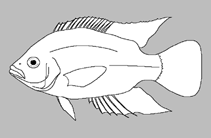 No image available for this species;
drawing shows typical species in Cichlidae.
Изображение на Google
drawing shows typical species in Cichlidae.
Классификация / Имена народные названия | синонимы | Catalog of Fishes(род, виды) | ITIS | CoL | WoRMS | Cloffa
> Cichliformes (Cichlids, convict blennies) > Cichlidae (Cichlids) > Pseudocrenilabrinae
Etymology: Haplochromis: Greek, Haploos = single + Greek, chromis = a fish, perhaps a perch (Ref. 45335); pappenheimi: Specific name in honour of Paul Pappenheim (1878-1945), at that time curator of fishes at the Museum für Naturkunde in Berlin, who co-authored the book in which the description appeared (Ref. 128938).
Eponymy: Professor Dr Eugen Julius Adolph Paul Pappenheim (1878–1945) was a German zoologist who was Curator of Fishes, Königliche Zoologische Museum, Berlin. [...] (Ref. 128868), visit book page.
More on author: Boulenger.
Etymology: Haplochromis: Greek, Haploos = single + Greek, chromis = a fish, perhaps a perch (Ref. 45335); pappenheimi: Specific name in honour of Paul Pappenheim (1878-1945), at that time curator of fishes at the Museum für Naturkunde in Berlin, who co-authored the book in which the description appeared (Ref. 128938).
Eponymy: Professor Dr Eugen Julius Adolph Paul Pappenheim (1878–1945) was a German zoologist who was Curator of Fishes, Königliche Zoologische Museum, Berlin. [...] (Ref. 128868), visit book page.
More on author: Boulenger.
Окружающая среда: среда / климатическая зона / пределы глубины / диапазон распространения экология
; пресноводный пелагический; немигрирующий. Tropical; 0° - 1°S
распространение Территории | регионы FAO | Экосистемы | места находок | карта точек | интродукции | Faunafri
Africa: only known from Lake Edward (Ref. 128938). Published information about Haplochromis pappenheimi from Lake George and the Kazinga Channel most likely refers to Haplochromis pelagicus (Ref. 128938).
Размер / Вес / Возраст
Краткое описание определительные ключи | морфология | морфометрия
колючие лучи спинного плавника (общее число) : 15 - 17; членистые (мягкие) лучи спинного плавника (общее число) : 9 - 10; колючие лучи анального плавника: 3; членистые (мягкие) лучи анального плавника: 8 - 9; позвонки: 30 - 32. Diagnosis: Haplochromis pappenheimi is a species with a shallow body, body depth 27.2-31.0% of standard length; long and shallow caudal peduncle, caudal peduncle length 17.4-19.6% of standard length, caudal peduncle depth 55.0-69.1% of caudal peduncle length; short upper jaw compared to lower jaw, upper jaw length 64.2-73.2% of lower jaw length; posterior 1/4-1/5 of premaxillary dentigerous arm sometimes edentulous; many gill rakers, 13-17 (Ref. 128938). It differs from H. aureus by a shallower body, 27.2-31.0% of standard length vs. 30.7-33.5%; shorter upper jaw, upper jaw length 26.8-29.4% of head length vs. 29.3-35.6%; more gill rakers, 13-17 vs. 12-14; dominant males with dark grey vs. yellow snout and cheeks (Ref. 128938). It is similar to H. oregosoma in body shape and dominant male colour pattern, differs by deeper lacrimals, lacrimal depth 16.1-18.1% of head length vs. 10.5-15.2%, and a broader interorbital area, interorbital width 54.0-63.5% of head width vs. 45.9-48.8% (Ref. 128938). It is very similar to H. pelagicus and differs by anal fin dark-dusky vs. hyaline to rarely faintly dusky; major cusps of outer oral teeth acutely vs. bluntly pointed, and with no to a small flange, rarely a large flange, vs. with a small to large flange; anterior outer oral teeth including often several vs. rarely some tricuspid teeth; dominant males differ further from those of H. pelagicus by anal and caudal fins crimson vs. hyaline; belly and chest dark-coloured vs. light-coloured belly and speckled-black chest; cheek dark-coloured with a well-defined lacrimal stripe vs. light-coloured with a very well-defined lacrimal stripe; pelvic fins slightly longer, pelvic fin length of male 25.2-33.5% of standard length vs. 23.3-27.0% (Ref. 128938).
Body shape (shape guide): fusiform / normal.
Body shape (shape guide): fusiform / normal.
Found in upper water levels in offshore regions (Ref. 4983); abundant in and near sublittoral regions and present in deepwater regions (Ref. 128938). It feeds on zooplankton, particularly copepods and cladocerans (Ref. 558, 128938) and larvae, pupae and emerging adults of chaoborids (Ref. 128938).
Жизненный цикл и брачное поведение половая зрелость | размножение | нерест | икра | Плодовитость | личинки
Mouthbrooding by females.
Основная ссылка
Загрузите свои рекомендации | ссылки | координатор : Kullander, Sven O. | соавторы
Vranken, N., M. Van Steenberge, M. Mbalassa and J. Snoeks, 2023. Just below the surface, the pelagic haplochromine cichlids from the Lake Edward system. Hydrobiologia 850:3173-3195. (Ref. 128938)
Статус Красного Списка МСОП (Ref. 130435: Version 2025-2 (Global))
Не вызывающий беспокойства (LC) ; Date assessed: 31 January 2006
CITES
Not Evaluated
Угроза для людей
Harmless
Использование человеком
рыболовство: интереса не представляет
FAO - Publication: search | FishSource |
дополнительная информация
Трофическая экология
Пищевые предметы (добыча)
состав пищи
потребление пищи
Продовольственные пайки
хищники
Пищевые предметы (добыча)
состав пищи
потребление пищи
Продовольственные пайки
хищники
Динамика численности населения
Параметры роста
Макс. возраст / размер
Отношение длины к весу.
Отношение длины к длине.
Размерный состав
Преобразование массы
пополнение
численность
Параметры роста
Макс. возраст / размер
Отношение длины к весу.
Отношение длины к длине.
Размерный состав
Преобразование массы
пополнение
численность
Жизненный цикл
размножение
половая зрелость
Зрелость/Жиры относительно.
Плодовитость
нерест
Нерестовые скопления
икра
Развитие икры
личинки
динамика численности личинок
размножение
половая зрелость
Зрелость/Жиры относительно.
Плодовитость
нерест
Нерестовые скопления
икра
Развитие икры
личинки
динамика численности личинок
Анатомия
жаберная область
Мозг
Отолит
жаберная область
Мозг
Отолит
Физиология
Состав тела
Питательные вещества
Потребление кислорода
Тип плавания
Скорость плавания
Зрительные пигменты
Звук рыбы
Болезни и паразиты
Токсичность (LC50s)
Состав тела
Питательные вещества
Потребление кислорода
Тип плавания
Скорость плавания
Зрительные пигменты
Звук рыбы
Болезни и паразиты
Токсичность (LC50s)
генетика
Геном
генетика
Гетерозиготность
наследуемость
Генетическое разнообразие
Геном
генетика
Гетерозиготность
наследуемость
Генетическое разнообразие
Связанные с человеком
Системы аквакультуры
особенности рыбоводства
степень растяжения
Случаи заболевания сигуатерой
Марки, монеты и прочее.
Системы аквакультуры
особенности рыбоводства
степень растяжения
Случаи заболевания сигуатерой
Марки, монеты и прочее.
инструменты
Специальные отчеты
Проверить содержание в аквариумах | Проверить опубликованные видовые данные | Проверить опубликованные данные по аквакультуре
Скачать в формате XML
ресурсы в Интернет
AFORO (otoliths) | Aquatic Commons | BHL | Cloffa | Websites from users | Проверить FishWatcher | CISTI | Catalog of Fishes: род, виды | DiscoverLife | ECOTOX | FAO - Publication: search | Faunafri | Fishipedia | Fishtrace | GloBI | Google Books | Google Scholar | Google | IGFA World Record | OneZoom | Open Tree of Life | Otolith Atlas of Taiwan Fishes | PubMed | Reef Life Survey | Socotra Atlas | TreeBase | Tree of Life | Wikipedia: Вперёд, поиск | World Records Freshwater Fishing | Зоологическая летопись
Оценки, основанные на моделях
Индекс филогенетического разнообразия (ссылка 82804): PD50 = 0.5000 [Uniqueness, from 0.5 = low to 2.0 = high].
Bayesian length-weight: a=0.01445 (0.00671 - 0.03113), b=2.99 (2.82 - 3.16), in cm total length, based on LWR estimates for this (Sub)family-body shape (Ref. 93245).
Трофический уровень (ссылка 69278): 3.2 ±0.30 se; based on food items.
устойчивость к внешним воздействиям (ссылка 120179): высокий, минимальное время удвоения популяции до 15 месяцев (Preliminary K or Fecundity.).