



Carregue seu(sua) Fotos e vídeos
Imagem do Google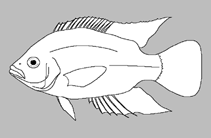 No image available for this species;
drawing shows typical species in Cichlidae.
Imagem do Google
drawing shows typical species in Cichlidae.
Classificação / Nomes Nomes comuns | Sinônimos | Catalog of Fishes(Gênero, Espécies) | ITIS | CoL | WoRMS | Cloffa
> Cichliformes (Cichlids, convict blennies) > Cichlidae (Cichlids) > Pseudocrenilabrinae
Etymology: Haplochromis: Greek, Haploos = single + Greek, chromis = a fish, perhaps a perch (Ref. 45335); pappenheimi: Specific name in honour of Paul Pappenheim (1878-1945), at that time curator of fishes at the Museum für Naturkunde in Berlin, who co-authored the book in which the description appeared (Ref. 128938).
Eponymy: Professor Dr Eugen Julius Adolph Paul Pappenheim (1878–1945) was a German zoologist who was Curator of Fishes, Königliche Zoologische Museum, Berlin. [...] (Ref. 128868), visit book page.
More on author: Boulenger.
Etymology: Haplochromis: Greek, Haploos = single + Greek, chromis = a fish, perhaps a perch (Ref. 45335); pappenheimi: Specific name in honour of Paul Pappenheim (1878-1945), at that time curator of fishes at the Museum für Naturkunde in Berlin, who co-authored the book in which the description appeared (Ref. 128938).
Eponymy: Professor Dr Eugen Julius Adolph Paul Pappenheim (1878–1945) was a German zoologist who was Curator of Fishes, Königliche Zoologische Museum, Berlin. [...] (Ref. 128868), visit book page.
More on author: Boulenger.
Meio ambiente: milieu / Zona climática / intervalo de profundidade / faixa de distribuição Ecologia
; Água doce pelágico(a,os,as); não migratória. Tropical; 0° - 1°S
Distribuição Territórios | Áreas da FAO | Ecossistemas | Ocorrências | Mapa de pontos | Introduções | Faunafri
Africa: only known from Lake Edward (Ref. 128938). Published information about Haplochromis pappenheimi from Lake George and the Kazinga Channel most likely refers to Haplochromis pelagicus (Ref. 128938).
Tamanho / Peso / Idade
Descrição suscinta Chaves de identificação | Morfologia | Morfometria
Espinhos dorsais (total) : 15 - 17; Raios dorsais (total) : 9 - 10; Espinhos anais: 3; Raios anais : 8 - 9; Vértebras: 30 - 32. Diagnosis: Haplochromis pappenheimi is a species with a shallow body, body depth 27.2-31.0% of standard length; long and shallow caudal peduncle, caudal peduncle length 17.4-19.6% of standard length, caudal peduncle depth 55.0-69.1% of caudal peduncle length; short upper jaw compared to lower jaw, upper jaw length 64.2-73.2% of lower jaw length; posterior 1/4-1/5 of premaxillary dentigerous arm sometimes edentulous; many gill rakers, 13-17 (Ref. 128938). It differs from H. aureus by a shallower body, 27.2-31.0% of standard length vs. 30.7-33.5%; shorter upper jaw, upper jaw length 26.8-29.4% of head length vs. 29.3-35.6%; more gill rakers, 13-17 vs. 12-14; dominant males with dark grey vs. yellow snout and cheeks (Ref. 128938). It is similar to H. oregosoma in body shape and dominant male colour pattern, differs by deeper lacrimals, lacrimal depth 16.1-18.1% of head length vs. 10.5-15.2%, and a broader interorbital area, interorbital width 54.0-63.5% of head width vs. 45.9-48.8% (Ref. 128938). It is very similar to H. pelagicus and differs by anal fin dark-dusky vs. hyaline to rarely faintly dusky; major cusps of outer oral teeth acutely vs. bluntly pointed, and with no to a small flange, rarely a large flange, vs. with a small to large flange; anterior outer oral teeth including often several vs. rarely some tricuspid teeth; dominant males differ further from those of H. pelagicus by anal and caudal fins crimson vs. hyaline; belly and chest dark-coloured vs. light-coloured belly and speckled-black chest; cheek dark-coloured with a well-defined lacrimal stripe vs. light-coloured with a very well-defined lacrimal stripe; pelvic fins slightly longer, pelvic fin length of male 25.2-33.5% of standard length vs. 23.3-27.0% (Ref. 128938).
Body shape (shape guide): fusiform / normal.
Body shape (shape guide): fusiform / normal.
Found in upper water levels in offshore regions (Ref. 4983); abundant in and near sublittoral regions and present in deepwater regions (Ref. 128938). It feeds on zooplankton, particularly copepods and cladocerans (Ref. 558, 128938) and larvae, pupae and emerging adults of chaoborids (Ref. 128938).
Ciclo de vida ou comportamento de acasalamento Maturidade | Reprodução | Desova | Ovos | Fecundidade | Larvas
Mouthbrooding by females.
Referência principal
Carregar suas referências | Referências | Coordenador : Kullander, Sven O. | Colaboradores
Vranken, N., M. Van Steenberge, M. Mbalassa and J. Snoeks, 2023. Just below the surface, the pelagic haplochromine cichlids from the Lake Edward system. Hydrobiologia 850:3173-3195. (Ref. 128938)
Status na Lista Vermelha da UICN (Ref. 130435: Version 2025-2 (Global))
Segura ou pouco preocupante (LC) ; Date assessed: 31 January 2006
CITES
Not Evaluated
Ameaça para os humanos
Harmless
Uso pelos humanos
Pescarias: sem interesse
FAO - Publication: search | FishSource |
Mais informação
Ecologia Trófica
Itens alimentares (presas)
Composição da dieta
Consumo alimentar
Rações alimentares
Predadores
Itens alimentares (presas)
Composição da dieta
Consumo alimentar
Rações alimentares
Predadores
Dinâmica populacional
Parâmetros de crescimento
Idade máxima / tamanhos
Relação comprimento-peso.
Relação comprimento-comprimento.
Frequências de comprimento
Conversão de massa
Recrutamento
Abundância
Parâmetros de crescimento
Idade máxima / tamanhos
Relação comprimento-peso.
Relação comprimento-comprimento.
Frequências de comprimento
Conversão de massa
Recrutamento
Abundância
Ciclo de vida
Reprodução
Maturidade
Maturidade/Rel. das guelras
Fecundidade
Desova
Agregações de desova
Ovos
Desenvolvimento dos ovos
Larvas
Dinâmica larval
Reprodução
Maturidade
Maturidade/Rel. das guelras
Fecundidade
Desova
Agregações de desova
Ovos
Desenvolvimento dos ovos
Larvas
Dinâmica larval
Anatomia
Área branquial
Cérebro
Otólito
Área branquial
Cérebro
Otólito
Fisiologia
Composição corporal
Nutrientes
Consumo de oxigênio
Tipo de natação
Velocidade de natação
Pigmentos visuais
Som de peixe
Doenças e Parasitas
Toxicidade (LC50s)
Composição corporal
Nutrientes
Consumo de oxigênio
Tipo de natação
Velocidade de natação
Pigmentos visuais
Som de peixe
Doenças e Parasitas
Toxicidade (LC50s)
Genética
genoma
Genética
Heterozigosidade
Hereditariedade
Diversidade genética
genoma
Genética
Heterozigosidade
Hereditariedade
Diversidade genética
Relacionado a humanos
Sistemas de aquicultura
Perfis para aquacultura
Estirpes
Casos de Ciguatera
Selos, moedas, diversos.
Sistemas de aquicultura
Perfis para aquacultura
Estirpes
Casos de Ciguatera
Selos, moedas, diversos.
Ferramentas
Livro eletrônico | Guia de campo | Ferramenta auxiliar de frequências de comprimento | Ferramenta sobre a história de vida | Mapa de pontos |
Catch-MSY |
Relatórios especiais
Checar Manutenção em Aquário | Checar Planilhas de Fatos sobre as Espécies | Checar Planilhas de Fatos sobre Aquicultura
Baixar XML
Fontes da internet
AFORO (otoliths) | Aquatic Commons | BHL | Cloffa | Websites from users | Checar Observador de Peixes (FishWatcher) | CISTI | Catalog of Fishes: Gênero, Espécies | DiscoverLife | ECOTOX | FAO - Publication: search | Faunafri | Fishipedia | Fishtrace | GloBI | Google Books | Google Scholar | Google | IGFA World Record | OneZoom | Open Tree of Life | Otolith Atlas of Taiwan Fishes | PubMed | Reef Life Survey | Socotra Atlas | TreeBase | Árvore da vida | Wikipedia: Ir para, procura | World Records Freshwater Fishing | Registro zoológico
Estimativas baseadas em modelos
Índice de diversidade filogenética (Ref. 82804): PD50 = 0.5000 [Uniqueness, from 0.5 = low to 2.0 = high].
Bayesian length-weight: a=0.01445 (0.00671 - 0.03113), b=2.99 (2.82 - 3.16), in cm total length, based on LWR estimates for this (Sub)family-body shape (Ref. 93245).
Nível Trófico (Ref. 69278): 3.2 ±0.30 se; based on food items.
Resiliência (Ref. 120179): Elevada, tempo mínimo de duplicação da população menor que 15 meses (Preliminary K or Fecundity.).