



Tải lên của bạn hình ảnh Và Video
Google image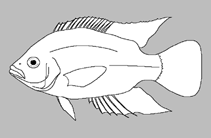 No image available for this species;
drawing shows typical species in Cichlidae.
Google image
drawing shows typical species in Cichlidae.
Phân loại / Tên Tên thường gặp | Các synonym ( Các tên trùng) | Catalog of Fishes(Giống, Các loài) | ITIS | CoL | WoRMS | Cloffa
> Cichliformes (Cichlids, convict blennies) > Cichlidae (Cichlids) > Pseudocrenilabrinae
Etymology: Haplochromis: Greek, Haploos = single + Greek, chromis = a fish, perhaps a perch (Ref. 45335); mentatus: Specific name probably derived from the Latin 'mentum' for 'chin'; probably referring to the protruding lower jaw (Ref. 126312).
More on author: Regan.
Etymology: Haplochromis: Greek, Haploos = single + Greek, chromis = a fish, perhaps a perch (Ref. 45335); mentatus: Specific name probably derived from the Latin 'mentum' for 'chin'; probably referring to the protruding lower jaw (Ref. 126312).
More on author: Regan.
Môi trường: môi trường / vùng khí hậu / Mức độ sâu / phạm vi phân phối Sinh thái học
; nước ngọt sống nổi và đáy. Tropical; 0° - 1°S
Sự phân bố Lãnh thổ | Các khu vực của FAO | Các hệ sinh thái | Những lần xuất hiện | Bản đồ điểm | Những chỉ dẫn | Faunafri
Africa: endemic to Lake Edward system (Ref. 126312).
Bộ gần gũi / Khối lượng (Trọng lượng) / Tuổi
Chín muồi sinh dục: Lm ? range ? - ? cm
Max length : 11.5 cm TL con đực/không giới tính; (Ref. 4983)
Max length : 11.5 cm TL con đực/không giới tính; (Ref. 4983)
Mô tả ngắn gọn Khóa để định loại | Hình thái học | Sinh trắc học
Các tia vây lưng cứng (tổng cộng) : 15 - 16; Các vây lưng mềm (tổng cộng) : 9 - 10; Tia cứng vây hậu môn: 3; Tia mềm vây hậu môn: 8 - 9; Động vật có xương sống: 30 - 32. Diagnosis: Species with a piscivorous morphology; body shallow, body depth 29.0-32.3% of standard length; snout very acute in dorsal and lateral views; outer oral teeth few and large, number of upper outer teeth 28-46; vertebrae many, 30-32; dominant males yellow-green with a red anterior part of flank (Ref. 126312). Amongst piscivorous species from the Lake Edward system, Haplochromis mentatus differs from H. latifrons by the combination of a longer dorsal fin base, dorsal-fin base 50.3-54.2% of standard length vs. 47.2-50.1%; a weakly vs. strongly prominent premaxillary pedicel; a steeper sloping lower jaw side, 30-45° vs. 25-30°; and absence vs. presence of a well-defined mid-lateral band (Ref. 126312). It differs from H. rex and H. aquila by the combination of a longer caudal peduncle, caudal peduncle length 15.7-17.5% of standard length vs. 13.5-16.2%; a gentler sloping snout, 30-35° vs. 35-50°; and dominant males yellow-green with a red anterior part of flank vs. cream-coloured with an orange operculum, or light grey with a black head, respectively; further from H. rex by a lower number of infraorbital cheek scales, 3-4 vs. 5-6, rarely 4 or 7; further from H. aquila by smaller eyes, eye diameter 25.4-29.9% of head length vs. 30.0-31.5% (Ref. 126312). It differs from H. simba by the combination of a broader interorbital area, interorbital width 51.3-61.0% of head width vs. 45.5-50.4%; a larger number of outer upper jaw teeth, 28-46 vs. 22-31; absent to weakly prominent vs. strongly prominent premaxillary pedicel and mentum; and dominant males yellow-green with a red anterior part of flank vs. yellow with an orange anterior part of flank (Ref. 126312). It differs from H. glaucus by the combination of a longer caudal peduncle, caudal peduncle length 15.7-17.5% of standard length vs. 13.4-16.1%; a narrower lower pharyngeal bone, lower pharyngeal width 83.6-85.7% of lower pharyngeal length vs. 93.3-95.1%; a slightly shorter pre-pectoral distance, 33.1-38.2% of standard length vs. 36.4-39.4%; and dominant males yellow-green with a red anterior part of flank vs. uniformly blue (Ref. 126312). It differs from H. kimondo and H. quasimodo by the combination of a narrower head, head width 39.4-42.3% of head length vs. 42.0-48.1%; and dominant males yellow-green with a red anterior part of flank vs. grey dorsally and yellow or blue-black ventrally; further from H. kimondo by a very acute vs. blunt snout, and a gentler sloping snout, 30-35° vs. 40-50°; further from H. quasimodo by a shallower body, body depth 27.2-30.1% of standard length vs. 33.5-41.7% (Ref. 126312). It differs from H. falcatus by the combination of a shorter predorsal distance, 33.3-36.4% of standard length vs. 36.9-41.1%; a shorter head, head length 33.4-37.0% of standard length vs. 36.6-39.6%; straight to weakly recurved vs. strongly recurved outer oral teeth, a steeper lower jaw side, 30-45° vs. 15-25°; absence vs. presence of well-defined mid-lateral and dorsal-lateral bands (Ref. 126312). It differs from H. curvidens and H. pardus by the combination of a deeper lacrimal, 18.1-20.9% of head length vs. 16.0-18.3%; and smaller eyes, eye diameter 25.4-29.9% of headclength vs. 29.4-34.1%; further from H. pardus by dominant males yellow-green with a red anterior part of flank vs. speckled to uniformly black (Ref. 126312). It differs from H. squamipinnis by the combination of large vs. small outer oral teeth and a smaller number of outer upper jaw teeth, 28-46 vs. 46-71; a shallower body, body depth 29.0-32.3% of standard length vs. 32.4-39.3%; absence vs. presence of minute scales on proximal part of dorsal fin; and dominant males yellow-green with a red anterior part of flank vs. uniformly slate blue (Ref. 126312).
Found in offshore areas, mostly in shallow waters (Ref. 126312). Based on its morphology, most probably a piscivorous species (Ref. 126312).
Vòng đời và hành vi giao phối Chín muồi sinh dục | Sự tái sinh sản | Đẻ trứng | Các trứng | Sự sinh sản | Ấu trùng
Mouthbrooding by females.
Tài liệu tham khảo chính
Tải lên tài liệu tham khảo của bạn | Các tài liệu tham khảo | Người điều phối : Kullander, Sven O. | Người cộng tác
Vranken, N., M. Van Steenberge, A. Heylen, E. Decru and J. Snoeks, 2022. From a pair to a dozen: the piscivorous species of Haplochromis (Cichlidae) from the Lake Edward system. Eur. J. Taxon. 815:1-94. (Ref. 126312)
Tình trạng Sách đỏ IUCN (Ref. 130435: Version 2025-2 (Global))
Least Concern (LC) ; Date assessed: 22 August 2021
CITES
Not Evaluated
Mối đe dọa đối với con người
Harmless
Sử dụng của con người
FAO - Publication: search | FishSource |
Thêm thông tin
Sinh thái dinh dưỡng
Thức ăn (con mồi)
Thành phần thức ăn
Thành phần thức ăn
Khẩu phần ăn
Các động vật ăn mồi
Thức ăn (con mồi)
Thành phần thức ăn
Thành phần thức ăn
Khẩu phần ăn
Các động vật ăn mồi
Biến động dân số
Các thông số tăng trưởng
Độ tuổi / kích thước tối đa
Chiều dài-trọng lượng tương đối
Chiều dài-chiều dài tương đối.
Chiều dài-tần số
Chuyển đổi khối lượng
Bổ xung
Sự phong phú
Các thông số tăng trưởng
Độ tuổi / kích thước tối đa
Chiều dài-trọng lượng tương đối
Chiều dài-chiều dài tương đối.
Chiều dài-tần số
Chuyển đổi khối lượng
Bổ xung
Sự phong phú
Vòng đời
Sự tái sinh sản
Chín muồi sinh dục
Độ trưởng thành/Mang liên quan
Sự sinh sản
Đẻ trứng
Tập hợp sinh sản
Các trứng
Sự phát triển của trứng
Ấu trùng
Sự biến động ấu trùng
Sự tái sinh sản
Chín muồi sinh dục
Độ trưởng thành/Mang liên quan
Sự sinh sản
Đẻ trứng
Tập hợp sinh sản
Các trứng
Sự phát triển của trứng
Ấu trùng
Sự biến động ấu trùng
Sự phân bố
Lãnh thổ
Các khu vực của FAO
Các hệ sinh thái
Những lần xuất hiện
Những chỉ dẫn
BRUVS - Video
Lãnh thổ
Các khu vực của FAO
Các hệ sinh thái
Những lần xuất hiện
Những chỉ dẫn
BRUVS - Video
Giải phẫu
Vùng mang
Não
sỏi tai
Vùng mang
Não
sỏi tai
Sinh lý học
Thành phần cơ thể
Chất dinh dưỡng
Thành phần ô-xy
Kiểu bơi
Tốc độ bơi
Sắc tố thị giác
Tiếng cá
Bệnh tật & Ký sinh trùng
Độc tính (LC50)
Thành phần cơ thể
Chất dinh dưỡng
Thành phần ô-xy
Kiểu bơi
Tốc độ bơi
Sắc tố thị giác
Tiếng cá
Bệnh tật & Ký sinh trùng
Độc tính (LC50)
Di truyền
Bộ gen
Di truyền
Sự dị hợp tử
Di sản
Đa dạng di truyền
Bộ gen
Di truyền
Sự dị hợp tử
Di sản
Đa dạng di truyền
Liên quan đến con người
Hệ thống nuôi trồng thủy sản
Các tổng quan nuôi trồng thủy sản
Các giống
Các trường hợp ngộ độc Ciguatera
Tem, tiền xu, v.v.
Hệ thống nuôi trồng thủy sản
Các tổng quan nuôi trồng thủy sản
Các giống
Các trường hợp ngộ độc Ciguatera
Tem, tiền xu, v.v.
Các công cụ
Sách điện tử | Hướng dẫn hiện trường | Tần suất chiều dài Wizard | Công cụ của vòng đời | Bản đồ điểm |
Bắt-MSY |
Báo cáo đặc biệt
Kiểm tra bảo trì bể cá | Kiểm tra các tờ thông tin về loài | Kiểm tra các tờ thông tin về nuôi trồng thủy sản
Tải xuống XML
Các nguồn internet
AFORO (otoliths) | Aquatic Commons | BHL | Cloffa | Websites from users | Check FishWatcher | CISTI | Catalog of Fishes: Giống, Các loài | DiscoverLife | ECOTOX | FAO - Publication: search | Faunafri | Fishipedia | Fishtrace | GloBI | Google Books | Google Scholar | Google | IGFA World Record | OneZoom | Open Tree of Life | Otolith Atlas of Taiwan Fishes | PubMed | Reef Life Survey | Socotra Atlas | TreeBase | Cây Đời sống | Wikipedia: Go, tìm | World Records Freshwater Fishing | Zoobank | Tạp chí Zoological Record
Ước tính dựa trên mô hình
Chỉ số đa dạng phát sinh loài (Tài liệu tham khảo 82804): PD50 = 0.5000 [Uniqueness, from 0.5 = low to 2.0 = high].
Bayesian length-weight: a=0.00389 (0.00180 - 0.00842), b=3.12 (2.94 - 3.30), in cm total length, based on all LWR estimates for this body shape (Ref. 93245).
Mức dinh dưỡng (Tài liệu tham khảo 69278): 3.3 ±0.4 se; based on size and trophs of closest relatives
Thích nghi nhanh (Tài liệu tham khảo 120179): Chiêù cao, thời gian nhân đôi của chủng quần tối thiểu là dưới 15 tháng (Preliminary K or Fecundity.).