



Carica il tuo foto e Video
Google image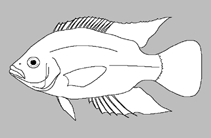 No image available for this species;
drawing shows typical species in Cichlidae.
Google image
drawing shows typical species in Cichlidae.
Classificazione / Nomi Nomi Comuni | Sinonimi | Catalog of Fishes(Genere, Specie) | ITIS | CoL | WoRMS | Cloffa
> Cichliformes (Cichlids, convict blennies) > Cichlidae (Cichlids) > Pseudocrenilabrinae
Etymology: Haplochromis: Greek, Haploos = single + Greek, chromis = a fish, perhaps a perch (Ref. 45335); mentatus: Specific name probably derived from the Latin 'mentum' for 'chin'; probably referring to the protruding lower jaw (Ref. 126312).
More on author: Regan.
Etymology: Haplochromis: Greek, Haploos = single + Greek, chromis = a fish, perhaps a perch (Ref. 45335); mentatus: Specific name probably derived from the Latin 'mentum' for 'chin'; probably referring to the protruding lower jaw (Ref. 126312).
More on author: Regan.
Ambiente: milieu / zona climatica / distribuzione batimetrica / gamma di distribuzione Ecologia
; acqua dolce benthopelagico. Tropical; 0° - 1°S
Distribuzione Territories | Aree FAO | Ecosistemi | Presenze | Mappa dei ritrovamenti | Introduzioni | Faunafri
Africa: endemic to Lake Edward system (Ref. 126312).
Dimensione / Peso / Età
Breve descrizione Chiavi di identificazione | Morfologia | Morfometria
Spine dorsali (totale) : 15 - 16; Raggi dorsali molli (totale) : 9 - 10; Spine anali: 3; Raggi anali molli: 8 - 9; Vertebre: 30 - 32. Diagnosis: Species with a piscivorous morphology; body shallow, body depth 29.0-32.3% of standard length; snout very acute in dorsal and lateral views; outer oral teeth few and large, number of upper outer teeth 28-46; vertebrae many, 30-32; dominant males yellow-green with a red anterior part of flank (Ref. 126312). Amongst piscivorous species from the Lake Edward system, Haplochromis mentatus differs from H. latifrons by the combination of a longer dorsal fin base, dorsal-fin base 50.3-54.2% of standard length vs. 47.2-50.1%; a weakly vs. strongly prominent premaxillary pedicel; a steeper sloping lower jaw side, 30-45° vs. 25-30°; and absence vs. presence of a well-defined mid-lateral band (Ref. 126312). It differs from H. rex and H. aquila by the combination of a longer caudal peduncle, caudal peduncle length 15.7-17.5% of standard length vs. 13.5-16.2%; a gentler sloping snout, 30-35° vs. 35-50°; and dominant males yellow-green with a red anterior part of flank vs. cream-coloured with an orange operculum, or light grey with a black head, respectively; further from H. rex by a lower number of infraorbital cheek scales, 3-4 vs. 5-6, rarely 4 or 7; further from H. aquila by smaller eyes, eye diameter 25.4-29.9% of head length vs. 30.0-31.5% (Ref. 126312). It differs from H. simba by the combination of a broader interorbital area, interorbital width 51.3-61.0% of head width vs. 45.5-50.4%; a larger number of outer upper jaw teeth, 28-46 vs. 22-31; absent to weakly prominent vs. strongly prominent premaxillary pedicel and mentum; and dominant males yellow-green with a red anterior part of flank vs. yellow with an orange anterior part of flank (Ref. 126312). It differs from H. glaucus by the combination of a longer caudal peduncle, caudal peduncle length 15.7-17.5% of standard length vs. 13.4-16.1%; a narrower lower pharyngeal bone, lower pharyngeal width 83.6-85.7% of lower pharyngeal length vs. 93.3-95.1%; a slightly shorter pre-pectoral distance, 33.1-38.2% of standard length vs. 36.4-39.4%; and dominant males yellow-green with a red anterior part of flank vs. uniformly blue (Ref. 126312). It differs from H. kimondo and H. quasimodo by the combination of a narrower head, head width 39.4-42.3% of head length vs. 42.0-48.1%; and dominant males yellow-green with a red anterior part of flank vs. grey dorsally and yellow or blue-black ventrally; further from H. kimondo by a very acute vs. blunt snout, and a gentler sloping snout, 30-35° vs. 40-50°; further from H. quasimodo by a shallower body, body depth 27.2-30.1% of standard length vs. 33.5-41.7% (Ref. 126312). It differs from H. falcatus by the combination of a shorter predorsal distance, 33.3-36.4% of standard length vs. 36.9-41.1%; a shorter head, head length 33.4-37.0% of standard length vs. 36.6-39.6%; straight to weakly recurved vs. strongly recurved outer oral teeth, a steeper lower jaw side, 30-45° vs. 15-25°; absence vs. presence of well-defined mid-lateral and dorsal-lateral bands (Ref. 126312). It differs from H. curvidens and H. pardus by the combination of a deeper lacrimal, 18.1-20.9% of head length vs. 16.0-18.3%; and smaller eyes, eye diameter 25.4-29.9% of headclength vs. 29.4-34.1%; further from H. pardus by dominant males yellow-green with a red anterior part of flank vs. speckled to uniformly black (Ref. 126312). It differs from H. squamipinnis by the combination of large vs. small outer oral teeth and a smaller number of outer upper jaw teeth, 28-46 vs. 46-71; a shallower body, body depth 29.0-32.3% of standard length vs. 32.4-39.3%; absence vs. presence of minute scales on proximal part of dorsal fin; and dominant males yellow-green with a red anterior part of flank vs. uniformly slate blue (Ref. 126312).
Found in offshore areas, mostly in shallow waters (Ref. 126312). Based on its morphology, most probably a piscivorous species (Ref. 126312).
Ciclo vitale e comportamento di accoppiamento Maturità | Riproduzione | Deposizione | Uova | Fecondità | Larve
Mouthbrooding by females.
Riferimento principale
Caricare le referenze | Bibliografia | Coordinatore : Kullander, Sven O. | Collaboratori
Vranken, N., M. Van Steenberge, A. Heylen, E. Decru and J. Snoeks, 2022. From a pair to a dozen: the piscivorous species of Haplochromis (Cichlidae) from the Lake Edward system. Eur. J. Taxon. 815:1-94. (Ref. 126312)
Stato della Lista Rossa IUCN (Ref. 130435: Version 2025-2 (Global))
Least Concern (LC) ; Date assessed: 22 August 2021
CITES
Not Evaluated
Minaccia per l'uomo
Harmless
Usi umani
FAO - Publication: search | FishSource |
Informazioni ulteriori
Ecologia trofica
Articoli alimentari (prede)
Alimentazione
Consumo di cibo
Razioni alimentari
Predatori
Articoli alimentari (prede)
Alimentazione
Consumo di cibo
Razioni alimentari
Predatori
Dinamica della popolazione
Parametri di crescita
Età massima / dimensioni massime
Rapporto lunghezza-peso.
Lunghezza-lunghezza rel.
Lunghezza-frequenze
Conversione di massa
Reclutamento
Abbondanza
Parametri di crescita
Età massima / dimensioni massime
Rapporto lunghezza-peso.
Lunghezza-lunghezza rel.
Lunghezza-frequenze
Conversione di massa
Reclutamento
Abbondanza
Ciclo di vita
Riproduzione
Maturità
Maturità/Gli occhielli sono relativi.
Fecondità
Deposizione
Aggregazioni riproduttive
Uova
Sviluppo delle uova
Larve
Dinamica popolazioni larvali
Riproduzione
Maturità
Maturità/Gli occhielli sono relativi.
Fecondità
Deposizione
Aggregazioni riproduttive
Uova
Sviluppo delle uova
Larve
Dinamica popolazioni larvali
Anatomia
Area branchiale
Cervello
Otolite
Area branchiale
Cervello
Otolite
Fisiologia
Composizione corporea
Nutrienti
Consumo di ossigeno
Tipo di nuoto
Velocità di nuoto
Pigmenti visivi
Suono del pesce
Malattie e parassiti
Tossicità (LC50)
Composizione corporea
Nutrienti
Consumo di ossigeno
Tipo di nuoto
Velocità di nuoto
Pigmenti visivi
Suono del pesce
Malattie e parassiti
Tossicità (LC50)
Genetica
Genome
Genetica
Eterozigosi
Ereditarietà
Diversità genetica
Genome
Genetica
Eterozigosi
Ereditarietà
Diversità genetica
Legato all'uomo
Sistemi di acquacoltura
Profili di acquacoltura
Varietà
Casi di Ciguatera
Francobolli, monete, materiale vario.
Sistemi di acquacoltura
Profili di acquacoltura
Varietà
Casi di Ciguatera
Francobolli, monete, materiale vario.
Strumenti
Libro elettronico | Giuda pratica | Generatore frequenze di lunghezza | Strumento Parametri Biologici | Mappa dei ritrovamenti |
Cattura-MSY |
Rapporti speciali
Controllo della manutenzione dell'acquario | Verificare la presenza di schede informative sulle specie | Verifica delle schede informative sull'acquacoltura
Scarica XML
Fonti Internet
AFORO (otoliths) | Aquatic Commons | BHL | Cloffa | Websites from users | Check FishWatcher | CISTI | Catalog of Fishes: Genere, Specie | DiscoverLife | ECOTOX | FAO - Publication: search | Faunafri | Fishipedia | Fishtrace | GloBI | Google Books | Google Scholar | Google | IGFA World Record | OneZoom | Open Tree of Life | Otolith Atlas of Taiwan Fishes | PubMed | Reef Life Survey | Socotra Atlas | TreeBase | Tree of Life | Wikipedia: Go, ricerca | World Records Freshwater Fishing | Zoobank | Record zoologico
Stime basate su modelli
Indice di diversità filogenetica (Fonte Biblio. 82804): PD50 = 0.5000 [Uniqueness, from 0.5 = low to 2.0 = high].
Bayesian length-weight: a=0.00389 (0.00180 - 0.00842), b=3.12 (2.94 - 3.30), in cm total length, based on all LWR estimates for this body shape (Ref. 93245).
Livello trofico (Fonte Biblio. 69278): 3.3 ±0.4 se; based on size and trophs of closest relatives
Resilienza (Fonte Biblio. 120179): Alto, tempo minimo di raddoppiamento della popolazione meno di 15 mesi (Preliminary K or Fecundity.).