



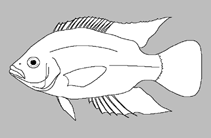
分类 / 名称 俗名 | 同种异名 | Catalog of Fishes(属, 种) | ITIS | CoL | WoRMS | Cloffa
Teleostei > Cichliformes (Cichlids, convict blennies) 鱸形目 (Cichlids, convict blennies) > Cichlidae (Cichlids) 麗魚科 (Cichlids) > Pseudocrenilabrinae
Etymology: Haplochromis: Greek, Haploos = single + Greek, chromis = a fish, perhaps a perch (Ref. 45335); mentatus: Specific name probably derived from the Latin 'mentum' for 'chin'; probably referring to the protruding lower jaw (Ref. 126312).
More on author: Regan.
Etymology: Haplochromis: Greek, Haploos = single + Greek, chromis = a fish, perhaps a perch (Ref. 45335); mentatus: Specific name probably derived from the Latin 'mentum' for 'chin'; probably referring to the protruding lower jaw (Ref. 126312).
More on author: Regan.
环境:氛围 / 气候带 / 深度上下限 / 分布范围 生态学
; 淡水 底中水层性. 熱帶; 0° - 1°S
分布 领土 | FAO区域 | 生态系 | 标本纪录 | 分布图 | 简介 | Faunafri
Africa: endemic to Lake Edward system (Ref. 126312).
非洲: 愛德華湖。
非洲: 愛德華湖。
大小 / 重量 / 年龄
简单描述 检索表 | 型态特徵 | 形态测量图
背棘 (总数) : 15 - 16; 背的软条 (总数) : 9 - 10; 臀棘: 3; 臀鳍软条: 8 - 9; 脊椎骨: 30 - 32. Diagnosis: Species with a piscivorous morphology; body shallow, body depth 29.0-32.3% of standard length; snout very acute in dorsal and lateral views; outer oral teeth few and large, number of upper outer teeth 28-46; vertebrae many, 30-32; dominant males yellow-green with a red anterior part of flank (Ref. 126312). Amongst piscivorous species from the Lake Edward system, Haplochromis mentatus differs from H. latifrons by the combination of a longer dorsal fin base, dorsal-fin base 50.3-54.2% of standard length vs. 47.2-50.1%; a weakly vs. strongly prominent premaxillary pedicel; a steeper sloping lower jaw side, 30-45° vs. 25-30°; and absence vs. presence of a well-defined mid-lateral band (Ref. 126312). It differs from H. rex and H. aquila by the combination of a longer caudal peduncle, caudal peduncle length 15.7-17.5% of standard length vs. 13.5-16.2%; a gentler sloping snout, 30-35° vs. 35-50°; and dominant males yellow-green with a red anterior part of flank vs. cream-coloured with an orange operculum, or light grey with a black head, respectively; further from H. rex by a lower number of infraorbital cheek scales, 3-4 vs. 5-6, rarely 4 or 7; further from H. aquila by smaller eyes, eye diameter 25.4-29.9% of head length vs. 30.0-31.5% (Ref. 126312). It differs from H. simba by the combination of a broader interorbital area, interorbital width 51.3-61.0% of head width vs. 45.5-50.4%; a larger number of outer upper jaw teeth, 28-46 vs. 22-31; absent to weakly prominent vs. strongly prominent premaxillary pedicel and mentum; and dominant males yellow-green with a red anterior part of flank vs. yellow with an orange anterior part of flank (Ref. 126312). It differs from H. glaucus by the combination of a longer caudal peduncle, caudal peduncle length 15.7-17.5% of standard length vs. 13.4-16.1%; a narrower lower pharyngeal bone, lower pharyngeal width 83.6-85.7% of lower pharyngeal length vs. 93.3-95.1%; a slightly shorter pre-pectoral distance, 33.1-38.2% of standard length vs. 36.4-39.4%; and dominant males yellow-green with a red anterior part of flank vs. uniformly blue (Ref. 126312). It differs from H. kimondo and H. quasimodo by the combination of a narrower head, head width 39.4-42.3% of head length vs. 42.0-48.1%; and dominant males yellow-green with a red anterior part of flank vs. grey dorsally and yellow or blue-black ventrally; further from H. kimondo by a very acute vs. blunt snout, and a gentler sloping snout, 30-35° vs. 40-50°; further from H. quasimodo by a shallower body, body depth 27.2-30.1% of standard length vs. 33.5-41.7% (Ref. 126312). It differs from H. falcatus by the combination of a shorter predorsal distance, 33.3-36.4% of standard length vs. 36.9-41.1%; a shorter head, head length 33.4-37.0% of standard length vs. 36.6-39.6%; straight to weakly recurved vs. strongly recurved outer oral teeth, a steeper lower jaw side, 30-45° vs. 15-25°; absence vs. presence of well-defined mid-lateral and dorsal-lateral bands (Ref. 126312). It differs from H. curvidens and H. pardus by the combination of a deeper lacrimal, 18.1-20.9% of head length vs. 16.0-18.3%; and smaller eyes, eye diameter 25.4-29.9% of headclength vs. 29.4-34.1%; further from H. pardus by dominant males yellow-green with a red anterior part of flank vs. speckled to uniformly black (Ref. 126312). It differs from H. squamipinnis by the combination of large vs. small outer oral teeth and a smaller number of outer upper jaw teeth, 28-46 vs. 46-71; a shallower body, body depth 29.0-32.3% of standard length vs. 32.4-39.3%; absence vs. presence of minute scales on proximal part of dorsal fin; and dominant males yellow-green with a red anterior part of flank vs. uniformly slate blue (Ref. 126312).
Found in offshore areas, mostly in shallow waters (Ref. 126312). Based on its morphology, most probably a piscivorous species (Ref. 126312).
生命周期和交配行为 成熟度 | 繁殖 | 产卵场 | 卵 | 孕卵数 | 仔鱼
Mouthbrooding by females.非洲: 愛德華湖。
主要参考文献
上传您的参考资料 | 参考文献 | 合作者 : Kullander, Sven O. | 合作者
Vranken, N., M. Van Steenberge, A. Heylen, E. Decru and J. Snoeks, 2022. From a pair to a dozen: the piscivorous species of Haplochromis (Cichlidae) from the Lake Edward system. Eur. J. Taxon. 815:1-94. (Ref. 126312)
CITES
Not Evaluated
对人类的威胁
无害处的
人类利用
FAO - Publication: search | FishSource |
更多信息
解剖学
鳃区
大脑
耳石
鳃区
大脑
耳石
生理学
身体成分
营养素
耗氧量
游泳类型
游泳速度
视觉色素
鱼声
疾病与寄生虫
毒性(半数致死浓度)
身体成分
营养素
耗氧量
游泳类型
游泳速度
视觉色素
鱼声
疾病与寄生虫
毒性(半数致死浓度)
遗传学
基因组
遗传学
异质性
遗传率
基因多样性
基因组
遗传学
异质性
遗传率
基因多样性
工具
特别资料
下载 XML
网络资源
AFORO (otoliths) | Aquatic Commons | BHL | Cloffa | Websites from users | 核实 FishWatcher | CISTI | Catalog of Fishes: 属, 种 | DiscoverLife | ECOTOX | FAO - Publication: search | Faunafri | Fishipedia | Fishtrace | GloBI | Google Books | Google Scholar | Google | IGFA World Record | OneZoom | Open Tree of Life | Otolith Atlas of Taiwan Fishes | PubMed | Reef Life Survey | Socotra Atlas | TreeBase | 树状分类阶层 | Wikipedia: 转至, 搜寻 | World Records Freshwater Fishing | Zoobank | 动物学的记录
基于模型的估算
系统发育多样性指数 (参考文献 82804): PD50 = 0.5000 [Uniqueness, from 0.5 = low to 2.0 = high].
Bayesian length-weight: a=0.00389 (0.00180 - 0.00842), b=3.12 (2.94 - 3.30), in cm total length, based on all LWR estimates for this body shape (Ref. 93245).
营养阶层 (参考文献 69278): 3.3 ±0.4 se; based on size and trophs of closest relatives
回复力 (参考文献 120179): 高度, 族群倍增时间少于 15个月 (Preliminary K or Fecundity.).