



Canthigaster valentini (Bleeker, 1853)
Valentin's sharpnose puffer
Lägg till din observation i Fish Watcher
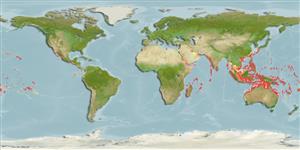
| Native range | All suitable habitat | Point map | Year 2050 |
|
| This map was computer-generated and has not yet been reviewed. |
| Canthigaster valentini AquaMaps Data sources: GBIF OBIS |
Ladda upp din foton och Videor
Bilder | Videor | Google image Canthigaster valentini
Bild av Wilkie, M.
Bilder | Videor | Google image
Bild av Wilkie, M.
Klassificering / Namn Populärnamn | synonymer | Catalog of Fishes(Släkte, Arter) | ITIS | CoL | WoRMS | Cloffa
> Tetraodontiformes (Puffers and filefishes) > Tetraodontidae (Puffers) > Canthigasterinae
Etymology: Canthigaster: Greek, kanthos = the outer or inner corner of the eye, where the lids meet, 1646 + Greek, gaster = stomach (Ref. 45335).
Eponymy: François Valentijn (1666–1727) was a Dutch minister and naturalist who spent some time in the Dutch East Indies. [...] (Ref. 128868), visit book page.
More on author: Bleeker.
Etymology: Canthigaster: Greek, kanthos = the outer or inner corner of the eye, where the lids meet, 1646 + Greek, gaster = stomach (Ref. 45335).
Eponymy: François Valentijn (1666–1727) was a Dutch minister and naturalist who spent some time in the Dutch East Indies. [...] (Ref. 128868), visit book page.
More on author: Bleeker.
Miljö: miljö / Klimatzon / djupintervall / distributionsområde Ekologi
marina revassocierade; ej vandrande (Ref. 52884); djupintervall 1 - 55 m (Ref. 1602). Tropical; 32°N - 32°S
Utbredning Territorier | FAO områden | Ekosystem | Förekomster | Prickkarta | Utplanteringar | Faunafri
Indo-Pacific: Red Sea south to Durban, South Africa (Ref. 4919) and east to the Tuamoto Islands, north to southern Japan, south to Lord Howe Island.
Längd vid första mognad / Storlek / Vikt / Ålder
Kort beskrivning Bestämningsnycklar | Morfologi | Morfometri
Taggstrålar i ryggfenan (totalt) : 0; Mjukstrålar i ryggfenan (totalt) : 9; Taggstrålar i analfenan: 0; Mjukstrålar i analfenan: 9. Side with two prominent dark bars extending to belly (Ref. 559).
Body shape (shape guide): short and / or deep.
Body shape (shape guide): short and / or deep.
Adults are found among coral heads and rocks of subtidal lagoon and seaward reefs (Ref. 4919, 5503). Common on coastal reefs at various depths. They mimic filefish, males are territorial and are often seen fighting (Ref. 48637). Food consists primarily of filamentous green and red algae, tunicates, and on smaller amounts of corals, bryozoans, polychaetes, echinoderms, mollusks, and brown and coralline red algae. They form shoals (10-100 or more) often with the filefish, Paraluteres prionurus (about 5% of shoal) mimicking C. valentini to protect it from predators (Ref. 4919, 5503). Territorial and haremic; males spawn with a different female each day (Ref. 9710). One or more territories are occupied and defended each by a female where a single large male stands guard (Ref. 55082). All sexually mature females are territorial females (Ref. 55082). Demersal spawner (Ref. 35298).
Livscykel och parningsbeteende Könsmognad | Reproduktion | Lek | Ägg | Fekunditet | Larver
Oviparous (Ref. 205). Social and mating systems of this species are based upon female territoriality where polygyny results from males defending females occupying a certain territory (female-defense polygyny) (Ref. 55082). All sexually mature females are territorial females (Ref. 55082). Neither parent guards the eggs which are laid in a nest located in the female's territory (Ref. 46142).
During breeding, territorial females perform the 'caudal flexing with swollen abdomen display' to signal courtship and readiness to spawn. The male acknowledges with no courtship or color displays but rather by visiting the sites frequently. The territorial female then begins pecking at the substrate in preparation for egg laying. The female initiates the spawning event by pressing her abdomen into the prepared site. The territorial male quickly lays his body across her caudal peduncle and both remained in this position for 5-10 sec. The male swims away after leaving the female beating her anal fin rapidly over the nest site to ensure fertilization of the eggs and to push the eggs deep into the algal substrate (Ref. 46142). All territorial males spawn with territorial females, depriving the bachelor males of the chance to copulate which nevertheless don't interfere with the spawning between the territorial male and females (Ref. 46142).
Huvudreferens
Ladda upp dina referenser | referenser | Koordinator : Matsuura, Keiichi | Medarbetare
Myers, R.F., 1991. Micronesian reef fishes. Second Ed. Coral Graphics, Barrigada, Guam. 298 p. (Ref. 1602)
Status på IUCN:s rödlista (Ref. 130435: Version 2025-2 (Global))
Least Concern (LC) ; Date assessed: 08 June 2011
CITES
Not Evaluated
Hot mot människor
Poisonous to eat (Ref. 4919)
Mänskliga användningsområden
Fiskeri: kommersiell; Akvarium: Kommersiell
FAO - Publication: search | FishSource |
Ytterligare information
Populationsdynamik
Tillväxtparametrar
Max. åldrar / storlekar
Längd-vikt rel.
Längd-längd rel.
Längd-frekvenser
Massakonvertering
Rekrytering
Abundans
Tillväxtparametrar
Max. åldrar / storlekar
Längd-vikt rel.
Längd-längd rel.
Längd-frekvenser
Massakonvertering
Rekrytering
Abundans
Livscykel
Reproduktion
Könsmognad
Mognad/Gills rel.
Fekunditet
Lek
Lekande aggregat
Ägg
Utveckling av ägg
Larver
Larvdynamik
Reproduktion
Könsmognad
Mognad/Gills rel.
Fekunditet
Lek
Lekande aggregat
Ägg
Utveckling av ägg
Larver
Larvdynamik
Fysiologi
Kroppssammansättning
Näringsämnen
Syreförbrukning
Typ av simning
Simhastighet
Visuella pigment
Ljud från fisk
Sjukdomar & Parasiter
Toxicitet (LC50)
Kroppssammansättning
Näringsämnen
Syreförbrukning
Typ av simning
Simhastighet
Visuella pigment
Ljud från fisk
Sjukdomar & Parasiter
Toxicitet (LC50)
Genetik
Genom
Genetik
Heterozygositet
Ärftlighet
Genetisk mångfald
Genom
Genetik
Heterozygositet
Ärftlighet
Genetisk mångfald
Människorelaterad
Vattenbrukssystem
Vattenbruksprofiler
Avelslinjer
Ciguatera-fall
Frimärken, mynt, diverse.
Vattenbrukssystem
Vattenbruksprofiler
Avelslinjer
Ciguatera-fall
Frimärken, mynt, diverse.
Verktyg
Organisk frågesport | E-bok | Fälthandbok | Längdfördelnings-verktyg | Livshistorie-verktyg | Prickkarta |
Fångst-MSY |
Särskilda rapporter
Kontrollera för underhåll av akvarium | Kontrollera om det finns faktablad om arter | Kontrollera om det finns faktablad om vattenbruk
Ladda ner XML
Internet-källor
AFORO (otoliths) | Aquatic Commons | BHL | Cloffa | Websites from users | Check FishWatcher | CISTI | Catalog of Fishes: Släkte, Arter | DiscoverLife | DORIS | ECOTOX | FAO - Publication: search | Faunafri | Fishipedia | Fishtrace | GloBI | Google Books | Google Scholar | Google | IGFA World Record | Nationella databaser | OneZoom | Open Tree of Life | Otolith Atlas of Taiwan Fishes | Offentliga akvarier | PubMed | Reef Life Survey | Socotra Atlas | TreeBase | Tree of Life | Wikipedia: Go, sök | | Zoologiskt register
Uppskattningar baserade på modeller
|
Index för fylogenetisk mångfald (Ref. 82804) |
PD50 = 0.5000 [Uniqueness, from 0.5 = low to 2.0 = high]. |
| Bayesian length-weight | a=0.03388 (0.01919 - 0.05984), b=2.85 (2.69 - 3.01), in cm total length, based on LWR estimates for this species & Genus-body shape (Ref. 93245). |
|
Trofisk nivå (Ref. 69278) |
2.8 ±0.30 se; based on food items. |
|
Resiliens (Ref. 120179) |
Mellan, lägsta populationsfördubblingstid 1,4-4,4 år (Fecundity = 400). |
|
Sårbarhet i fisket (Ref. 59153) |
Low vulnerability (10 of 100). 🛈 |
|
Priskategori (Ref. 80766) |
Very high. |
|
Näringsämnen (Ref. 124155) |
Calcium = 113 [51, 272] mg/100g; Iron = 1.05 [0.51, 2.51] mg/100g; Protein = 17.9 [15.7, 20.1] %; Omega3 = 0.13 [0.06, 0.26] g/100g; Selenium = 39.9 [18.9, 91.4] μg/100g; VitaminA = 47.6 [12.6, 189.6] μg/100g; Zinc = 1.85 [1.19, 2.80] mg/100g (wet weight); |