



Canthigaster valentini (Bleeker, 1853)
Valentin's sharpnose puffer
個人による観察記録の追加 Fish Watcher
| Native range | All suitable habitat | Point map | Year 2050 |
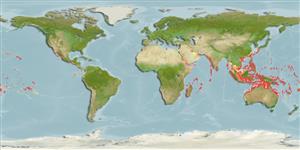
|
| This map was computer-generated and has not yet been reviewed. |
| Canthigaster valentini AquaMaps Data sources: GBIF OBIS |

分類 / 名前 共通名の | 類義語 | Catalog of Fishes(部類, 種) | ITIS | CoL | WoRMS | Cloffa
> Tetraodontiformes (Puffers and filefishes) > Tetraodontidae (Puffers) > Canthigasterinae
Etymology: Canthigaster: Greek, kanthos = the outer or inner corner of the eye, where the lids meet, 1646 + Greek, gaster = stomach (Ref. 45335).
Eponymy: François Valentijn (1666–1727) was a Dutch minister and naturalist who spent some time in the Dutch East Indies. [...] (Ref. 128868), visit book page.
More on author: Bleeker.
Etymology: Canthigaster: Greek, kanthos = the outer or inner corner of the eye, where the lids meet, 1646 + Greek, gaster = stomach (Ref. 45335).
Eponymy: François Valentijn (1666–1727) was a Dutch minister and naturalist who spent some time in the Dutch East Indies. [...] (Ref. 128868), visit book page.
More on author: Bleeker.
環境:環境 / 気候帯 / 深さの範囲 / 分布範囲 生態学
分布 領土 | 国連食糧農業機関の区域 | エコシステム | 事件 | 目的のマップ | 導入 | Faunafri
Indo-Pacific: Red Sea south to Durban, South Africa (Ref. 4919) and east to the Tuamoto Islands, north to southern Japan, south to Lord Howe Island.
初回成熟時の長さ / サイズ / 重さ / 年齢
簡単な記述 検索表 | 形態学 | 形態計測学
背面の脊椎 (合計) : 0; 背鰭 (合計) : 9; 肛門の骨: 0; 臀鰭: 9. Side with two prominent dark bars extending to belly (Ref. 559).
Body shape (shape guide): short and / or deep.
Body shape (shape guide): short and / or deep.
Adults are found among coral heads and rocks of subtidal lagoon and seaward reefs (Ref. 4919, 5503). Common on coastal reefs at various depths. They mimic filefish, males are territorial and are often seen fighting (Ref. 48637). Food consists primarily of filamentous green and red algae, tunicates, and on smaller amounts of corals, bryozoans, polychaetes, echinoderms, mollusks, and brown and coralline red algae. They form shoals (10-100 or more) often with the filefish, Paraluteres prionurus (about 5% of shoal) mimicking C. valentini to protect it from predators (Ref. 4919, 5503). Territorial and haremic; males spawn with a different female each day (Ref. 9710). One or more territories are occupied and defended each by a female where a single large male stands guard (Ref. 55082). All sexually mature females are territorial females (Ref. 55082). Demersal spawner (Ref. 35298).
ライフサイクルと交尾行動 成熟 | 繁殖 | 放精 | 卵 | 生産力 | 幼生
Oviparous (Ref. 205). Social and mating systems of this species are based upon female territoriality where polygyny results from males defending females occupying a certain territory (female-defense polygyny) (Ref. 55082). All sexually mature females are territorial females (Ref. 55082). Neither parent guards the eggs which are laid in a nest located in the female's territory (Ref. 46142).
During breeding, territorial females perform the 'caudal flexing with swollen abdomen display' to signal courtship and readiness to spawn. The male acknowledges with no courtship or color displays but rather by visiting the sites frequently. The territorial female then begins pecking at the substrate in preparation for egg laying. The female initiates the spawning event by pressing her abdomen into the prepared site. The territorial male quickly lays his body across her caudal peduncle and both remained in this position for 5-10 sec. The male swims away after leaving the female beating her anal fin rapidly over the nest site to ensure fertilization of the eggs and to push the eggs deep into the algal substrate (Ref. 46142). All territorial males spawn with territorial females, depriving the bachelor males of the chance to copulate which nevertheless don't interfere with the spawning between the territorial male and females (Ref. 46142).
主な参考文献
参考文献のアップロード | 参考文献 | コーディネーター : Matsuura, Keiichi | 協力者
Myers, R.F., 1991. Micronesian reef fishes. Second Ed. Coral Graphics, Barrigada, Guam. 298 p. (Ref. 1602)
CITES
Not Evaluated
人間に対する脅威
Poisonous to eat (Ref. 4919)
人間の用途
水産業: 商業; 水族館・水槽: 商業
FAO - Publication: search | FishSource |
より多くの情報
生理学
体組成
栄養素
酸素消費
水泳タイプ
泳ぐ速さ
視覚色素
フィッシュ・サウンド
病気と寄生虫
毒性(LC50)
体組成
栄養素
酸素消費
水泳タイプ
泳ぐ速さ
視覚色素
フィッシュ・サウンド
病気と寄生虫
毒性(LC50)
遺伝子の
ゲノム
遺伝子の
ヘテロ接合性
遺伝
遺伝的多様性
ゲノム
遺伝子の
ヘテロ接合性
遺伝
遺伝的多様性
用具
オーガニック・クイズ | 電子書籍 | 野外観察図鑑 | 長さ-周波数ウィザード | 生活史の基盤ツール | 目的のマップ |
キャッチ-MSY |
特記事項
XMLをダウンロードして下さい
インターネットの情報源
AFORO (otoliths) | Aquatic Commons | BHL | Cloffa | Websites from users | Check FishWatcher | CISTI | Catalog of Fishes: 部類, 種 | DiscoverLife | DORIS | ECOTOX | FAO - Publication: search | Faunafri | Fishipedia | Fishtrace | GloBI | Google Books | Google Scholar | Google | IGFA World Record | 国のデーターベース | OneZoom | Open Tree of Life | Otolith Atlas of Taiwan Fishes | 公共の水族館 | PubMed | Reef Life Survey | Socotra Atlas | TreeBase | 生命の木 | Wikipedia: 行く, 検索する | World Records Freshwater Fishing | 動物に関する記録
モデルに基づく推定値
好ましい温度 (参照 123201): 24.6 - 28.9, mean 27.6 °C (based on 846 cells).
系統多様性指数 (参照 82804): PD50 = 0.5000 [Uniqueness, from 0.5 = low to 2.0 = high].
Bayesian length-weight: a=0.03311 (0.01875 - 0.05847), b=2.84 (2.68 - 3.00), in cm total length, based on LWR estimates for this species & Genus-body shape (Ref. 93245).
栄養段階 (参照 69278): 2.8 ±0.30 se; based on food items.
回復力 (参照 120179): 手段, 1.4年~4.4年の倍増期間の最小個体群 (Fecundity = 400).
栄養素 (Ref. 124155): Calcium = 113 [51, 272] mg/100g; Iron = 1.05 [0.51, 2.51] mg/100g; Protein = 17.9 [15.7, 20.1] %; Omega3 = 0.13 [0.06, 0.26] g/100g; Selenium = 39.9 [18.9, 91.4] μg/100g; VitaminA = 47.6 [12.6, 189.6] μg/100g; Zinc = 1.85 [1.19, 2.80] mg/100g (wet weight);