



Parupeneus barberinus (Lacepède, 1801)
Dotdash goatfish
Adicionar sua observação em Fish Watcher
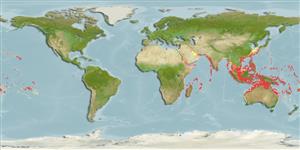
| Native range | All suitable habitat | Point map | Year 2050 |
|
| This map was computer-generated and has not yet been reviewed. |
| Parupeneus barberinus AquaMaps Data sources: GBIF OBIS |
Carregue seu(sua) Fotos e vídeos
Fotos | vídeos | Imagem do Google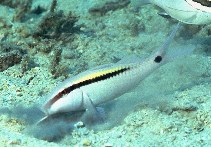 Parupeneus barberinus
Foto de Cook, D.C.
Fotos | vídeos | Imagem do Google
Foto de Cook, D.C.
Classificação / Nomes Nomes comuns | Sinônimos | Catalog of Fishes(Gênero, Espécies) | ITIS | CoL | WoRMS | Cloffa
> Mulliformes (Goatfishes) > Mullidae (Goatfishes)
Etymology: Parupeneus: Latin, parum, parvum = small + Peneus, the name of a river.
More on author: Lacepède.
Etymology: Parupeneus: Latin, parum, parvum = small + Peneus, the name of a river.
More on author: Lacepède.
Taxonomic Remarks
FishBase common name changed from Dash-and-dot goatfish to Dotdash goatfish (Uiblein et al., 2024: Ref. 130857).
Meio ambiente: milieu / Zona climática / intervalo de profundidade / faixa de distribuição Ecologia
marinhas associadas(os) a recifes; intervalo de profundidade 0 - 100 m (Ref. 90102). Tropical; 34°N - 34°S, 22°E - 134°W
Distribuição Territórios | Áreas da FAO | Ecossistemas | Ocorrências | Mapa de pontos | Introduções | Faunafri
Indo-Pacific: Gulf of Aden and Oman, south on the east coast of Africa to Mossel Bay, South Africa, east to the islands of Micronesia, Line Islands, Marquesas Islands, and Tuamotu Archipelago; and from southern Japan to Australia and New Caledonia.
Comprimento de primeira maturação / Tamanho / Peso / Idade
Maturidade: Lm 19.2, range 13 - ? cm
Max length : 60.0 cm TL macho/indeterminado; (Ref. 9710); common length : 30.0 cm TL macho/indeterminado; (Ref. 30573)
Max length : 60.0 cm TL macho/indeterminado; (Ref. 9710); common length : 30.0 cm TL macho/indeterminado; (Ref. 30573)
Descrição suscinta Chaves de identificação | Morfologia | Morfometria
Espinhos dorsais (total) : 8; Raios dorsais (total) : 9; Espinhos anais: 1; Raios anais : 7. This species is distinguished by the following characters: pectoral rays 16-18 (usually 17); gill rakers 6-7 + 20-25 = 26-31; body moderately elongate, depth 3.3-3.7 in SL; head length (HL) 2.6-3.0 in SL; snout length 1.45-2.1 in HL (relatively longer with growth); barbel length 1.4-1.6 in HL; longest dorsal spine 1.15-1.75 in HL (longer with growth); penultimate dorsal soft ray about equal to last ray in young, 1.2 in last ray in large adults; pectoral fins 1.5-1.75 in HL; pelvic fins 1.35-1.6 in HL. Colour of body whitish with a dark brown to black stripe (red on fish in deeper water) from upper lip through eye to below posterior part of second dorsal fin or anteriorly on upper caudal peduncle; body above stripe yellow or yellowish gray; body below whitish, scale edges narrowly gray to brownish red; a black or red spot larger than eye at the midbase of caudal fin; some large adults with centers of scales below dark stripe pale blue, the edges yellow or with yellow spots, especially posteriorly; peritoneum dark brown (Ref. 54393).
Body shape (shape guide): fusiform / normal; Cross section: oval.
Body shape (shape guide): fusiform / normal; Cross section: oval.
One of the most abundant species of Parupeneus (Ref. 37816). Adults, solitary or in small groups inhabit large sand patches as well as sand and rubble areas of reef flats, and lagoon and seaward reefs to a depth of about 100 m. Juveniles usually in small groups, often mixed with other species in sparse seagrass habitats (Ref. 48636). Adults forage on sand-dwelling invertebrates like polychaete worms and crustaceans. Feeding is diurnal; from 19 adult specimens for food-habit study, the prey in order by volume in the stomachs: crabs (portunid, anomuran, xanthid, and raninid), worms (mainly polychaetes but also sipunculids and unidentified), small bivalve molluscs, brachiopods, shrimps, small gastropods, isopods, amphipods, foraminifera, and a small unidentified eel (Ref. 54393). Individuals from Palau and eastern Carolines often have a yellow band immediately above the broad black band extending behind the eye (Ref. 37816). Minimum depth reported taken from Ref. 128797.
Ciclo de vida ou comportamento de acasalamento Maturidade | Reprodução | Desova | Ovos | Fecundidade | Larvas
Mature individuals migrate shoreward to spawn and feed (Ref. 7002). Some immature Individuals with size ranging from 16.1 to 22.5 cm FL from this study are bisexual, however, this species is classified as a functional gonochore (Ref. 125700).
Referência principal
Carregar suas referências | Referências | Coordenador : Randall, John E. | Colaboradores
Randall, J.E., 2004. Revision of the goatfish genus Parupeneus (Perciformes: Mullidae), with descriptions of two new species. Indo-Pac. Fish. (36):64 p. (Ref. 54393)
Status na Lista Vermelha da UICN (Ref. 130435: Version 2025-2 (Global))
Segura ou pouco preocupante (LC) ; Date assessed: 11 March 2015
CITES
Not Evaluated
Ameaça para os humanos
Harmless
Uso pelos humanos
Pescarias: espécies comerciais; peixe esportivo: sim; Aquário: Espécies comerciais
FAO - Publication: search | FishSource | Sea Around Us
Mais informação
Ecologia Trófica
Itens alimentares (presas)
Composição da dieta
Consumo alimentar
Rações alimentares
Predadores
Itens alimentares (presas)
Composição da dieta
Consumo alimentar
Rações alimentares
Predadores
Dinâmica populacional
Parâmetros de crescimento
Idade máxima / tamanhos
Relação comprimento-peso.
Relação comprimento-comprimento.
Frequências de comprimento
Conversão de massa
Recrutamento
Abundância
Parâmetros de crescimento
Idade máxima / tamanhos
Relação comprimento-peso.
Relação comprimento-comprimento.
Frequências de comprimento
Conversão de massa
Recrutamento
Abundância
Ciclo de vida
Reprodução
Maturidade
Maturidade/Rel. das guelras
Fecundidade
Desova
Agregações de desova
Ovos
Desenvolvimento dos ovos
Larvas
Dinâmica larval
Reprodução
Maturidade
Maturidade/Rel. das guelras
Fecundidade
Desova
Agregações de desova
Ovos
Desenvolvimento dos ovos
Larvas
Dinâmica larval
Fisiologia
Composição corporal
Nutrientes
Consumo de oxigênio
Tipo de natação
Velocidade de natação
Pigmentos visuais
Som de peixe
Doenças e Parasitas
Toxicidade (LC50s)
Composição corporal
Nutrientes
Consumo de oxigênio
Tipo de natação
Velocidade de natação
Pigmentos visuais
Som de peixe
Doenças e Parasitas
Toxicidade (LC50s)
Genética
genoma
Genética
Heterozigosidade
Hereditariedade
Diversidade genética
genoma
Genética
Heterozigosidade
Hereditariedade
Diversidade genética
Relacionado a humanos
Sistemas de aquicultura
Perfis para aquacultura
Estirpes
Casos de Ciguatera
Selos, moedas, diversos.
Sistemas de aquicultura
Perfis para aquacultura
Estirpes
Casos de Ciguatera
Selos, moedas, diversos.
Ferramentas
Questionário orgânico | Livro eletrônico | Guia de campo | Chaves de identificação | Ferramenta auxiliar de frequências de comprimento | Ferramenta sobre a história de vida | Mapa de pontos |
Catch-MSY |
Relatórios especiais
Checar Manutenção em Aquário | Checar Planilhas de Fatos sobre as Espécies | Checar Planilhas de Fatos sobre Aquicultura
Baixar XML
Fontes da internet
AFORO (otoliths) | Aquatic Commons | BHL | Cloffa | Websites from users | Checar Observador de Peixes (FishWatcher) | CISTI | Catalog of Fishes: Gênero, Espécies | DiscoverLife | ECOTOX | FAO - Publication: search | Faunafri | Fishipedia | Fishtrace | GloBI | Google Books | Google Scholar | Google | IGFA World Record | Bases de dados nacionais | OneZoom | Open Tree of Life | Otolith Atlas of Taiwan Fishes | PubMed | Reef Life Survey | Socotra Atlas | TreeBase | Árvore da vida | Wikipedia: Ir para, procura | World Records Freshwater Fishing | Registro zoológico
Estimativas baseadas em modelos
Temperatura preferida (Ref. 123201): 24.6 - 29, mean 27.9 °C (based on 1480 cells).
Índice de diversidade filogenética (Ref. 82804): PD50 = 0.5000 [Uniqueness, from 0.5 = low to 2.0 = high].
Bayesian length-weight: a=0.01122 (0.00912 - 0.01380), b=3.09 (3.06 - 3.12), in cm total length, based on LWR estimates for this species (Ref. 93245).
Nível Trófico (Ref. 69278): 3.4 ±0.38 se; based on food items.
Generation time: 5.3 ( na - na) years. Estimated as median ln(3)/K based on 2 growth studies.
Resiliência (Ref. 120179): médio(a), tempo mínimo de duplicação da população 1,4 - 4,4 anos (K=0.21-1.2;).
Nutrientes (Ref. 124155): Calcium = 22 [12, 48] mg/100g; Iron = 0.268 [0.136, 0.587] mg/100g; Protein = 17.8 [14.5, 20.9] %; Omega3 = 0.114 [0.066, 0.208] g/100g; Selenium = 66.7 [33.1, 142.6] μg/100g; VitaminA = 158 [31, 651] μg/100g; Zinc = 0.487 [0.293, 0.925] mg/100g (wet weight); based on nutrient studies.