



Parupeneus barberinus (Lacepède, 1801)
Dotdash goatfish
Ajouter votre observation dans Fish Watcher
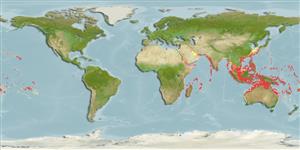
| Native range | All suitable habitat | Point map | Year 2050 |
|
| This map was computer-generated and has not yet been reviewed. |
| Parupeneus barberinus AquaMaps Data sources: GBIF OBIS |
Envoyez vos Photos et vidéos
Images | vidéos | Images Google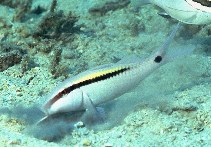 Parupeneus barberinus
Photo de Cook, D.C.
Images | vidéos | Images Google
Photo de Cook, D.C.
Classification / Noms Noms communs | Synonymes | Catalog of Fishes(Genre, Espèce) | ITIS | CoL | WoRMS | Cloffa
> Mulliformes (Goatfishes) > Mullidae (Goatfishes)
Etymology: Parupeneus: Latin, parum, parvum = small + Peneus, the name of a river.
More on author: Lacepède.
Etymology: Parupeneus: Latin, parum, parvum = small + Peneus, the name of a river.
More on author: Lacepède.
Taxonomic Remarks
FishBase common name changed from Dash-and-dot goatfish to Dotdash goatfish (Uiblein et al., 2024: Ref. 130857).
Environnement : milieu / zone climatique / profondeur / gamme de distribution Écologie
marin récifal; profondeur 0 - 100 m (Ref. 90102). Tropical; 34°N - 34°S, 22°E - 134°W
Distribution Territoires | Zones FAO | Écosystèmes | Occurrences | Carte par point | Introductions | Faunafri
Indo-Pacific: Gulf of Aden and Oman, south on the east coast of Africa to Mossel Bay, South Africa, east to the islands of Micronesia, Line Islands, Marquesas Islands, and Tuamotu Archipelago; and from southern Japan to Australia and New Caledonia.
Longueur à la première maturité / Taille / Poids / Âge
Maturité: Lm 19.2, range 13 - ? cm
Max length : 60.0 cm TL mâle / non sexé; (Ref. 9710); common length : 30.0 cm TL mâle / non sexé; (Ref. 30573)
Max length : 60.0 cm TL mâle / non sexé; (Ref. 9710); common length : 30.0 cm TL mâle / non sexé; (Ref. 30573)
Description synthétique Clés d'identification | Morphologie | Morphométrie
Épines dorsales (Total) : 8; Rayons mous dorsaux (Total) : 9; Épines anales: 1; Rayons mous anaux: 7. This species is distinguished by the following characters: pectoral rays 16-18 (usually 17); gill rakers 6-7 + 20-25 = 26-31; body moderately elongate, depth 3.3-3.7 in SL; head length (HL) 2.6-3.0 in SL; snout length 1.45-2.1 in HL (relatively longer with growth); barbel length 1.4-1.6 in HL; longest dorsal spine 1.15-1.75 in HL (longer with growth); penultimate dorsal soft ray about equal to last ray in young, 1.2 in last ray in large adults; pectoral fins 1.5-1.75 in HL; pelvic fins 1.35-1.6 in HL. Colour of body whitish with a dark brown to black stripe (red on fish in deeper water) from upper lip through eye to below posterior part of second dorsal fin or anteriorly on upper caudal peduncle; body above stripe yellow or yellowish gray; body below whitish, scale edges narrowly gray to brownish red; a black or red spot larger than eye at the midbase of caudal fin; some large adults with centers of scales below dark stripe pale blue, the edges yellow or with yellow spots, especially posteriorly; peritoneum dark brown (Ref. 54393).
Body shape (shape guide): fusiform / normal; Cross section: oval.
Body shape (shape guide): fusiform / normal; Cross section: oval.
One of the most abundant species of Parupeneus (Ref. 37816). Adults, solitary or in small groups inhabit large sand patches as well as sand and rubble areas of reef flats, and lagoon and seaward reefs to a depth of about 100 m. Juveniles usually in small groups, often mixed with other species in sparse seagrass habitats (Ref. 48636). Adults forage on sand-dwelling invertebrates like polychaete worms and crustaceans. Feeding is diurnal; from 19 adult specimens for food-habit study, the prey in order by volume in the stomachs: crabs (portunid, anomuran, xanthid, and raninid), worms (mainly polychaetes but also sipunculids and unidentified), small bivalve molluscs, brachiopods, shrimps, small gastropods, isopods, amphipods, foraminifera, and a small unidentified eel (Ref. 54393). Individuals from Palau and eastern Carolines often have a yellow band immediately above the broad black band extending behind the eye (Ref. 37816). Minimum depth reported taken from Ref. 128797.
Cycle de vie et comportement reproducteur Maturité | Reproduction | Frai | Œufs | Fécondité | Larves
Mature individuals migrate shoreward to spawn and feed (Ref. 7002). Some immature Individuals with size ranging from 16.1 to 22.5 cm FL from this study are bisexual, however, this species is classified as a functional gonochore (Ref. 125700).
Référence principale
Téléchargez vos références | Références | Coordinateur : Randall, John E. | Collaborateurs
Randall, J.E., 2004. Revision of the goatfish genus Parupeneus (Perciformes: Mullidae), with descriptions of two new species. Indo-Pac. Fish. (36):64 p. (Ref. 54393)
Statut dans la liste rouge de l'IUCN (Ref. 130435: Version 2025-2 (Global))
Préoccupation mineure (LC) ; Date assessed: 11 March 2015
CITES
Not Evaluated
Menace pour l'homme
Harmless
Utilisations par l'homme
Pêcheries: commercial; pêche sportive: oui; Aquarium: Commercial
FAO - Publication: search | FishSource | Sea Around Us
Plus d'informations
Écologie trophique
Aliments (proies)
Composition du régime alimentaire
Consommation alimentaire
Rations alimentaires
Prédateurs
Aliments (proies)
Composition du régime alimentaire
Consommation alimentaire
Rations alimentaires
Prédateurs
Dynamique des populations
Paramètres de croissance
Âges / tailles maximales
Longueur-poids rel.
Rel. longueur-longueur.
Fréquences de longueurs
Conversion de masse
Recrutement
Abondance
Paramètres de croissance
Âges / tailles maximales
Longueur-poids rel.
Rel. longueur-longueur.
Fréquences de longueurs
Conversion de masse
Recrutement
Abondance
Cycle de vie
Reproduction
Maturité
Maturité/épines rel.
Fécondité
Frai
Agrégats de frai
Œufs
Développement de l'œuf
Larves
Dynamique des populations larvaires
Reproduction
Maturité
Maturité/épines rel.
Fécondité
Frai
Agrégats de frai
Œufs
Développement de l'œuf
Larves
Dynamique des populations larvaires
Physiologie
Composition corporelle
Nutriments
Consommation d'oxygène
Type de natation
Vitesse de nage
Pigments visuels
Son de poisson
Maladies et parasites
Toxicité (CL50)
Composition corporelle
Nutriments
Consommation d'oxygène
Type de natation
Vitesse de nage
Pigments visuels
Son de poisson
Maladies et parasites
Toxicité (CL50)
Génétique
génôme
Génétique
Hétérozygotie
Héritabilité
Diversité génétique
génôme
Génétique
Hétérozygotie
Héritabilité
Diversité génétique
Liées à l'homme
Systèmes d'aquaculture
Profils d'aquaculture
Souches
Cas de ciguatera
Timbres, pièces de monnaie, divers
Systèmes d'aquaculture
Profils d'aquaculture
Souches
Cas de ciguatera
Timbres, pièces de monnaie, divers
Outils
Quiz bio | E-book | Guide de terrain | Clés d'identification | Générateur de fréquences de longueur | Outil de dynamique de population | Carte par point |
Capture-MSY |
Articles particuliers
Télécharger en XML
Sources Internet
AFORO (otoliths) | Aquatic Commons | BHL | Cloffa | Websites from users | FishWatcher | CISTI | Catalog of Fishes: Genre, Espèce | DiscoverLife | ECOTOX | FAO - Publication: search | Faunafri | Fishipedia | Fishtrace | GloBI | Google Books | Google Scholar | Google | IGFA World Record | Bases de données nationales | OneZoom | Open Tree of Life | Otolith Atlas of Taiwan Fishes | PubMed | Reef Life Survey | Socotra Atlas | TreeBase | Arbre de Vie | Wikipedia: aller à, chercher | World Records Freshwater Fishing | Zoological Record
Estimations basées sur des modèles
Température préférée (Réf. 123201): 24.6 - 29, mean 27.9 °C (based on 1480 cells).
Indice de diversité phylogénétique (Réf. 82804): PD50 = 0.5000 [Uniqueness, from 0.5 = low to 2.0 = high].
Bayesian length-weight: a=0.01122 (0.00912 - 0.01380), b=3.09 (3.06 - 3.12), in cm total length, based on LWR estimates for this species (Ref. 93245).
Niveau trophique (Réf. 69278): 3.4 ±0.38 se; based on food items.
Generation time: 5.3 ( na - na) years. Estimated as median ln(3)/K based on 2 growth studies.
Résilience (Réf. 120179): Milieu, temps minimum de doublement de population : 1,4 à 4,4 années (K=0.21-1.2;).
Nutriments (Ref. 124155): Calcium = 22 [12, 48] mg/100g; Iron = 0.268 [0.136, 0.587] mg/100g; Protein = 17.8 [14.5, 20.9] %; Omega3 = 0.114 [0.066, 0.208] g/100g; Selenium = 66.7 [33.1, 142.6] μg/100g; VitaminA = 158 [31, 651] μg/100g; Zinc = 0.487 [0.293, 0.925] mg/100g (wet weight); based on nutrient studies.