



Polypterus bichir Lacepède, 1803
Nile bichir
Carica il tuo foto e Video
Immagini | Google image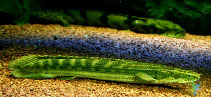 Polypterus bichir
Immagine di van Uitert, K.
Immagini | Google image
Immagine di van Uitert, K.
Classificazione / Nomi Nomi Comuni | Sinonimi | Catalog of Fishes(Genere, Specie) | ITIS | CoL | WoRMS | Cloffa
> Polypteriformes (Bichirs) > Polypteridae (Bichirs)
Etymology: Polypterus: Greek, poly = a lot of + Greek, pteron = wing, fin (Ref. 45335); bichir: Named after the local name for the fish (Ref. 43537).
More on author: Lacepède.
Etymology: Polypterus: Greek, poly = a lot of + Greek, pteron = wing, fin (Ref. 45335); bichir: Named after the local name for the fish (Ref. 43537).
More on author: Lacepède.
Ambiente: milieu / zona climatica / distribuzione batimetrica / gamma di distribuzione Ecologia
; acqua dolce demersale; potamodromo (Ref. 51243). Tropical
Distribuzione Territories | Aree FAO | Ecosistemi | Presenze | Mappa dei ritrovamenti | Introduzioni | Faunafri
Africa: The subspecies Polypterus bichir bichir is known from the Chad basin, Nile River basin and Lake Turkana (Ref. 2835, 81263). Reports from Lake Turkana and the Ouémé are questionable as unsupported by photographs or museum specimens (Ref. 122071). The subspecies Polypterus bichir lapradei is known from the rivers Senegal, Gambia, Geba, Volta and Niger (Ref. 2835, 81263).
Dimensione / Peso / Età
Maturità: Lm ? range ? - ? cm
Max length : 74.0 cm TL maschio/sesso non determinato; (Ref. 81263); peso massimo pubblicato: 2.7 kg (Ref. 367)
Max length : 74.0 cm TL maschio/sesso non determinato; (Ref. 81263); peso massimo pubblicato: 2.7 kg (Ref. 367)
Breve descrizione Chiavi di identificazione | Morfologia | Morfometria
Spine dorsali (totale) : 13 - 18; Raggi dorsali molli (totale) : 0; Spine anali: 0; Raggi anali molli: 13 - 16; Vertebre: 61 - 62. Diagnosis: Polypterus bichir is characterized by a lower jaw slightly longer than upper jaw and a pectoral fin reaching the first dorsal ray (Ref. 2835, 42908, 81263). The subspecies P. bichir bichir has 63 to 70 scales in lateral line, 14 to 18 dorsal fin rays and 11 to 13 pelvic fin rays (Ref. 367, 81263). The subspecies P. bichir lapradei has 58 to 68 scales in lateral line, 13 to 15 dorsal fin rays and 13 to 16 pelvic fin rays (Ref. 367, 81263).
Body shape (shape guide): elongated; Cross section: circular.
Body shape (shape guide): elongated; Cross section: circular.
Facultative air-breathing (Ref. 126274); Polypterus bichir bichir likes shallow water and will often lie basking fo hours near the surface, but when swimming the fish is very pliant, and can turn and twist like an eel (Ref. 4904). The eggs are deposited in weeds, where the adult fish guards the eggs and young (Ref. 36900). It feeds on bottom-feeding fish (Ref. 36900) and is essentially piscivorous (Ref. 367).
Ciclo vitale e comportamento di accoppiamento Maturità | Riproduzione | Deposizione | Uova | Fecondità | Larve
Riferimento principale
Caricare le referenze | Bibliografia | Coordinatore | Collaboratori
Gosse, J.P. and J. Daget, 2003. Polypteridae. p. 101-112. In D. Paugy, C. Lévêque and G.G Teugels (eds.) The fresh and brackish water fishes of West Africa Volume 1. Coll. faune et flore tropicales 40. Institut de recherche de développement, Paris, France, Muséum national d'histoire naturelle, Paris, France and Musée royal de l'Afrique Central, Tervuren, Belgium, 457p. (Ref. 81263)
Stato della Lista Rossa IUCN (Ref. 130435: Version 2025-2 (Global))
Least Concern (LC) ; Date assessed: 01 January 2020
CITES
Not Evaluated
Minaccia per l'uomo
Harmless
Usi umani
Pesca: commerciale
FAO - Publication: search | FishSource |
Informazioni ulteriori
Ecologia trofica
Articoli alimentari (prede)
Alimentazione
Consumo di cibo
Razioni alimentari
Predatori
Articoli alimentari (prede)
Alimentazione
Consumo di cibo
Razioni alimentari
Predatori
Dinamica della popolazione
Parametri di crescita
Età massima / dimensioni massime
Rapporto lunghezza-peso.
Lunghezza-lunghezza rel.
Lunghezza-frequenze
Conversione di massa
Reclutamento
Abbondanza
Parametri di crescita
Età massima / dimensioni massime
Rapporto lunghezza-peso.
Lunghezza-lunghezza rel.
Lunghezza-frequenze
Conversione di massa
Reclutamento
Abbondanza
Ciclo di vita
Riproduzione
Maturità
Maturità/Gli occhielli sono relativi.
Fecondità
Deposizione
Aggregazioni riproduttive
Uova
Sviluppo delle uova
Larve
Dinamica popolazioni larvali
Riproduzione
Maturità
Maturità/Gli occhielli sono relativi.
Fecondità
Deposizione
Aggregazioni riproduttive
Uova
Sviluppo delle uova
Larve
Dinamica popolazioni larvali
Anatomia
Area branchiale
Cervello
Otolite
Area branchiale
Cervello
Otolite
Fisiologia
Composizione corporea
Nutrienti
Consumo di ossigeno
Tipo di nuoto
Velocità di nuoto
Pigmenti visivi
Suono del pesce
Malattie e parassiti
Tossicità (LC50)
Composizione corporea
Nutrienti
Consumo di ossigeno
Tipo di nuoto
Velocità di nuoto
Pigmenti visivi
Suono del pesce
Malattie e parassiti
Tossicità (LC50)
Genetica
Genome
Genetica
Eterozigosi
Ereditarietà
Diversità genetica
Genome
Genetica
Eterozigosi
Ereditarietà
Diversità genetica
Legato all'uomo
Sistemi di acquacoltura
Profili di acquacoltura
Varietà
Casi di Ciguatera
Francobolli, monete, materiale vario.
Sistemi di acquacoltura
Profili di acquacoltura
Varietà
Casi di Ciguatera
Francobolli, monete, materiale vario.
Strumenti
Libro elettronico | Giuda pratica | Chiavi di identificazione | Generatore frequenze di lunghezza | Strumento Parametri Biologici | Mappa dei ritrovamenti |
Cattura-MSY |
Rapporti speciali
Controllo della manutenzione dell'acquario | Verificare la presenza di schede informative sulle specie | Verifica delle schede informative sull'acquacoltura
Scarica XML
Fonti Internet
AFORO (otoliths) | Aquatic Commons | BHL | Cloffa | Websites from users | Check FishWatcher | CISTI | Catalog of Fishes: Genere, Specie | DiscoverLife | ECOTOX | FAO - Publication: search | Faunafri | Fishipedia | Fishtrace | GloBI | Google Books | Google Scholar | Google | IGFA World Record | OneZoom | Open Tree of Life | Otolith Atlas of Taiwan Fishes | Acquari pubblici | PubMed | Reef Life Survey | Socotra Atlas | TreeBase | Tree of Life | Wikipedia: Go, ricerca | World Records Freshwater Fishing | Zoobank | Record zoologico
Stime basate su modelli
Indice di diversità filogenetica (Fonte Biblio. 82804): PD50 = 0.5003 [Uniqueness, from 0.5 = low to 2.0 = high].
Bayesian length-weight: a=0.00457 (0.00194 - 0.01077), b=3.05 (2.85 - 3.25), in cm total length, based on LWR estimates for this (Sub)family-body shape (Ref. 93245).
Livello trofico (Fonte Biblio. 69278): 4.5 ±0.80 se; based on food items.
Resilienza (Fonte Biblio. 120179): Alto, tempo minimo di raddoppiamento della popolazione meno di 15 mesi (Preliminary K or Fecundity.).