



Polypterus bichir Lacepède, 1803
Nile bichir
Envoyez vos Photos et vidéos
Images | Images Google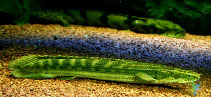 Polypterus bichir
Photo de van Uitert, K.
Images | Images Google
Photo de van Uitert, K.
Classification / Noms Noms communs | Synonymes | Catalog of Fishes(Genre, Espèce) | ITIS | CoL | WoRMS | Cloffa
> Polypteriformes (Bichirs) > Polypteridae (Bichirs)
Etymology: Polypterus: Greek, poly = a lot of + Greek, pteron = wing, fin (Ref. 45335); bichir: Named after the local name for the fish (Ref. 43537).
More on author: Lacepède.
Etymology: Polypterus: Greek, poly = a lot of + Greek, pteron = wing, fin (Ref. 45335); bichir: Named after the local name for the fish (Ref. 43537).
More on author: Lacepède.
Environnement : milieu / zone climatique / profondeur / gamme de distribution Écologie
; eau douce démersal; potamodrome (Ref. 51243). Tropical
Distribution Territoires | Zones FAO | Écosystèmes | Occurrences | Carte par point | Introductions | Faunafri
Africa: The subspecies Polypterus bichir bichir is known from the Chad basin, Nile River basin and Lake Turkana (Ref. 2835, 81263). Reports from Lake Turkana and the Ouémé are questionable as unsupported by photographs or museum specimens (Ref. 122071). The subspecies Polypterus bichir lapradei is known from the rivers Senegal, Gambia, Geba, Volta and Niger (Ref. 2835, 81263).
Taille / Poids / Âge
Maturité: Lm ? range ? - ? cm
Max length : 74.0 cm TL mâle / non sexé; (Ref. 81263); poids max. publié: 2.7 kg (Ref. 367)
Max length : 74.0 cm TL mâle / non sexé; (Ref. 81263); poids max. publié: 2.7 kg (Ref. 367)
Description synthétique Clés d'identification | Morphologie | Morphométrie
Épines dorsales (Total) : 13 - 18; Rayons mous dorsaux (Total) : 0; Épines anales: 0; Rayons mous anaux: 13 - 16; Vertèbres: 61 - 62. Diagnosis: Polypterus bichir is characterized by a lower jaw slightly longer than upper jaw and a pectoral fin reaching the first dorsal ray (Ref. 2835, 42908, 81263). The subspecies P. bichir bichir has 63 to 70 scales in lateral line, 14 to 18 dorsal fin rays and 11 to 13 pelvic fin rays (Ref. 367, 81263). The subspecies P. bichir lapradei has 58 to 68 scales in lateral line, 13 to 15 dorsal fin rays and 13 to 16 pelvic fin rays (Ref. 367, 81263).
Body shape (shape guide): elongated; Cross section: circular.
Body shape (shape guide): elongated; Cross section: circular.
Facultative air-breathing (Ref. 126274); Polypterus bichir bichir likes shallow water and will often lie basking fo hours near the surface, but when swimming the fish is very pliant, and can turn and twist like an eel (Ref. 4904). The eggs are deposited in weeds, where the adult fish guards the eggs and young (Ref. 36900). It feeds on bottom-feeding fish (Ref. 36900) and is essentially piscivorous (Ref. 367).
Cycle de vie et comportement reproducteur Maturité | Reproduction | Frai | Œufs | Fécondité | Larves
Référence principale
Téléchargez vos références | Références | Coordinateur | Collaborateurs
Gosse, J.P. and J. Daget, 2003. Polypteridae. p. 101-112. In D. Paugy, C. Lévêque and G.G Teugels (eds.) The fresh and brackish water fishes of West Africa Volume 1. Coll. faune et flore tropicales 40. Institut de recherche de développement, Paris, France, Muséum national d'histoire naturelle, Paris, France and Musée royal de l'Afrique Central, Tervuren, Belgium, 457p. (Ref. 81263)
Statut dans la liste rouge de l'IUCN (Ref. 130435: Version 2025-2 (Global))
Préoccupation mineure (LC) ; Date assessed: 01 January 2020
CITES
Not Evaluated
Menace pour l'homme
Harmless
Utilisations par l'homme
Pêcheries: commercial
FAO - Publication: search | FishSource |
Plus d'informations
Écologie trophique
Aliments (proies)
Composition du régime alimentaire
Consommation alimentaire
Rations alimentaires
Prédateurs
Aliments (proies)
Composition du régime alimentaire
Consommation alimentaire
Rations alimentaires
Prédateurs
Dynamique des populations
Paramètres de croissance
Âges / tailles maximales
Longueur-poids rel.
Rel. longueur-longueur.
Fréquences de longueurs
Conversion de masse
Recrutement
Abondance
Paramètres de croissance
Âges / tailles maximales
Longueur-poids rel.
Rel. longueur-longueur.
Fréquences de longueurs
Conversion de masse
Recrutement
Abondance
Cycle de vie
Reproduction
Maturité
Maturité/épines rel.
Fécondité
Frai
Agrégats de frai
Œufs
Développement de l'œuf
Larves
Dynamique des populations larvaires
Reproduction
Maturité
Maturité/épines rel.
Fécondité
Frai
Agrégats de frai
Œufs
Développement de l'œuf
Larves
Dynamique des populations larvaires
Anatomie
Surface branchiale
Cerveau
Otolithe
Surface branchiale
Cerveau
Otolithe
Physiologie
Composition corporelle
Nutriments
Consommation d'oxygène
Type de natation
Vitesse de nage
Pigments visuels
Son de poisson
Maladies et parasites
Toxicité (CL50)
Composition corporelle
Nutriments
Consommation d'oxygène
Type de natation
Vitesse de nage
Pigments visuels
Son de poisson
Maladies et parasites
Toxicité (CL50)
Génétique
génôme
Génétique
Hétérozygotie
Héritabilité
Diversité génétique
génôme
Génétique
Hétérozygotie
Héritabilité
Diversité génétique
Liées à l'homme
Systèmes d'aquaculture
Profils d'aquaculture
Souches
Cas de ciguatera
Timbres, pièces de monnaie, divers
Systèmes d'aquaculture
Profils d'aquaculture
Souches
Cas de ciguatera
Timbres, pièces de monnaie, divers
Outils
E-book | Guide de terrain | Clés d'identification | Générateur de fréquences de longueur | Outil de dynamique de population | Carte par point |
Capture-MSY |
Articles particuliers
Télécharger en XML
Sources Internet
AFORO (otoliths) | Aquatic Commons | BHL | Cloffa | Websites from users | FishWatcher | CISTI | Catalog of Fishes: Genre, Espèce | DiscoverLife | ECOTOX | FAO - Publication: search | Faunafri | Fishipedia | Fishtrace | GloBI | Google Books | Google Scholar | Google | IGFA World Record | OneZoom | Open Tree of Life | Otolith Atlas of Taiwan Fishes | Aquariums publics | PubMed | Reef Life Survey | Socotra Atlas | TreeBase | Arbre de Vie | Wikipedia: aller à, chercher | World Records Freshwater Fishing | Zoobank | Zoological Record
Estimations basées sur des modèles
Indice de diversité phylogénétique (Réf. 82804): PD50 = 0.5003 [Uniqueness, from 0.5 = low to 2.0 = high].
Bayesian length-weight: a=0.00457 (0.00194 - 0.01077), b=3.05 (2.85 - 3.25), in cm total length, based on LWR estimates for this (Sub)family-body shape (Ref. 93245).
Niveau trophique (Réf. 69278): 4.5 ±0.80 se; based on food items.
Résilience (Réf. 120179): Haut, temps minimum de doublement de population inférieur à 15 mois (Preliminary K or Fecundity.).