



Polypterus bichir Lacepède, 1803
Nile bichir
Hochladen Photos und videos
Bilder | Google Bild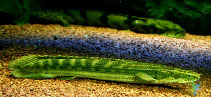 Polypterus bichir
Photo von van Uitert, K.
Bilder | Google Bild
Photo von van Uitert, K.
Klassifizierung / Names Namen | Synonyme | Catalog of Fishes(Gattung, Arten) | ITIS | CoL | WoRMS | Cloffa
> Polypteriformes (Bichirs) > Polypteridae (Bichirs)
Etymology: Polypterus: Greek, poly = a lot of + Greek, pteron = wing, fin (Ref. 45335); bichir: Named after the local name for the fish (Ref. 43537).
More on author: Lacepède.
Etymology: Polypterus: Greek, poly = a lot of + Greek, pteron = wing, fin (Ref. 45335); bichir: Named after the local name for the fish (Ref. 43537).
More on author: Lacepède.
Umwelt: Milieu / Klimazone / Tiefenbereich / Verbreitungsgebiet Ökologie
; süßwasser demersal; potamodrom (Ref. 51243). Tropical
Verbreitung Territorien | FAO Gebiete | Ökosysteme | Vorkommen | Punkt Karte | Einführungen | Faunafri
Africa: The subspecies Polypterus bichir bichir is known from the Chad basin, Nile River basin and Lake Turkana (Ref. 2835, 81263). Reports from Lake Turkana and the Ouémé are questionable as unsupported by photographs or museum specimens (Ref. 122071). The subspecies Polypterus bichir lapradei is known from the rivers Senegal, Gambia, Geba, Volta and Niger (Ref. 2835, 81263).
Größe / Gewicht / Alter
Geschlechtsreife: Lm ? range ? - ? cm
Max length : 74.0 cm TL Männchen/unbestimmt; (Ref. 81263); max. veröff. Gewicht: 2.7 kg (Ref. 367)
Max length : 74.0 cm TL Männchen/unbestimmt; (Ref. 81263); max. veröff. Gewicht: 2.7 kg (Ref. 367)
Kurzbeschreibung Bestimmungsschlüssel | Morphologie | Morphometrie
Rückenflossenstacheln (insgesamt) : 13 - 18; Rückenflossenweichstrahlen (insgesamt) : 0; Afterflossenstacheln: 0; Afterflossenweichstrahlen: 13 - 16; Wirbelzahl: 61 - 62. Diagnosis: Polypterus bichir is characterized by a lower jaw slightly longer than upper jaw and a pectoral fin reaching the first dorsal ray (Ref. 2835, 42908, 81263). The subspecies P. bichir bichir has 63 to 70 scales in lateral line, 14 to 18 dorsal fin rays and 11 to 13 pelvic fin rays (Ref. 367, 81263). The subspecies P. bichir lapradei has 58 to 68 scales in lateral line, 13 to 15 dorsal fin rays and 13 to 16 pelvic fin rays (Ref. 367, 81263).
Body shape (shape guide): elongated; Cross section: circular.
Body shape (shape guide): elongated; Cross section: circular.
Facultative air-breathing (Ref. 126274); Polypterus bichir bichir likes shallow water and will often lie basking fo hours near the surface, but when swimming the fish is very pliant, and can turn and twist like an eel (Ref. 4904). The eggs are deposited in weeds, where the adult fish guards the eggs and young (Ref. 36900). It feeds on bottom-feeding fish (Ref. 36900) and is essentially piscivorous (Ref. 367).
Lebenszyklus und Paarungsverhalten Geschlechtsreife | Fortpflanzung | Ablaichen | Eier | Fruchtbarkeit | Larven
Hauptreferenz
Laden Sie Ihre Referenzen hoch | Referenzen | Koordinator | Partner
Gosse, J.P. and J. Daget, 2003. Polypteridae. p. 101-112. In D. Paugy, C. Lévêque and G.G Teugels (eds.) The fresh and brackish water fishes of West Africa Volume 1. Coll. faune et flore tropicales 40. Institut de recherche de développement, Paris, France, Muséum national d'histoire naturelle, Paris, France and Musée royal de l'Afrique Central, Tervuren, Belgium, 457p. (Ref. 81263)
IUCN Rote Liste Status (Ref. 130435: Version 2025-2 (Global))
nicht bedroht (LC) ; Date assessed: 01 January 2020
CITES
Not Evaluated
Bedrohung für Menschen
Harmless
Nutzung durch Menschen
Fischereien: kommerziell
FAO - Publication: search | FishSource |
Mehr Information
Trophische Ökologie
Lebensmittel (Beutetiere)
Nahrungszusammensetzung
Nahrungsaufnahme
Lebensmittelrationen
Räuber
Lebensmittel (Beutetiere)
Nahrungszusammensetzung
Nahrungsaufnahme
Lebensmittelrationen
Räuber
Populationsdynamik
Wachstumsparameter
Max. Alter/Größen
Länge-Gewicht-Rel.
Länge-Länge-Verhältnis.
Längenhäufigkeiten
Massenkonvertierung
Rekrutierung
Dichte
Wachstumsparameter
Max. Alter/Größen
Länge-Gewicht-Rel.
Länge-Länge-Verhältnis.
Längenhäufigkeiten
Massenkonvertierung
Rekrutierung
Dichte
Lebenszyklus
Fortpflanzung
Geschlechtsreife
Reifung/Kiemen rel.
Fruchtbarkeit
Ablaichen
Laichaggregationen
Eier
Eientwicklung
Larven
Larven Pop.Dyn.
Fortpflanzung
Geschlechtsreife
Reifung/Kiemen rel.
Fruchtbarkeit
Ablaichen
Laichaggregationen
Eier
Eientwicklung
Larven
Larven Pop.Dyn.
Anatomie
Kiemenoberfläche
Gehirn
Otolith
Kiemenoberfläche
Gehirn
Otolith
Physiologie
Körperliche Zusammensetzung
Nährstoffe
Sauerstoffverbrauch
Schwimmart
Schwimmgeschwindigkeit
Visuelle Pigmente
Fischgeräusche
Krankheiten und Parasiten
Toxizität (LC50s)
Körperliche Zusammensetzung
Nährstoffe
Sauerstoffverbrauch
Schwimmart
Schwimmgeschwindigkeit
Visuelle Pigmente
Fischgeräusche
Krankheiten und Parasiten
Toxizität (LC50s)
Genetik
Genom
Genetik
Heterozygotie
Vererbbarkeit
Genetische Vielfalt
Genom
Genetik
Heterozygotie
Vererbbarkeit
Genetische Vielfalt
Menschenbezogen
Aquakultur-Systeme
Aquakultur Profile
Zuchtlinien
Ciguatera-Fälle
Briefmarken, Münzen, Verschiedenes.
Aquakultur-Systeme
Aquakultur Profile
Zuchtlinien
Ciguatera-Fälle
Briefmarken, Münzen, Verschiedenes.
Tools
E-Book | Feldführer | Bestimmungsschlüssel | Längenhäufigkeits Tool | Lebensdaten Tool | Punkt Karte |
Catch-MSY |
Zusatzinformationen
Download XML
Zusammenfassung | Punktdaten | Namen | Photos
Internet Quellen
AFORO (otoliths) | Aquatic Commons | BHL | Cloffa | Websites from users | FishWatcher Einträge suchen | CISTI | Catalog of Fishes: Gattung, Arten | DiscoverLife | ECOTOX | FAO - Publication: search | Faunafri | Fishipedia | Fishtrace | GloBI | Google Books | Google Scholar | Google | IGFA World Record | OneZoom | Open Tree of Life | Otolith Atlas of Taiwan Fishes | Öffentliche Aquarien | PubMed | Reef Life Survey | Socotra Atlas | TreeBase | Tree of Life | Wikipedia: Gehe zu, Suchen | World Records Freshwater Fishing | Zoobank | Zoologischer Rekord
Schätzungen auf der Grundlage von Modellen
Phylogenetischer Diversitätsindex (Ref. 82804): PD50 = 0.5003 [Uniqueness, from 0.5 = low to 2.0 = high].
Bayesian length-weight: a=0.00457 (0.00194 - 0.01077), b=3.05 (2.85 - 3.25), in cm total length, based on LWR estimates for this (Sub)family-body shape (Ref. 93245).
Trophische Ebene (Ref. 69278): 4.5 ±0.80 se; based on food items.
Widerstandsfähigkeit (Ref. 120179): hoch, Verdopplung der Population dauert weniger als 15 Monate. (Preliminary K or Fecundity.).