



Lägg till din observation i Fish Watcher
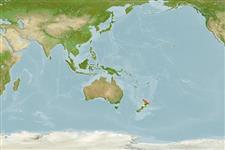
| Native range | All suitable habitat | Point map | Year 2050 |
|
| This map was computer-generated and has not yet been reviewed. |
| Pempheris adspersa AquaMaps Data sources: GBIF OBIS |
Ladda upp din foton och Videor
Bilder | Videor | Google image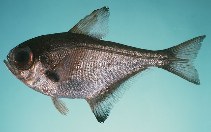 Pempheris adspersa
Bild av Randall, J.E.
Bilder | Videor | Google image
Bild av Randall, J.E.
Klassificering / Namn Populärnamn | synonymer | Catalog of Fishes(Släkte, Arter) | ITIS | CoL | WoRMS | Cloffa
> Acropomatiformes (Oceanic basses) > Pempheridae (Sweepers)
Etymology: Pempheris: Greek, pempheris = the name of a fish (Ref. 45335); adspersa: Name from Latin 'sparsus' meaning sprinkled or strewn, referring to the small pigment spots observed on preserved specimens.
Etymology: Pempheris: Greek, pempheris = the name of a fish (Ref. 45335); adspersa: Name from Latin 'sparsus' meaning sprinkled or strewn, referring to the small pigment spots observed on preserved specimens.
Miljö: miljö / Klimatzon / djupintervall / distributionsområde Ekologi
marina revassocierade; djupintervall 0 - 70 m (Ref. 88976). Temperate
Utbredning Territorier | FAO områden | Ekosystem | Förekomster | Prickkarta | Utplanteringar | Faunafri
Southwest Pacific: endemic to New Zealand.
Storlek / Vikt / Ålder
Kort beskrivning Bestämningsnycklar | Morfologi | Morfometri
Taggstrålar i ryggfenan (totalt) : 5 - 6; Mjukstrålar i ryggfenan (totalt) : 10 - 12; Taggstrålar i analfenan: 3; Mjukstrålar i analfenan: 29 - 35. This species is distinguished by the following set of characters: some interorbital scales are cycloid; usually 3 or more predorsal scales cycloid, often forming a mesial line of cycloid scales; axillary scale absent; 56-68 lateral-line scales, rarely more than 66; 18-24 scales below lateral line, rarely more than 22; 29-35 anal fin rays; ratio of preanal length to anal-fin base length 1.19-1.55; ratio of pelvic-fin origin to anal-fin origin to anal-fin base length 0.38-0.59; anterior light organ associated with pyloric caeca absent (Ref. 88976).
Body shape (shape guide): short and / or deep.
Body shape (shape guide): short and / or deep.
Nocturnal, retreats to large surge pools or channels open to the sea during the day and usually under overhangs or ledges in small schools. Juveniles occur amongst weed along rocky shores in late summer. Feeds on plankton and benthic organisms (Ref. 26966). Adult diet observed consists of amphipods (45%), mysids (20%), polychaetes (20%), isopods (7%), and crab larvae and ostracods (8%) which are taken out of the water column c. 4-5 m from the bottom. Juveniles that are less than 40 mm are diurnal feeders, mostly feeding on small copepods. Some groups were observed to enter rivers by night in summer and swim well upstream into mangrove forests to feed on crab larvae, shrimps, amphipods, and other zooplankton (Ref. 88976). The smallest identified gravid female was 8.56 cm SL and the largest 12.3 cm SL. Gravid females were found among collections made in mid November into February. These observations agree with reported observations that spawning occurs from November through February and that juveniles settle in January through April (Ref. 88976).
Livscykel och parningsbeteende Könsmognad | Reproduktion | Lek | Ägg | Fekunditet | Larver
Huvudreferens
Ladda upp dina referenser | referenser | Koordinator | Medarbetare
Paulin, C. and C. Roberts, 1992. The rockpool fishes of New Zealand (Te ika aaria o Aotearoa). Museum of New Zealand (Te Papa Tongarewa). 177 p. (Ref. 9003)
CITES
Not Evaluated
Hot mot människor
Harmless
Mänskliga användningsområden
FAO - Publication: search | FishSource |
Ytterligare information
Populationsdynamik
Tillväxtparametrar
Max. åldrar / storlekar
Längd-vikt rel.
Längd-längd rel.
Längd-frekvenser
Massakonvertering
Rekrytering
Abundans
Tillväxtparametrar
Max. åldrar / storlekar
Längd-vikt rel.
Längd-längd rel.
Längd-frekvenser
Massakonvertering
Rekrytering
Abundans
Livscykel
Reproduktion
Könsmognad
Mognad/Gills rel.
Fekunditet
Lek
Lekande aggregat
Ägg
Utveckling av ägg
Larver
Larvdynamik
Reproduktion
Könsmognad
Mognad/Gills rel.
Fekunditet
Lek
Lekande aggregat
Ägg
Utveckling av ägg
Larver
Larvdynamik
Anatomi
Gälyta
Hjärna
Otolit
Gälyta
Hjärna
Otolit
Fysiologi
Kroppssammansättning
Näringsämnen
Syreförbrukning
Typ av simning
Simhastighet
Visuella pigment
Ljud från fisk
Sjukdomar & Parasiter
Toxicitet (LC50)
Kroppssammansättning
Näringsämnen
Syreförbrukning
Typ av simning
Simhastighet
Visuella pigment
Ljud från fisk
Sjukdomar & Parasiter
Toxicitet (LC50)
Genetik
Genom
Genetik
Heterozygositet
Ärftlighet
Genetisk mångfald
Genom
Genetik
Heterozygositet
Ärftlighet
Genetisk mångfald
Människorelaterad
Vattenbrukssystem
Vattenbruksprofiler
Avelslinjer
Ciguatera-fall
Frimärken, mynt, diverse.
Vattenbrukssystem
Vattenbruksprofiler
Avelslinjer
Ciguatera-fall
Frimärken, mynt, diverse.
Verktyg
Särskilda rapporter
Kontrollera för underhåll av akvarium | Kontrollera om det finns faktablad om arter | Kontrollera om det finns faktablad om vattenbruk
Ladda ner XML
Internet-källor
AFORO (otoliths) | Aquatic Commons | BHL | Cloffa | Websites from users | Check FishWatcher | CISTI | Catalog of Fishes: Släkte, Arter | DiscoverLife | ECOTOX | FAO - Publication: search | Faunafri | Fishipedia | Fishtrace | GloBI | Google Books | Google Scholar | Google | IGFA World Record | OneZoom | Open Tree of Life | Otolith Atlas of Taiwan Fishes | PubMed | Reef Life Survey | Socotra Atlas | TreeBase | Tree of Life | Wikipedia: Go, sök | World Records Freshwater Fishing | Zoologiskt register
Uppskattningar baserade på modeller
Önskad temperatur (Ref. 123201): 16 - 18.3, mean 17.6 °C (based on 34 cells).
Index för fylogenetisk mångfald (Ref. 82804): PD50 = 0.5000 [Uniqueness, from 0.5 = low to 2.0 = high].
Bayesian length-weight: a=0.01148 (0.00639 - 0.02064), b=3.01 (2.85 - 3.17), in cm total length, based on LWR estimates for this species & Genus-body shape (Ref. 93245).
Trofisk nivå (Ref. 69278): 3.0 ±0.0 se; based on diet studies.
Generation time: 2.0 ( na - na) years. Estimated as median ln(3)/K based on 1 growth studies.
Resiliens (Ref. 120179): Hög, lägsta populationsfördubblingstid mindre än 15 månader (K=0.55).
Näringsämnen (Ref. 124155): Calcium = 27.7 [11.9, 50.7] mg/100g; Iron = 0.241 [0.131, 0.450] mg/100g; Protein = 18.6 [17.4, 19.9] %; Omega3 = 0.32 [0.17, 0.64] g/100g; Selenium = 6.83 [3.00, 16.03] μg/100g; VitaminA = 49.2 [10.5, 227.2] μg/100g; Zinc = 0.702 [0.435, 1.125] mg/100g (wet weight);