



Waarneming toevoegen in Fish Watcher
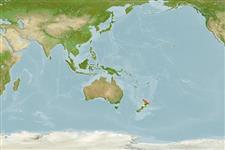
| Native range | All suitable habitat | Point map | Year 2050 |
|
| This map was computer-generated and has not yet been reviewed. |
| Pempheris adspersa AquaMaps Data sources: GBIF OBIS |
Uploaden van uw Foto's en video's
Afbeeldingen | video's | Google afbeelding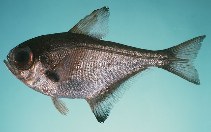 Pempheris adspersa
Afbeelding van Randall, J.E.
Afbeeldingen | video's | Google afbeelding
Afbeelding van Randall, J.E.
Classificatie / Namen Lokale namen | Synoniemen | Catalog of Fishes(Genus, Soort(en)) | ITIS | CoL | WoRMS | Cloffa
> Acropomatiformes (Oceanic basses) > Pempheridae (Sweepers)
Etymology: Pempheris: Greek, pempheris = the name of a fish (Ref. 45335); adspersa: Name from Latin 'sparsus' meaning sprinkled or strewn, referring to the small pigment spots observed on preserved specimens.
Etymology: Pempheris: Greek, pempheris = the name of a fish (Ref. 45335); adspersa: Name from Latin 'sparsus' meaning sprinkled or strewn, referring to the small pigment spots observed on preserved specimens.
Milieu: milieu / Klimaatzone / Diepte / verspreidingsgebied Ecologie
marien rifbewoner; diepte 0 - 70 m (Ref. 88976). Temperate
Verspreiding Gebieden | FAO regio's | Ecosystemen | Voorkomen | Verspreidingskaart | Introducties | Faunafri
Southwest Pacific: endemic to New Zealand.
Grootte / Gewicht / Leeftijd
Korte beschrijving Determinatiesleutels | Morfologie | Morfometrie
Dorsale stekels (totaal) : 5 - 6; Dorsale zachte stralen (totaal) : 10 - 12; Anale stekels: 3; Anale zachte stralen: 29 - 35. This species is distinguished by the following set of characters: some interorbital scales are cycloid; usually 3 or more predorsal scales cycloid, often forming a mesial line of cycloid scales; axillary scale absent; 56-68 lateral-line scales, rarely more than 66; 18-24 scales below lateral line, rarely more than 22; 29-35 anal fin rays; ratio of preanal length to anal-fin base length 1.19-1.55; ratio of pelvic-fin origin to anal-fin origin to anal-fin base length 0.38-0.59; anterior light organ associated with pyloric caeca absent (Ref. 88976).
Body shape (shape guide): short and / or deep.
Body shape (shape guide): short and / or deep.
Nocturnal, retreats to large surge pools or channels open to the sea during the day and usually under overhangs or ledges in small schools. Juveniles occur amongst weed along rocky shores in late summer. Feeds on plankton and benthic organisms (Ref. 26966). Adult diet observed consists of amphipods (45%), mysids (20%), polychaetes (20%), isopods (7%), and crab larvae and ostracods (8%) which are taken out of the water column c. 4-5 m from the bottom. Juveniles that are less than 40 mm are diurnal feeders, mostly feeding on small copepods. Some groups were observed to enter rivers by night in summer and swim well upstream into mangrove forests to feed on crab larvae, shrimps, amphipods, and other zooplankton (Ref. 88976). The smallest identified gravid female was 8.56 cm SL and the largest 12.3 cm SL. Gravid females were found among collections made in mid November into February. These observations agree with reported observations that spawning occurs from November through February and that juveniles settle in January through April (Ref. 88976).
Levenscyclus en paargedrag Maturiteit | Voortplanting | Paaien | Eieren | Fecunditeit | Larven
Hoofdreferentie
Upload uw referenties | Referenties | Coördinator | Medewerkers
Paulin, C. and C. Roberts, 1992. The rockpool fishes of New Zealand (Te ika aaria o Aotearoa). Museum of New Zealand (Te Papa Tongarewa). 177 p. (Ref. 9003)
CITES
Not Evaluated
Gevaar voor de mens
Harmless
Gebruik door de mens
FAO - Publication: search | FishSource |
Meer informatie
Trofische ecologie
Voedsel (prooien)
Dieetsamenstelling
Voedselconsumptie
Voedselrantsoenen
Predatoren
Voedsel (prooien)
Dieetsamenstelling
Voedselconsumptie
Voedselrantsoenen
Predatoren
Populatiedynamica
Groeiparameters
Max. leeftijden / maten
Lengte-gewicht rel.
Lengte-lengte rel.
Lengtefrequenties
Massaconversie
Rekrutering
Abundantie
Groeiparameters
Max. leeftijden / maten
Lengte-gewicht rel.
Lengte-lengte rel.
Lengtefrequenties
Massaconversie
Rekrutering
Abundantie
Levenscyclus
Voortplanting
Maturiteit
Rijpheid/kieuwen rel.
Fecunditeit
Paaien
Paaibestanden
Eieren
Ontwikkeling van de eieren
Larven
Larvale populatiedynamiek
Voortplanting
Maturiteit
Rijpheid/kieuwen rel.
Fecunditeit
Paaien
Paaibestanden
Eieren
Ontwikkeling van de eieren
Larven
Larvale populatiedynamiek
Anatomie
Kieuwoppervlak
Hersenen
Otoliet
Kieuwoppervlak
Hersenen
Otoliet
Fysiologie
Lichaamssamenstelling
Voedingsstoffen
Zuurstofverbruik
Type zwemmen
Zwemsnelheid
Visuele pigmenten
Vis geluid
Ziekten en parasieten
Toxiciteit (LC50)
Lichaamssamenstelling
Voedingsstoffen
Zuurstofverbruik
Type zwemmen
Zwemsnelheid
Visuele pigmenten
Vis geluid
Ziekten en parasieten
Toxiciteit (LC50)
Genetica
genoom
Genetica
Heterozygositeit
Erfelijkheid
Genetische diversiteit
genoom
Genetica
Heterozygositeit
Erfelijkheid
Genetische diversiteit
Menselijk gerelateerd
Aquacultuursystemen
Aquacultuurprofielen
Kweeklijnen
Ciguatera gevallen
Postzegels, munten, diversen.
Aquacultuursystemen
Aquacultuurprofielen
Kweeklijnen
Ciguatera gevallen
Postzegels, munten, diversen.
Tools
Speciale rapporten
Bekijk gegevens voor het houden in een aquarium | Bekijk Fact Sheets voor de soort | Bekijk Aquacultuur Fact Sheets
Download XML
Internetbronnen
AFORO (otoliths) | Aquatic Commons | BHL | Cloffa | Websites from users | Bekijk FishWatcher | CISTI | Catalog of Fishes: Genus, Soort(en) | DiscoverLife | ECOTOX | FAO - Publication: search | Faunafri | Fishipedia | Fishtrace | GloBI | Google Books | Google Scholar | Google | IGFA World Record | OneZoom | Open Tree of Life | Otolith Atlas of Taiwan Fishes | PubMed | Reef Life Survey | Socotra Atlas | TreeBase | Tree of Life | Wikipedia: ga naar, zoek | World Records Freshwater Fishing | Zoological Record
Schattingen op basis van modellen
Gewenste temperatuur (Ref. 123201): 16 - 18.3, mean 17.6 °C (based on 34 cells).
Fylogenetische diversiteitsindex (Ref. 82804): PD50 = 0.5000 [Uniqueness, from 0.5 = low to 2.0 = high].
Bayesian length-weight: a=0.01148 (0.00639 - 0.02064), b=3.01 (2.85 - 3.17), in cm total length, based on LWR estimates for this species & Genus-body shape (Ref. 93245).
Trofisch niveau (Ref. 69278): 3.0 ±0.0 se; based on diet studies.
Generation time: 2.0 ( na - na) years. Estimated as median ln(3)/K based on 1 growth studies.
Weerstandsvermogen (Ref. 120179): Hoog, minimale populatieverdubbelingstijd minder dan 15 maanden (K=0.55).
Voedingsstoffen (Ref. 124155): Calcium = 27.7 [11.9, 50.7] mg/100g; Iron = 0.241 [0.131, 0.450] mg/100g; Protein = 18.6 [17.4, 19.9] %; Omega3 = 0.32 [0.17, 0.64] g/100g; Selenium = 6.83 [3.00, 16.03] μg/100g; VitaminA = 49.2 [10.5, 227.2] μg/100g; Zinc = 0.702 [0.435, 1.125] mg/100g (wet weight);