



Leiognathus equula (Forsskål, 1775)
Common ponyfish
Uploaden van uw Foto's en video's
Afbeeldingen | Google afbeelding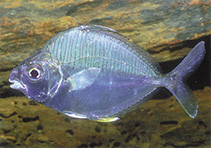 Leiognathus equula
Afbeelding van Allen, G.R.
Afbeeldingen | Google afbeelding
Afbeelding van Allen, G.R.
Classificatie / Namen Lokale namen | Synoniemen | Catalog of Fishes(Genus, Soort(en)) | ITIS | CoL | WoRMS | Cloffa
> Acanthuriformes (Surgeonfishes) > Leiognathidae (Slimys, slipmouths, or ponyfishes) > Leiognathinae
Etymology: Leiognathus: Greek, leios = smooth + Greek, gnathos = jaw (Ref. 45335).
More on author: Forsskål.
Etymology: Leiognathus: Greek, leios = smooth + Greek, gnathos = jaw (Ref. 45335).
More on author: Forsskål.
Milieu: milieu / Klimaatzone / Diepte / verspreidingsgebied Ecologie
marien; zoet water; brak water demersaal; amfidroom; diepte 10 - 110 m (Ref. 12260). Tropical; 26°C - 29°C (Ref. 4959); 30°N - 36°S, 27°E - 170°W
Verspreiding Gebieden | FAO regio's | Ecosystemen | Voorkomen | Verspreidingskaart | Introducties | Faunafri
Indo-West Pacific: Red Sea, Persian Gulf and East Africa (including Reunion, Comoros, Seychelles, Madagascar and Mauritius) to Fiji, north to the Ryukyu Islands, south to Australia.
Lengte bij maturiteit / Grootte / Gewicht / Leeftijd
Maturiteit: Lm 10.7 range ? - ? cm
Max length : 28.0 cm TL mannelijk / geslacht onbekend; (Ref. 9710); common length : 18.0 cm TL mannelijk / geslacht onbekend; (Ref. 47581)
Max length : 28.0 cm TL mannelijk / geslacht onbekend; (Ref. 9710); common length : 18.0 cm TL mannelijk / geslacht onbekend; (Ref. 47581)
Korte beschrijving Determinatiesleutels | Morfologie | Morfometrie
Dorsale stekels (totaal) : 8; Dorsale zachte stralen (totaal) : 15 - 16; Anale stekels: 3; Anale zachte stralen: 14 - 15. This species is distinguished by the following characters: body very deep, compressed, with a strongly humped back; body depth 1.7-1.9 times in standard length; mouth pointing downward when protracted; gill rakers short and fleshy, less than 1/2 length of corresponding gill lamellae, total gill rakers on first gill arch 18-22; head and breast scaleless; tubed scales on lateral line 61-66. Colour of adults, back greyish, belly silvery and many parallel close-set faint bars on back; usually a dark brown saddle on caudal peduncle; axil of pectoral fins grey to black; margin of soft dorsal fin black; both caudal-fin lobes with broad dusky margins; pectoral, pelvic, and anal fins colourless to yellowish. In juveniles (5-7 cm TL), thin, closely arranged, grey vertical lines descending from back to about midheight; membrane between anal-fin spines conspicuously yellow; posterior margin of caudal-fin lobes pale yellow and dusky; other fins hyaline; snout dotted black (Ref. 47581).
Body shape (shape guide): short and / or deep; Cross section: compressed.
Body shape (shape guide): short and / or deep; Cross section: compressed.
Found in river mouths and muddy inshore areas (Ref. 2847, 37816), often in mangrove areas (Ref. 48635). Adults are coastal inhabitants found on soft bottoms, usually between depths of 10-70 meters. Juveniles are commonly found in mangrove estuaries and tidal creeks, sometimes entering the lower reaches of freshwater streams (Ref. 44894). Adults move in schools. Frequently ascend into freshwater reaches of rivers (Ref. 12693). Active by day (Ref. 12693). Feed on polychaetes, small crustaceans, small fishes (Ref. 30573) and worms (Ref. 12693). Important food fish in the tropics (Ref. 4376). Caught near the bottom with bottom trawls, set nets, push nets, dip nets, and beach seines. In Indian waters, schools near the surface during April-May when caught with drift gill nets. Larger specimens sorted for human consumption and marketed fresh or dried-salted, but surplus fish used to feed ducks, converted to fishmeal, or discarded (Ref. 47581).
Levenscyclus en paargedrag Maturiteit | Voortplanting | Paaien | Eieren | Fecunditeit | Larven
Hoofdreferentie
Upload uw referenties | Referenties | Coördinator : Woodland, David J. | Medewerkers
James, P.S.B.R., 1984. Leiognathidae. In W. Fischer and G. Bianchi (eds.) FAO species identification sheets for fishery purposes. Western Indian Ocean (Fishing Area 51). Vol. 2. FAO, Rome. pag. var. (Ref. 3424)
Status op de Rode Lijst van het IUCN (Ref. 130435: Version 2025-2 (Global))
Niet bedreigd (LC) ; Date assessed: 02 July 2016
CITES
Not Evaluated
Gevaar voor de mens
Harmless
Gebruik door de mens
Visserij: van minder commercieel belang; Aquacultuur: commercieel
FAO - Publication: search | FishSource | Sea Around Us
Meer informatie
Trofische ecologie
Voedsel (prooien)
Dieetsamenstelling
Voedselconsumptie
Voedselrantsoenen
Predatoren
Voedsel (prooien)
Dieetsamenstelling
Voedselconsumptie
Voedselrantsoenen
Predatoren
Populatiedynamica
Groeiparameters
Max. leeftijden / maten
Lengte-gewicht rel.
Lengte-lengte rel.
Lengtefrequenties
Massaconversie
Rekrutering
Abundantie
Groeiparameters
Max. leeftijden / maten
Lengte-gewicht rel.
Lengte-lengte rel.
Lengtefrequenties
Massaconversie
Rekrutering
Abundantie
Levenscyclus
Voortplanting
Maturiteit
Rijpheid/kieuwen rel.
Fecunditeit
Paaien
Paaibestanden
Eieren
Ontwikkeling van de eieren
Larven
Larvale populatiedynamiek
Voortplanting
Maturiteit
Rijpheid/kieuwen rel.
Fecunditeit
Paaien
Paaibestanden
Eieren
Ontwikkeling van de eieren
Larven
Larvale populatiedynamiek
Fysiologie
Lichaamssamenstelling
Voedingsstoffen
Zuurstofverbruik
Type zwemmen
Zwemsnelheid
Visuele pigmenten
Vis geluid
Ziekten en parasieten
Toxiciteit (LC50)
Lichaamssamenstelling
Voedingsstoffen
Zuurstofverbruik
Type zwemmen
Zwemsnelheid
Visuele pigmenten
Vis geluid
Ziekten en parasieten
Toxiciteit (LC50)
Menselijk gerelateerd
Aquacultuursystemen
Aquacultuurprofielen
Kweeklijnen
Ciguatera gevallen
Postzegels, munten, diversen.
Aquacultuursystemen
Aquacultuurprofielen
Kweeklijnen
Ciguatera gevallen
Postzegels, munten, diversen.
Tools
E-boek | Veldgids | Determinatiesleutels | Lengtefrequentie Tool | Levenscyclus tool | Verspreidingskaart |
Vangst-MSY |
Speciale rapporten
Bekijk gegevens voor het houden in een aquarium | Bekijk Fact Sheets voor de soort | Bekijk Aquacultuur Fact Sheets
Download XML
Internetbronnen
AFORO (otoliths) | Aquatic Commons | BHL | Cloffa | Websites from users | Bekijk FishWatcher | CISTI | Catalog of Fishes: Genus, Soort(en) | DiscoverLife | ECOTOX | FAO - Publication: search | Faunafri | Fishipedia | Fishtrace | GloBI | Google Books | Google Scholar | Google | IGFA World Record | Nationale databanken | OneZoom | Open Tree of Life | Otolith Atlas of Taiwan Fishes | PubMed | Reef Life Survey | Socotra Atlas | TreeBase | Tree of Life | Wikipedia: ga naar, zoek | World Records Freshwater Fishing | Zoological Record
Schattingen op basis van modellen
Gewenste temperatuur (Ref. 123201): 24.7 - 29.1, mean 28 °C (based on 1800 cells).
Fylogenetische diversiteitsindex (Ref. 82804): PD50 = 0.5312 [Uniqueness, from 0.5 = low to 2.0 = high].
Bayesian length-weight: a=0.01479 (0.01164 - 0.01879), b=3.08 (3.01 - 3.15), in cm total length, based on LWR estimates for this species (Ref. 93245).
Trofisch niveau (Ref. 69278): 3.0 ±0.37 se; based on food items.
Generation time: 1.2 (0.9 - 1.6) years. Estimated as median ln(3)/K based on 11 growth studies.
Weerstandsvermogen (Ref. 120179): Hoog, minimale populatieverdubbelingstijd minder dan 15 maanden (K=0.35-1.88).
Voedingsstoffen (Ref. 124155): Calcium = 209 [112, 444] mg/100g; Iron = 1.6 [0.9, 2.9] mg/100g; Protein = 18.9 [17.4, 20.5] %; Omega3 = 0.22 [0.12, 0.41] g/100g; Selenium = 73.2 [37.7, 156.1] μg/100g; VitaminA = 7.83 [2.57, 24.74] μg/100g; Zinc = 1.49 [1.02, 2.25] mg/100g (wet weight);