This website uses cookies to enhance your browsing experience and ensure the functionality of our site. For more detailed information about the types of cookies we use and how we protect your privacy, please visit our Privacy Information page.
×
Cookie Settings
This website uses different types of cookies to enhance your experience. Please select your preferences below:
> Tetraodontiformes (Puffers and filefishes) > Monacanthidae (Filefishes)
Etymology: Aluterus:Name from Greek meaning not free or detached, referring to the pelvis that does not form a spiny project (as it does in triggerfish) (R. Chandler, pers. Comm. 10/2014). More on author: Linnaeus.
Umwelt: Milieu / Klimazone / Tiefenbereich / Verbreitungsgebiet Ökologie
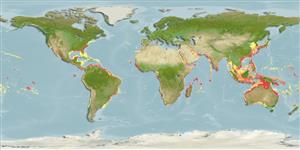
Circumtropical. Western Atlantic: Massachusetts, USA to Argentina (Ref. 36453). Eastern Atlantic: west coast of tropical Africa (Ref. 3592). Eastern Pacific: Guatemala to Chile (Ref. 9068); probably in Mexico (Ref. 9318). Western Indian Ocean: Mozambique and South Africa (Ref. 4421). Recorded from La Reunion (Ref. 53568).
Größe / Gewicht / Alter
Geschlechtsreife: Lm? range ? - ? cm Max length : 76.2 cm TL Männchen/unbestimmt; (Ref. 26340); common length : 40.0 cm TL Männchen/unbestimmt; (Ref. 3467); max. veröff. Gewicht: 2.7 kg (Ref. 40637)
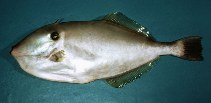
Rückenflossenstacheln (insgesamt) : 2; Rückenflossenweichstrahlen (insgesamt) : 45 - 52; Afterflossenstacheln: 0; Afterflossenweichstrahlen: 47 - 53. Rudimentary pelvic spine disappears in large specimen (Ref. 36453). Snout convex in adults (Ref. 1602). Sandy to grey with small brown spots above; soft dorsal and anal fins pale yellowish to brownish; caudal membrane blackish brown (Ref. 4421).
Body shape (shape guide): short and / or deep.
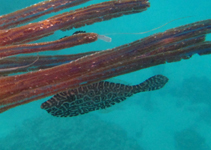
Occasionally in shallow water by steep drop-offs. Solitary or in pairs, occasionally in groups of five or six, at less than 10 m depth. Juveniles are pelagic, seen under floating objects (Ref. 9318, 48637). Benthopelagic (Ref. 58302). Adults and juveniles are rarely seen near reefs. Juveniles often with large jellies and these may bring them close to reefs and adults may nest on sandflats adjacent to reefs in deep water. At other times, the adults may form large schools under weed-rafts that usually form during the wet season (Ref. 48637). Feed on benthic organisms (Ref. 30573).
Harmelin-Vivien, M.L. and J.-C. Quéro, 1990. Monacanthidae. p. 1061-1066. In J.C. Quero, J.C. Hureau, C. Karrer, A. Post and L. Saldanha (eds.) Check-list of the fishes of the eastern tropical Atlantic (CLOFETA). JNICT, Lisbon; SEI, Paris; and UNESCO, Paris. Vol. 2. (Ref. 3592)
IUCN Rote Liste Status (Ref. 130435: Version 2025-2 (Global))
Bevorzugte Temperatur (Ref. 123201): 22.8 - 29, mean 27.6 °C (based on 1868 cells).
Phylogenetischer Diversitätsindex (Ref. 82804): PD50 = 0.5625 [Uniqueness, from 0.5 = low to 2.0 = high].
Bayesian length-weight: a=0.01905 (0.01192 - 0.03047), b=2.89 (2.75 - 3.03), in cm total length, based on LWR estimates for this species & (Sub)family-body (Ref. 93245).
Trophische Ebene (Ref. 69278): 3.8 ±0.0 se; based on diet studies.
Generation time: 5.0 ( na - na) years. Estimated as median ln(3)/K based on 1 growth studies.
Widerstandsfähigkeit (Ref. 120179): mittel, Verdopplung der Population dauert 1,4 - 4,4 Jahre. (Preliminary K or Fecundity.).
Anfälligkeit der Fischerei (Ref. 59153): Moderate to high vulnerability (48 of 100). 🛈