



Cottus asper Richardson, 1836
Prickly sculpin
Ladda upp din foton och Videor
Bilder | Google image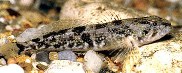 Cottus asper
Bild av The Native Fish Conservancy
Bilder | Google image
Bild av The Native Fish Conservancy
Klassificering / Namn Populärnamn | synonymer | Catalog of Fishes(Släkte, Arter) | ITIS | CoL | WoRMS | Cloffa
> Perciformes/Cottoidei (Sculpins) > Cottidae (Sculpins)
Etymology: Cottus: Greek, kottos = a fish (Ref. 45335); asper: asper meaning rough (Ref. 1998).
More on author: Richardson.
Etymology: Cottus: Greek, kottos = a fish (Ref. 45335); asper: asper meaning rough (Ref. 1998).
More on author: Richardson.
Miljö: miljö / Klimatzon / djupintervall / distributionsområde Ekologi
marina; sötvatten; brackvatten bottenlevande; katadrom (Ref. 138280). Temperate; 60°N - 32°N
Utbredning Territorier | FAO områden | Ekosystem | Förekomster | Prickkarta | Utplanteringar | Faunafri
North America: Pacific slope drainages from Seward, Alaska to Ventura River, California, USA; also east of Continental Divide in upper Peace River in British Columbia, Canada. Exhibits coastal and inland forms that are genetically distinct (Ref. 27547).
Storlek / Vikt / Ålder
Könsmognad: Lm ? range ? - ? cm
Max length : 30.0 cm TL hane/ej könsbestämd; (Ref. 5723); common length : 7.0 cm TL hane/ej könsbestämd; (Ref. 12193); rapporterad maxålder: 7 år (Ref. 28210)
Max length : 30.0 cm TL hane/ej könsbestämd; (Ref. 5723); common length : 7.0 cm TL hane/ej könsbestämd; (Ref. 12193); rapporterad maxålder: 7 år (Ref. 28210)
Kort beskrivning Bestämningsnycklar | Morfologi | Morfometri
Taggstrålar i ryggfenan (totalt) : 7 - 10; Mjukstrålar i ryggfenan (totalt) : 18 - 23; Taggstrålar i analfenan: 0; Mjukstrålar i analfenan: 15 - 19; Ryggkotor: 34 - 39. Distinguished by a complete lateral line, a single pore at the tip of the chin, the presence of 15 to 19 anal rays, and well developed palatine teeth (Ref. 27547). Pectorals large and fan-shaped; caudal truncate or slightly rounded (Ref. 27547). Dark brown, olive or gray above and on sides, whitish yellow to white below; usually three dark irregular blotches or bars below soft dorsal; vague irregular dark mark on sides; fins (except anal) have dark bars, the first dorsal with a dark spot towards the rear (Ref. 27547). Both sexes show an orange band on the edge of the first dorsal fin at spawning time (Ref. 27547). The inland form is generally more densely prickled over a larger portion of the body while the coastal form shows a reduced number of prickles (Ref. 28211).
Body shape (shape guide): elongated.
Body shape (shape guide): elongated.
There appears to be two genetically distinct forms (Ref. 27547), an inland form found in sandy and rocky shores of lakes, and a coastal form usually found over sand in quiet runs of small to medium rivers; sometimes in salt water near river mouths (Ref. 2850). The coastal form moves into brackish estuaries to spawn (Ref. 27547). Oviparous with demersal, adhesive eggs and pelagic larvae (Ref. 265). Adults feed mainly on aquatic insect larvae and bottom invertebrates (Ref. 1998). Too small to be used as food and too difficult to capture in large numbers to be used for anything else (Ref. 27547) but large individuals are reported to be excellent eating as well as good bait fishes (Ref. 2850).
Livscykel och parningsbeteende Könsmognad | Reproduktion | Lek | Ägg | Fekunditet | Larver
Prior to breeding, males move downstream and select a nesting site under boulders or flat rocks. Females aggregate some distance upstream and move down singly to the spawning area. Courtship behavior occurs outside the nest until a female is selected. The pair enter the nesting site, courting continues until eggs are deposited and fertilized. The female then leaves the nest and goes back upstream to feed, while the male spawns with other females or fans and guards the eggs. The male does not feed until the eggs have hatched, moving upstream only in the late summer (Ref. 1998, 27547). During the planktonic stage, larvae of the freshwater nonanadromous form in lakes show distinct diurnal vertical migrations, being most abundant at the surface during the darkest hours of the night. They apparently stay deep in the water during the day and on bright moonlight nights (Ref. 28920). Metamorphosis is complete by the end of the planktonic period and the young take up a demersal mode of life. The young coastal form may move upstream during the fall, although the young may remain in the estuary for a full year (Ref. 27547).
Huvudreferens
Ladda upp dina referenser | referenser | Koordinator | Medarbetare
Page, L.M. and B.M. Burr, 1991. A field guide to freshwater fishes of North America north of Mexico. Houghton Mifflin Company, Boston. 432 p. (Ref. 5723)
Status på IUCN:s rödlista (Ref. 130435: Version 2025-2 (Global))
Least Concern (LC) ; Date assessed: 08 November 2011
CITES
Not Evaluated
Hot mot människor
Harmless
Mänskliga användningsområden
Fiskeri: kommersiell; Akvarium: Offentliga akvarier; bete: occasionally
FAO - Publication: search | FishSource |
Ytterligare information
Populationsdynamik
Tillväxtparametrar
Max. åldrar / storlekar
Längd-vikt rel.
Längd-längd rel.
Längd-frekvenser
Massakonvertering
Rekrytering
Abundans
Tillväxtparametrar
Max. åldrar / storlekar
Längd-vikt rel.
Längd-längd rel.
Längd-frekvenser
Massakonvertering
Rekrytering
Abundans
Livscykel
Reproduktion
Könsmognad
Mognad/Gills rel.
Fekunditet
Lek
Lekande aggregat
Ägg
Utveckling av ägg
Larver
Larvdynamik
Reproduktion
Könsmognad
Mognad/Gills rel.
Fekunditet
Lek
Lekande aggregat
Ägg
Utveckling av ägg
Larver
Larvdynamik
Anatomi
Gälyta
Hjärna
Otolit
Gälyta
Hjärna
Otolit
Fysiologi
Kroppssammansättning
Näringsämnen
Syreförbrukning
Typ av simning
Simhastighet
Visuella pigment
Ljud från fisk
Sjukdomar & Parasiter
Toxicitet (LC50)
Kroppssammansättning
Näringsämnen
Syreförbrukning
Typ av simning
Simhastighet
Visuella pigment
Ljud från fisk
Sjukdomar & Parasiter
Toxicitet (LC50)
Genetik
Genom
Genetik
Heterozygositet
Ärftlighet
Genetisk mångfald
Genom
Genetik
Heterozygositet
Ärftlighet
Genetisk mångfald
Människorelaterad
Vattenbrukssystem
Vattenbruksprofiler
Avelslinjer
Ciguatera-fall
Frimärken, mynt, diverse.
Vattenbrukssystem
Vattenbruksprofiler
Avelslinjer
Ciguatera-fall
Frimärken, mynt, diverse.
Verktyg
Organisk frågesport | E-bok | Fälthandbok | Bestämningsnycklar | Längdfördelnings-verktyg | Livshistorie-verktyg | Prickkarta |
Fångst-MSY |
Särskilda rapporter
Kontrollera för underhåll av akvarium | Kontrollera om det finns faktablad om arter | Kontrollera om det finns faktablad om vattenbruk
Ladda ner XML
Internet-källor
AFORO (otoliths) | Alien/Invasive Species database | Aquatic Commons | BHL | Cloffa | Websites from users | Check FishWatcher | CISTI | Catalog of Fishes: Släkte, Arter | DiscoverLife | ECOTOX | FAO - Publication: search | Faunafri | Fishipedia | Fishtrace | GloBI | Google Books | Google Scholar | Google | IGFA World Record | OneZoom | Open Tree of Life | Otolith Atlas of Taiwan Fishes | Offentliga akvarier | PubMed | Reef Life Survey | Socotra Atlas | TreeBase | Tree of Life | Wikipedia: Go, sök | World Records Freshwater Fishing | Zoobank | Zoologiskt register
Uppskattningar baserade på modeller
Index för fylogenetisk mångfald (Ref. 82804): PD50 = 0.5000 [Uniqueness, from 0.5 = low to 2.0 = high].
Bayesian length-weight: a=0.00832 (0.00345 - 0.02005), b=3.16 (2.98 - 3.34), in cm total length, based on LWR estimates for this Genus-body shape (Ref. 93245).
Trofisk nivå (Ref. 69278): 3.2 ±0.0 se; based on diet studies.
Resiliens (Ref. 120179): Mellan, lägsta populationsfördubblingstid 1,4-4,4 år (tmax=7; Fec=280).