Channa striata, Striped snakehead : fisheries, aquaculture, aquarium

Channa striata (Bloch, 1793)

Striped snakehead
Adicionar o seu Fotografias e vídeos
Fotografias | Selos, moedas, diversos. | Imagem do Google

Classificação / Nomes Nomes comuns | Sinónimos | Catalog of Fishes(Género, Espécies) | ITIS | CoL | WoRMS | Cloffa

> Anabantiformes (Gouramies, snakeheads) > Channidae (Snakeheads)
Etymology: Channa: Greek, channe, -es = an anchovy (Ref. 45335).
More on author: Bloch.

Ambiente: milieu / zona climática / intervalo de profundidade / gama de distribuição Ecologia

; Água doce; estuarina bentopelágico; pH range: 7.0 - 8.0; dH range: ? - 20; potamódromo (Ref. 51243); intervalo de profundidade 1 - 10 m (Ref. 2686), usually 1 - 2 m (Ref. 4515). Tropical; 23°C - 27°C (Ref. 1672); 35°N - 18°S

Distribuição Territórios | Áreas FAO | Ecossistemas | Ocorrências | Mapa dos pontos | Introduções | Faunafri

Asia: Pakistan to Thailand and south China. Several countries report adverse ecological impact after introduction.

Comprimento na primeira maturidade / Tamanho / Peso / Idade

Maturidade: Lm 18.0, range 23 - ? cm
Max length : 100.0 cm SL macho/indeterminado; (Ref. 2686); common length : 61.0 cm TL macho/indeterminado; (Ref. 44091); peso máx. Publicado: 3.0 kg (Ref. 40637)

Descrição breve Chaves de identificação | Morfologia | Morfometria

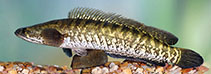
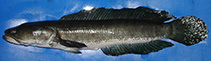
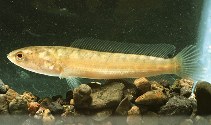
Espinhos dorsais (total) : 0; Raios dorsais moles (total) : 38 - 43; Espinhos anais: 0; Raios anais moles: 23 - 27. Body sub-cylindrical; head depressed; caudal fin rounded (Ref. 2847). The dorsal surface and sides is dark and mottled with a combination of black and ochre, and white on the belly; a large head reminiscent of a snake's head; deeply-gaping, fully toothed mouth; very large scales (Ref. 44091).
Body shape (shape guide): elongated; Cross section: other (see Diagnosi.

Biologia     Glossário (ex. epibenthic)

Obligate air-breathing (Ref. 126274); Adults inhabit ponds, streams and rivers, preferring stagnant and muddy water of plains (Ref. 41236). Found mainly in swamps, but also occurs in the lowland rivers. More common in relatively deep (1-2 m), still water. Very common in freshwater plains (Ref. 4515, 57235). Occur in medium to large rivers, brooks, flooded fields and stagnant waters including sluggish flowing canals (Ref. 12975). Recorded as having been or being farmed in rice fields (Ref. 119549). Survive dry season by burrowing in bottom mud of lakes, canals and swamps as long as skin and air-breathing apparatus remain moist (Ref. 2686) and subsists on the stored fat (Ref. 1479). Feed on fish, frogs, snakes, insects, earthworms, tadpoles (Ref. 1479) and crustaceans (Ref. 2847). Undertake lateral migration from the Mekong mainstream, or other permanent water bodies, to flooded areas during the flood season and return to the permanent water bodies at the onset of the dry season (Ref. 37770). During winter and dry season, its flesh around coelomic cavity is heavily infested by a larval trematode Isoparorchis hypselobargi. Other parasites infecting this fish include Pallisentis ophicephali in the intestine and Neocamallanus ophicepahli in the pyloric caecae (Ref. 1479). Processed into pra-hoc, mam-ruot, and mam-ca-loc (varieties of fish paste) in Kampuchea (Ref.4929). Perhaps the main food fish in Thailand, Indochina and Malaysia (Ref. 2686). Firm white flesh almost bone-free, heavy dark skin good for soup and usually sold separately (Ref. 2686). In Hawaiian waters the largest specimen taken reportedly exceeded 150 cm (Ref. 44091). Very economic important on both cultures and captures throughout southern and southeastern Asia (Ref. 57235).

Ciclo de vida e comportamento de acasalamento Maturidade | Reprodução | Desova | Ovos | Fecundidade | Larvas

Breeds in ditches, ponds and flooded paddy fields. Young shoal at the surface and are guarded by the male parent (Ref. 54793), hiding below the surface water (Ref. 1479). In captivity, as soon as the male bends its body close to the female during mating, milt is released following the release of the eggs (Ref. 45162).

Referência principal Carregar as suas referências | Referências | Coordenador | Colaboradores

Pethiyagoda, R., 1991. Freshwater fishes of Sri Lanka. The Wildlife Heritage Trust of Sri Lanka, Colombo. 362 p. (Ref. 6028)

Categoria na Lista Vermelha da IUCN (Ref. 130435: Version 2025-2 (Global))

  Preocupação menor (LC) ; Date assessed: 11 August 2019

CITES

Not Evaluated

CMS (Ref. 116361)

Not Evaluated

Ameaça para o homem

  Potential pest (Ref. 2847)


Utilização humana

Pescarias: altamente comercial; Aquacultura: espécies comerciais; Aquário: Aquários públicos
FAO - Sistemas de aquacultura: produção; pescarias: desembarques, perfil da espécie; Publication: search | FishSource |

Mais informação

Ecologia Trófica
Produtos alimentares (presas)
Composição da dieta
Consumo alimentar
Rações alimentares
Predadores
Ecologia
Ecologia
Dinâmica das populações
Parâmetros de crescimento
Idades / tamanhos máximos
Comprimento-peso rel.
Comprimento-comprimento rel.
Frequência de comprimento
Conversão de massa
Recrutamento
Abundância
Ciclo de vida
Reprodução
Maturidade
Maturidade/Rel. das guelras
Fecundidade
Desova
Agregações de desova
Ovos
Desenvolvimento dos ovos
Larvas
Dinâmica larvar
Anatomia
Área branquial
Cérebro
Otólitos
Fisiologia
Composição corporal
Nutrientes
Consumo de oxigénio
Tipo de natação
Velocidade de natação
Pigmentos visuais
Som de peixe
Doenças e Parasitas
Toxicidade (LC50s)
Genética
genoma
Genética
Heterozigotia
Hereditariedade
Diversidade genética
Relacionado com o ser humano
Sistemas de aquacultura
Perfis para aquacultura
Estirpes
Casos de Ciguatera
Selos, moedas, diversos.
Divulgação
Colaboradores
Referências
Referências

Ferramentas

Relatórios especiais

Descarregue XML

Fontes da internet

AFORO (otoliths) | Alien/Invasive Species database | Aquatic Commons | BHL | Cloffa | Websites from users | Consultar FishWatcher | CISTI | Catalog of Fishes: Género, Espécies | DiscoverLife | ECOTOX | FAO - Sistemas de aquacultura: produção; pescarias: desembarques, perfil da espécie; Publication: search | Faunafri | Fishipedia | Fishtrace | GloBI | Google Books | Google Scholar | Google | IGFA World Record | OneZoom | Open Tree of Life | Otolith Atlas of Taiwan Fishes | Aquários públicos | PubMed | Reef Life Survey | Socotra Atlas | TreeBase | Árvore da vida | Wikipedia: ir para, procurar | World Records Freshwater Fishing | Registo zoológico

Estimativas baseadas em modelos

Índice de diversidade filogenética (Ref. 82804):  PD50 = 0.5000   [Uniqueness, from 0.5 = low to 2.0 = high].
Bayesian length-weight: a=0.00912 (0.00748 - 0.01112), b=2.98 (2.94 - 3.02), in cm total length, based on LWR estimates for this species (Ref. 93245).
Nível Trófico (Ref. 69278):  3.6   ±0.47 se; based on food items.
Resiliência (Ref. 120179):  Médio, tempo mínimo de duplicação da população 1,4 - 4,4 anos (K=0.21; tm=1.5; Fec = 324).
Vulnerabilidade da pesca (Ref. 59153):  Moderate vulnerability (40 of 100). 🛈
Categoria de preço (Ref. 80766):   Unknown.
Nutrientes (Ref. 124155):  Calcium = 62.8 [31.2, 135.6] mg/100g; Iron = 0.668 [0.466, 0.942] mg/100g; Protein = 17.9 [16.9, 18.7] %; Omega3 = 0.114 [0.058, 0.219] g/100g; Selenium = 35.3 [15.9, 80.3] μg/100g; VitaminA = 23.5 [10.2, 52.3] μg/100g; Zinc = 0.926 [0.672, 1.421] mg/100g (wet weight); based on nutrient studies.