Channa striata, Striped snakehead : fisheries, aquaculture, aquarium

Channa striata (Bloch, 1793)

Striped snakehead
Uploaden van uw Foto's en video's
Afbeeldingen | Postzegels, munten, diversen. | Google afbeelding

Classificatie / Namen Lokale namen | Synoniemen | Catalog of Fishes(Genus, Soort(en)) | ITIS | CoL | WoRMS | Cloffa

> Anabantiformes (Gouramies, snakeheads) > Channidae (Snakeheads)
Etymology: Channa: Greek, channe, -es = an anchovy (Ref. 45335).
More on author: Bloch.

Milieu: milieu / Klimaatzone / Diepte / verspreidingsgebied Ecologie

; zoet water; brak water benthopelagisch; pH range: 7.0 - 8.0; dH range: ? - 20; potamodroom (Ref. 51243); diepte 1 - 10 m (Ref. 2686), usually 1 - 2 m (Ref. 4515). Tropical; 23°C - 27°C (Ref. 1672); 35°N - 18°S

Verspreiding Gebieden | FAO regio's | Ecosystemen | Voorkomen | Verspreidingskaart | Introducties | Faunafri

Asia: Pakistan to Thailand and south China. Several countries report adverse ecological impact after introduction.

Lengte bij maturiteit / Grootte / Gewicht / Leeftijd

Maturiteit: Lm 18.0, range 23 - ? cm
Max length : 100.0 cm SL mannelijk / geslacht onbekend; (Ref. 2686); common length : 61.0 cm TL mannelijk / geslacht onbekend; (Ref. 44091); max. gepubliceerd gewicht: 3.0 kg (Ref. 40637)

Korte beschrijving Determinatiesleutels | Morfologie | Morfometrie

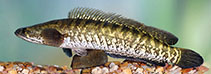
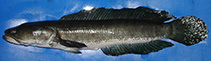
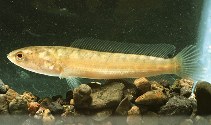
Dorsale stekels (totaal) : 0; Dorsale zachte stralen (totaal) : 38 - 43; Anale stekels: 0; Anale zachte stralen: 23 - 27. Body sub-cylindrical; head depressed; caudal fin rounded (Ref. 2847). The dorsal surface and sides is dark and mottled with a combination of black and ochre, and white on the belly; a large head reminiscent of a snake's head; deeply-gaping, fully toothed mouth; very large scales (Ref. 44091).
Body shape (shape guide): elongated; Cross section: other (see Diagnosi.

Biologie     Verklarende woordenlijst (bv. epibenthic)

Obligate air-breathing (Ref. 126274); Adults inhabit ponds, streams and rivers, preferring stagnant and muddy water of plains (Ref. 41236). Found mainly in swamps, but also occurs in the lowland rivers. More common in relatively deep (1-2 m), still water. Very common in freshwater plains (Ref. 4515, 57235). Occur in medium to large rivers, brooks, flooded fields and stagnant waters including sluggish flowing canals (Ref. 12975). Recorded as having been or being farmed in rice fields (Ref. 119549). Survive dry season by burrowing in bottom mud of lakes, canals and swamps as long as skin and air-breathing apparatus remain moist (Ref. 2686) and subsists on the stored fat (Ref. 1479). Feed on fish, frogs, snakes, insects, earthworms, tadpoles (Ref. 1479) and crustaceans (Ref. 2847). Undertake lateral migration from the Mekong mainstream, or other permanent water bodies, to flooded areas during the flood season and return to the permanent water bodies at the onset of the dry season (Ref. 37770). During winter and dry season, its flesh around coelomic cavity is heavily infested by a larval trematode Isoparorchis hypselobargi. Other parasites infecting this fish include Pallisentis ophicephali in the intestine and Neocamallanus ophicepahli in the pyloric caecae (Ref. 1479). Processed into pra-hoc, mam-ruot, and mam-ca-loc (varieties of fish paste) in Kampuchea (Ref.4929). Perhaps the main food fish in Thailand, Indochina and Malaysia (Ref. 2686). Firm white flesh almost bone-free, heavy dark skin good for soup and usually sold separately (Ref. 2686). In Hawaiian waters the largest specimen taken reportedly exceeded 150 cm (Ref. 44091). Very economic important on both cultures and captures throughout southern and southeastern Asia (Ref. 57235).

Levenscyclus en paargedrag Maturiteit | Voortplanting | Paaien | Eieren | Fecunditeit | Larven

Breeds in ditches, ponds and flooded paddy fields. Young shoal at the surface and are guarded by the male parent (Ref. 54793), hiding below the surface water (Ref. 1479). In captivity, as soon as the male bends its body close to the female during mating, milt is released following the release of the eggs (Ref. 45162).

Hoofdreferentie Upload uw referenties | Referenties | Coördinator | Medewerkers

Pethiyagoda, R., 1991. Freshwater fishes of Sri Lanka. The Wildlife Heritage Trust of Sri Lanka, Colombo. 362 p. (Ref. 6028)

Status op de Rode Lijst van het IUCN (Ref. 130435: Version 2025-2 (Global))

  Niet bedreigd (LC) ; Date assessed: 11 August 2019

CITES

Not Evaluated

CMS (Ref. 116361)

Not Evaluated

Gevaar voor de mens

  Potential pest (Ref. 2847)


Gebruik door de mens

Visserij: van groot commercieel belang; Aquacultuur: commercieel; Aquarium: Publieke aquaria
FAO - Aquacultuursystemen: productie; visserij: aanvoer, soortsprofiel; Publication: search | FishSource |

Meer informatie

Trofische ecologie
Voedsel (prooien)
Dieetsamenstelling
Voedselconsumptie
Voedselrantsoenen
Predatoren
Ecologie
Ecologie
Populatiedynamica
Groeiparameters
Max. leeftijden / maten
Lengte-gewicht rel.
Lengte-lengte rel.
Lengtefrequenties
Massaconversie
Rekrutering
Abundantie
Levenscyclus
Voortplanting
Maturiteit
Rijpheid/kieuwen rel.
Fecunditeit
Paaien
Paaibestanden
Eieren
Ontwikkeling van de eieren
Larven
Larvale populatiedynamiek
Verspreiding
Gebieden
FAO regio's
Ecosystemen
Voorkomen
Introducties
BRUVS - Video's
Anatomie
Kieuwoppervlak
Hersenen
Otoliet
Fysiologie
Lichaamssamenstelling
Voedingsstoffen
Zuurstofverbruik
Type zwemmen
Zwemsnelheid
Visuele pigmenten
Vis geluid
Ziekten en parasieten
Toxiciteit (LC50)
Genetica
genoom
Genetica
Heterozygositeit
Erfelijkheid
Genetische diversiteit
Menselijk gerelateerd
Aquacultuursystemen
Aquacultuurprofielen
Kweeklijnen
Ciguatera gevallen
Postzegels, munten, diversen.
Outreach
Medewerkers
Referenties
Referenties

Tools

Speciale rapporten

Download XML

Internetbronnen

AFORO (otoliths) | Exoten/Invasieve soorten database | Aquatic Commons | BHL | Cloffa | Websites from users | Bekijk FishWatcher | CISTI | Catalog of Fishes: Genus, Soort(en) | DiscoverLife | ECOTOX | FAO - Aquacultuursystemen: productie; visserij: aanvoer, soortsprofiel; Publication: search | Faunafri | Fishipedia | Fishtrace | GloBI | Google Books | Google Scholar | Google | IGFA World Record | OneZoom | Open Tree of Life | Otolith Atlas of Taiwan Fishes | Publieke aquaria | PubMed | Reef Life Survey | Socotra Atlas | TreeBase | Tree of Life | Wikipedia: ga naar, zoek | World Records Freshwater Fishing | Zoological Record

Schattingen op basis van modellen

Fylogenetische diversiteitsindex (Ref. 82804):  PD50 = 0.5000   [Uniqueness, from 0.5 = low to 2.0 = high].
Bayesian length-weight: a=0.00912 (0.00748 - 0.01112), b=2.98 (2.94 - 3.02), in cm total length, based on LWR estimates for this species (Ref. 93245).
Trofisch niveau (Ref. 69278):  3.6   ±0.47 se; based on food items.
Weerstandsvermogen (Ref. 120179):  Gemiddeld, minimale populatieverdubbelingstijd 1,4-4,4 jaar (K=0.21; tm=1.5; Fec = 324).
Kwetsbaarheid van de visserij (Ref. 59153):  Moderate vulnerability (40 of 100). 🛈
Prijsklasse (Ref. 80766):   Unknown.
Voedingsstoffen (Ref. 124155):  Calcium = 62.8 [31.2, 135.6] mg/100g; Iron = 0.668 [0.466, 0.942] mg/100g; Protein = 17.9 [16.9, 18.7] %; Omega3 = 0.114 [0.058, 0.219] g/100g; Selenium = 35.3 [15.9, 80.3] μg/100g; VitaminA = 23.5 [10.2, 52.3] μg/100g; Zinc = 0.926 [0.672, 1.421] mg/100g (wet weight); based on nutrient studies.