



Adicionar o seu Fotografias e vídeos
Fotografias | Selos, moedas, diversos. | Imagem do Google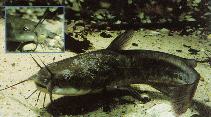 Ameiurus nebulosus
Fotografia de Zienert, S.
Fotografias | Selos, moedas, diversos. | Imagem do Google
Fotografia de Zienert, S.
Classificação / Nomes Nomes comuns | Sinónimos | Catalog of Fishes(Género, Espécies) | ITIS | CoL | WoRMS | Cloffa
> Siluriformes (Catfishes) > Ictaluridae (North American freshwater catfishes)
Etymology: Ameiurus: Greek, a = without + Greek, meiouros, -os, -on = without tail (Ref. 45335); nebulosus: nebulosus meaning clouded, in relation to mottled and grey coloring (Ref. 1998).
More on author: Lesueur.
Etymology: Ameiurus: Greek, a = without + Greek, meiouros, -os, -on = without tail (Ref. 45335); nebulosus: nebulosus meaning clouded, in relation to mottled and grey coloring (Ref. 1998).
More on author: Lesueur.
Ambiente: milieu / zona climática / intervalo de profundidade / gama de distribuição Ecologia
; Água doce demersal; potamódromo (Ref. 126106); intervalo de profundidade 0 - 12 m (Ref. 1998). Subtropical; 0°C - 37°C (Ref. 35682); 54°N - 25°N, 104°W - 61°W (Ref. 86798)
Distribuição Territórios | Áreas FAO | Ecossistemas | Ocorrências | Mapa dos pontos | Introduções | Faunafri
North America: Atlantic and Gulf Slope drainages from Nova Scotia and New Brunswick in Canada to Mobile Bay in Alabama in USA; St. Lawrence-Great Lakes, Hudson Bay, and Mississippi River basins from Quebec west to southeastern Saskatchewan in Canada, and south to Louisiana, USA. Introduced into several countries. Several countries report adverse ecological impact after introduction.
Comprimento na primeira maturidade / Tamanho / Peso / Idade
Maturidade: Lm 26.6, range 20 - 33 cm
Max length : 55.0 cm TL macho/indeterminado; (Ref. 40637); common length : 25.0 cm TL macho/indeterminado; (Ref. 556); peso máx. Publicado: 2.7 kg (Ref. 40637); Idade máx. registada: 9 anos (Ref. 59043)
Max length : 55.0 cm TL macho/indeterminado; (Ref. 40637); common length : 25.0 cm TL macho/indeterminado; (Ref. 556); peso máx. Publicado: 2.7 kg (Ref. 40637); Idade máx. registada: 9 anos (Ref. 59043)
Descrição breve Chaves de identificação | Morfologia | Morfometria
Espinhos dorsais (total) : 1; Raios dorsais moles (total) : 6 - 7; Espinhos anais: 1. Caudal fin with 18-19 rays.
Body shape (shape guide): fusiform / normal.
Body shape (shape guide): fusiform / normal.
Adults occur in pools and sluggish runs over soft substrates in creeks and small to large rivers. Also found in impoundments, lakes, and ponds (Ref. 86798). They rarely enter brackish waters (Ref. 1998). They are nocturnal feeders that feed on mollusks, insects, leeches, crayfish and plankton, worms, algae, plant material, fishes, eggs of least cisco, herring and lake trout (Ref. 1998). Juveniles (3-6 cm) feed mostly on chironomid larvae, cladocerans, ostracods, amphipods, bugs and mayflies (Ref. 1998). Can tolerate high carbon dioxide and low oxygen concentrations and temperatures up to 31.6 °C although experiments show upper lethal temp. to be 37.5 °C; resistant to domestic and industrial pollution (Ref. 1998). They have been observed to bury itself in mud to escape adverse environmental conditions (Ref. 1998). Prepared hot-smoked and also cooked in various ways (Ref. 1998).
Ciclo de vida e comportamento de acasalamento Maturidade | Reprodução | Desova | Ovos | Fecundidade | Larvas
Nests are built by one or both sexes. After a period of caressing each other with their barbels, male and female settle over the nest, face opposite directions (while maintaining body contact) and spawn. Although eggs are cared for by one or both parents, there have been reports of parents eating their own eggs. Caring entails fanning by the paired fins, moving and stirring by the barbels, and may be picked up and ejected from the mouth; this ensures hatching.
Referência principal
Carregar as suas referências | Referências | Coordenador | Colaboradores
Page, L.M. and B.M. Burr, 2011. A field guide to freshwater fishes of North America north of Mexico. Boston : Houghton Mifflin Harcourt, 663p. (Ref. 86798)
Categoria na Lista Vermelha da IUCN (Ref. 130435: Version 2025-2 (Global))
Preocupação menor (LC) ; Date assessed: 14 October 2011
CITES
Not Evaluated
Ameaça para o homem
Potential pest
Utilização humana
Pescarias: pouco comercial; Aquacultura: espécies comerciais; peixe desportivo: sim
FAO - pescarias: desembarques; Publication: search | FishSource |
Mais informação
Ecologia Trófica
Produtos alimentares (presas)
Composição da dieta
Consumo alimentar
Rações alimentares
Predadores
Produtos alimentares (presas)
Composição da dieta
Consumo alimentar
Rações alimentares
Predadores
Dinâmica das populações
Parâmetros de crescimento
Idades / tamanhos máximos
Comprimento-peso rel.
Comprimento-comprimento rel.
Frequência de comprimento
Conversão de massa
Recrutamento
Abundância
Parâmetros de crescimento
Idades / tamanhos máximos
Comprimento-peso rel.
Comprimento-comprimento rel.
Frequência de comprimento
Conversão de massa
Recrutamento
Abundância
Ciclo de vida
Reprodução
Maturidade
Maturidade/Rel. das guelras
Fecundidade
Desova
Agregações de desova
Ovos
Desenvolvimento dos ovos
Larvas
Dinâmica larvar
Reprodução
Maturidade
Maturidade/Rel. das guelras
Fecundidade
Desova
Agregações de desova
Ovos
Desenvolvimento dos ovos
Larvas
Dinâmica larvar
Fisiologia
Composição corporal
Nutrientes
Consumo de oxigénio
Tipo de natação
Velocidade de natação
Pigmentos visuais
Som de peixe
Doenças e Parasitas
Toxicidade (LC50s)
Composição corporal
Nutrientes
Consumo de oxigénio
Tipo de natação
Velocidade de natação
Pigmentos visuais
Som de peixe
Doenças e Parasitas
Toxicidade (LC50s)
Relacionado com o ser humano
Sistemas de aquacultura
Perfis para aquacultura
Estirpes
Casos de Ciguatera
Selos, moedas, diversos.
Sistemas de aquacultura
Perfis para aquacultura
Estirpes
Casos de Ciguatera
Selos, moedas, diversos.
Ferramentas
Questionário orgânico | E-book | Guia de campo | Chaves de identificação | Ferramenta auxiliar de frequências de comprimento | Ferramenta sobre a história de vida | Mapa dos pontos |
Captura-MSY |
Relatórios especiais
Descarregue XML
Fontes da internet
AFORO (otoliths) | Alien/Invasive Species database | Aquatic Commons | BHL | Cloffa | Websites from users | Consultar FishWatcher | CISTI | Catalog of Fishes: Género, Espécies | DiscoverLife | ECOTOX | FAO - pescarias: desembarques; Publication: search | Faunafri | Fishipedia | Fishtrace | GloBI | Google Books | Google Scholar | Google | IGFA World Record | Bases de dados nacionais | OneZoom | Open Tree of Life | Otolith Atlas of Taiwan Fishes | Aquários públicos | PubMed | Reef Life Survey | Socotra Atlas | TreeBase | Árvore da vida | Wikipedia: ir para, procurar | World Records Freshwater Fishing | Registo zoológico
Estimativas baseadas em modelos
Índice de diversidade filogenética (Ref. 82804): PD50 = 0.5078 [Uniqueness, from 0.5 = low to 2.0 = high].
Bayesian length-weight: a=0.00832 (0.00640 - 0.01081), b=3.12 (3.04 - 3.20), in cm total length, based on LWR estimates for this species (Ref. 93245).
Nível Trófico (Ref. 69278): 3.7 ±0.1 se; based on diet studies.
Resiliência (Ref. 120179): Médio, tempo mínimo de duplicação da população 1,4 - 4,4 anos (K=0.47; tm=3; tmax=8).