



Uploaden van uw Foto's en video's
Afbeeldingen | Postzegels, munten, diversen. | Google afbeelding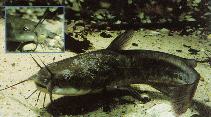 Ameiurus nebulosus
Afbeelding van Zienert, S.
Afbeeldingen | Postzegels, munten, diversen. | Google afbeelding
Afbeelding van Zienert, S.
Classificatie / Namen Lokale namen | Synoniemen | Catalog of Fishes(Genus, Soort(en)) | ITIS | CoL | WoRMS | Cloffa
> Siluriformes (Catfishes) > Ictaluridae (North American freshwater catfishes)
Etymology: Ameiurus: Greek, a = without + Greek, meiouros, -os, -on = without tail (Ref. 45335); nebulosus: nebulosus meaning clouded, in relation to mottled and grey coloring (Ref. 1998).
More on author: Lesueur.
Etymology: Ameiurus: Greek, a = without + Greek, meiouros, -os, -on = without tail (Ref. 45335); nebulosus: nebulosus meaning clouded, in relation to mottled and grey coloring (Ref. 1998).
More on author: Lesueur.
Milieu: milieu / Klimaatzone / Diepte / verspreidingsgebied Ecologie
; zoet water demersaal; potamodroom (Ref. 126106); diepte 0 - 12 m (Ref. 1998). Subtropical; 0°C - 37°C (Ref. 35682); 54°N - 25°N, 104°W - 61°W (Ref. 86798)
Verspreiding Gebieden | FAO regio's | Ecosystemen | Voorkomen | Verspreidingskaart | Introducties | Faunafri
North America: Atlantic and Gulf Slope drainages from Nova Scotia and New Brunswick in Canada to Mobile Bay in Alabama in USA; St. Lawrence-Great Lakes, Hudson Bay, and Mississippi River basins from Quebec west to southeastern Saskatchewan in Canada, and south to Louisiana, USA. Introduced into several countries. Several countries report adverse ecological impact after introduction.
Lengte bij maturiteit / Grootte / Gewicht / Leeftijd
Maturiteit: Lm 26.6, range 20 - 33 cm
Max length : 55.0 cm TL mannelijk / geslacht onbekend; (Ref. 40637); common length : 25.0 cm TL mannelijk / geslacht onbekend; (Ref. 556); max. gepubliceerd gewicht: 2.7 kg (Ref. 40637); max. gerapporteerde leeftijd: 9 Jaren (Ref. 59043)
Max length : 55.0 cm TL mannelijk / geslacht onbekend; (Ref. 40637); common length : 25.0 cm TL mannelijk / geslacht onbekend; (Ref. 556); max. gepubliceerd gewicht: 2.7 kg (Ref. 40637); max. gerapporteerde leeftijd: 9 Jaren (Ref. 59043)
Korte beschrijving Determinatiesleutels | Morfologie | Morfometrie
Dorsale stekels (totaal) : 1; Dorsale zachte stralen (totaal) : 6 - 7; Anale stekels: 1. Caudal fin with 18-19 rays.
Body shape (shape guide): fusiform / normal.
Body shape (shape guide): fusiform / normal.
Adults occur in pools and sluggish runs over soft substrates in creeks and small to large rivers. Also found in impoundments, lakes, and ponds (Ref. 86798). They rarely enter brackish waters (Ref. 1998). They are nocturnal feeders that feed on mollusks, insects, leeches, crayfish and plankton, worms, algae, plant material, fishes, eggs of least cisco, herring and lake trout (Ref. 1998). Juveniles (3-6 cm) feed mostly on chironomid larvae, cladocerans, ostracods, amphipods, bugs and mayflies (Ref. 1998). Can tolerate high carbon dioxide and low oxygen concentrations and temperatures up to 31.6 °C although experiments show upper lethal temp. to be 37.5 °C; resistant to domestic and industrial pollution (Ref. 1998). They have been observed to bury itself in mud to escape adverse environmental conditions (Ref. 1998). Prepared hot-smoked and also cooked in various ways (Ref. 1998).
Levenscyclus en paargedrag Maturiteit | Voortplanting | Paaien | Eieren | Fecunditeit | Larven
Nests are built by one or both sexes. After a period of caressing each other with their barbels, male and female settle over the nest, face opposite directions (while maintaining body contact) and spawn. Although eggs are cared for by one or both parents, there have been reports of parents eating their own eggs. Caring entails fanning by the paired fins, moving and stirring by the barbels, and may be picked up and ejected from the mouth; this ensures hatching.
Hoofdreferentie
Upload uw referenties | Referenties | Coördinator | Medewerkers
Page, L.M. and B.M. Burr, 2011. A field guide to freshwater fishes of North America north of Mexico. Boston : Houghton Mifflin Harcourt, 663p. (Ref. 86798)
Status op de Rode Lijst van het IUCN (Ref. 130435: Version 2025-2 (Global))
Niet bedreigd (LC) ; Date assessed: 14 October 2011
CITES
Not Evaluated
Gevaar voor de mens
Potential pest
Gebruik door de mens
Visserij: van minder commercieel belang; Aquacultuur: commercieel; sportvis: ja
FAO - visserij: aanvoer; Publication: search | FishSource |
Meer informatie
Trofische ecologie
Voedsel (prooien)
Dieetsamenstelling
Voedselconsumptie
Voedselrantsoenen
Predatoren
Voedsel (prooien)
Dieetsamenstelling
Voedselconsumptie
Voedselrantsoenen
Predatoren
Populatiedynamica
Groeiparameters
Max. leeftijden / maten
Lengte-gewicht rel.
Lengte-lengte rel.
Lengtefrequenties
Massaconversie
Rekrutering
Abundantie
Groeiparameters
Max. leeftijden / maten
Lengte-gewicht rel.
Lengte-lengte rel.
Lengtefrequenties
Massaconversie
Rekrutering
Abundantie
Levenscyclus
Voortplanting
Maturiteit
Rijpheid/kieuwen rel.
Fecunditeit
Paaien
Paaibestanden
Eieren
Ontwikkeling van de eieren
Larven
Larvale populatiedynamiek
Voortplanting
Maturiteit
Rijpheid/kieuwen rel.
Fecunditeit
Paaien
Paaibestanden
Eieren
Ontwikkeling van de eieren
Larven
Larvale populatiedynamiek
Fysiologie
Lichaamssamenstelling
Voedingsstoffen
Zuurstofverbruik
Type zwemmen
Zwemsnelheid
Visuele pigmenten
Vis geluid
Ziekten en parasieten
Toxiciteit (LC50)
Lichaamssamenstelling
Voedingsstoffen
Zuurstofverbruik
Type zwemmen
Zwemsnelheid
Visuele pigmenten
Vis geluid
Ziekten en parasieten
Toxiciteit (LC50)
Menselijk gerelateerd
Aquacultuursystemen
Aquacultuurprofielen
Kweeklijnen
Ciguatera gevallen
Postzegels, munten, diversen.
Aquacultuursystemen
Aquacultuurprofielen
Kweeklijnen
Ciguatera gevallen
Postzegels, munten, diversen.
Tools
Biologische quiz | E-boek | Veldgids | Determinatiesleutels | Lengtefrequentie Tool | Levenscyclus tool | Verspreidingskaart |
Vangst-MSY |
Speciale rapporten
Bekijk gegevens voor het houden in een aquarium | Bekijk Fact Sheets voor de soort | Bekijk Aquacultuur Fact Sheets
Download XML
Internetbronnen
AFORO (otoliths) | Exoten/Invasieve soorten database | Aquatic Commons | BHL | Cloffa | Websites from users | Bekijk FishWatcher | CISTI | Catalog of Fishes: Genus, Soort(en) | DiscoverLife | ECOTOX | FAO - visserij: aanvoer; Publication: search | Faunafri | Fishipedia | Fishtrace | GloBI | Google Books | Google Scholar | Google | IGFA World Record | Nationale databanken | OneZoom | Open Tree of Life | Otolith Atlas of Taiwan Fishes | Publieke aquaria | PubMed | Reef Life Survey | Socotra Atlas | TreeBase | Tree of Life | Wikipedia: ga naar, zoek | World Records Freshwater Fishing | Zoological Record
Schattingen op basis van modellen
Fylogenetische diversiteitsindex (Ref. 82804): PD50 = 0.5078 [Uniqueness, from 0.5 = low to 2.0 = high].
Bayesian length-weight: a=0.00832 (0.00640 - 0.01081), b=3.12 (3.04 - 3.20), in cm total length, based on LWR estimates for this species (Ref. 93245).
Trofisch niveau (Ref. 69278): 3.7 ±0.1 se; based on diet studies.
Weerstandsvermogen (Ref. 120179): Gemiddeld, minimale populatieverdubbelingstijd 1,4-4,4 jaar (K=0.47; tm=3; tmax=8).