



Hochladen Photos und videos
Bilder | Briefmarken, Münzen, Verschiedenes. | Google Bild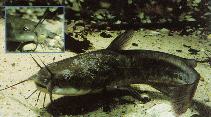 Ameiurus nebulosus
Photo von Zienert, S.
Bilder | Briefmarken, Münzen, Verschiedenes. | Google Bild
Photo von Zienert, S.
Klassifizierung / Names Namen | Synonyme | Catalog of Fishes(Gattung, Arten) | ITIS | CoL | WoRMS | Cloffa
> Siluriformes (Catfishes) > Ictaluridae (North American freshwater catfishes)
Etymology: Ameiurus: Greek, a = without + Greek, meiouros, -os, -on = without tail (Ref. 45335); nebulosus: nebulosus meaning clouded, in relation to mottled and grey coloring (Ref. 1998).
More on author: Lesueur.
Etymology: Ameiurus: Greek, a = without + Greek, meiouros, -os, -on = without tail (Ref. 45335); nebulosus: nebulosus meaning clouded, in relation to mottled and grey coloring (Ref. 1998).
More on author: Lesueur.
Umwelt: Milieu / Klimazone / Tiefenbereich / Verbreitungsgebiet Ökologie
; süßwasser demersal; potamodrom (Ref. 126106); tiefenbereich 0 - 12 m (Ref. 1998). Subtropical; 0°C - 37°C (Ref. 35682); 54°N - 25°N, 104°W - 61°W (Ref. 86798)
Verbreitung Territorien | FAO Gebiete | Ökosysteme | Vorkommen | Punkt Karte | Einführungen | Faunafri
North America: Atlantic and Gulf Slope drainages from Nova Scotia and New Brunswick in Canada to Mobile Bay in Alabama in USA; St. Lawrence-Great Lakes, Hudson Bay, and Mississippi River basins from Quebec west to southeastern Saskatchewan in Canada, and south to Louisiana, USA. Introduced into several countries. Several countries report adverse ecological impact after introduction.
Länge bei der ersten Reifung / Größe / Gewicht / Alter
Geschlechtsreife: Lm 26.6, range 20 - 33 cm
Max length : 55.0 cm TL Männchen/unbestimmt; (Ref. 40637); common length : 25.0 cm TL Männchen/unbestimmt; (Ref. 556); max. veröff. Gewicht: 2.7 kg (Ref. 40637); max. veröff. Alter: 9 Jahre (Ref. 59043)
Max length : 55.0 cm TL Männchen/unbestimmt; (Ref. 40637); common length : 25.0 cm TL Männchen/unbestimmt; (Ref. 556); max. veröff. Gewicht: 2.7 kg (Ref. 40637); max. veröff. Alter: 9 Jahre (Ref. 59043)
Kurzbeschreibung Bestimmungsschlüssel | Morphologie | Morphometrie
Rückenflossenstacheln (insgesamt) : 1; Rückenflossenweichstrahlen (insgesamt) : 6 - 7; Afterflossenstacheln: 1. Caudal fin with 18-19 rays.
Body shape (shape guide): fusiform / normal.
Body shape (shape guide): fusiform / normal.
Adults occur in pools and sluggish runs over soft substrates in creeks and small to large rivers. Also found in impoundments, lakes, and ponds (Ref. 86798). They rarely enter brackish waters (Ref. 1998). They are nocturnal feeders that feed on mollusks, insects, leeches, crayfish and plankton, worms, algae, plant material, fishes, eggs of least cisco, herring and lake trout (Ref. 1998). Juveniles (3-6 cm) feed mostly on chironomid larvae, cladocerans, ostracods, amphipods, bugs and mayflies (Ref. 1998). Can tolerate high carbon dioxide and low oxygen concentrations and temperatures up to 31.6 °C although experiments show upper lethal temp. to be 37.5 °C; resistant to domestic and industrial pollution (Ref. 1998). They have been observed to bury itself in mud to escape adverse environmental conditions (Ref. 1998). Prepared hot-smoked and also cooked in various ways (Ref. 1998).
Lebenszyklus und Paarungsverhalten Geschlechtsreife | Fortpflanzung | Ablaichen | Eier | Fruchtbarkeit | Larven
Nests are built by one or both sexes. After a period of caressing each other with their barbels, male and female settle over the nest, face opposite directions (while maintaining body contact) and spawn. Although eggs are cared for by one or both parents, there have been reports of parents eating their own eggs. Caring entails fanning by the paired fins, moving and stirring by the barbels, and may be picked up and ejected from the mouth; this ensures hatching.
Hauptreferenz
Laden Sie Ihre Referenzen hoch | Referenzen | Koordinator | Partner
Page, L.M. and B.M. Burr, 2011. A field guide to freshwater fishes of North America north of Mexico. Boston : Houghton Mifflin Harcourt, 663p. (Ref. 86798)
IUCN Rote Liste Status (Ref. 130435: Version 2025-2 (Global))
nicht bedroht (LC) ; Date assessed: 14 October 2011
CITES
Not Evaluated
Bedrohung für Menschen
Potential pest
Nutzung durch Menschen
Fischereien: weniger kommerziell; Aquakultur: kommerziell; Sportfisch: ja
FAO - Fischereien: landings search; Publication: search | FishSource |
Mehr Information
Trophische Ökologie
Lebensmittel (Beutetiere)
Nahrungszusammensetzung
Nahrungsaufnahme
Lebensmittelrationen
Räuber
Lebensmittel (Beutetiere)
Nahrungszusammensetzung
Nahrungsaufnahme
Lebensmittelrationen
Räuber
Populationsdynamik
Wachstumsparameter
Max. Alter/Größen
Länge-Gewicht-Rel.
Länge-Länge-Verhältnis.
Längenhäufigkeiten
Massenkonvertierung
Rekrutierung
Dichte
Wachstumsparameter
Max. Alter/Größen
Länge-Gewicht-Rel.
Länge-Länge-Verhältnis.
Längenhäufigkeiten
Massenkonvertierung
Rekrutierung
Dichte
Lebenszyklus
Fortpflanzung
Geschlechtsreife
Reifung/Kiemen rel.
Fruchtbarkeit
Ablaichen
Laichaggregationen
Eier
Eientwicklung
Larven
Larven Pop.Dyn.
Fortpflanzung
Geschlechtsreife
Reifung/Kiemen rel.
Fruchtbarkeit
Ablaichen
Laichaggregationen
Eier
Eientwicklung
Larven
Larven Pop.Dyn.
Physiologie
Körperliche Zusammensetzung
Nährstoffe
Sauerstoffverbrauch
Schwimmart
Schwimmgeschwindigkeit
Visuelle Pigmente
Fischgeräusche
Krankheiten und Parasiten
Toxizität (LC50s)
Körperliche Zusammensetzung
Nährstoffe
Sauerstoffverbrauch
Schwimmart
Schwimmgeschwindigkeit
Visuelle Pigmente
Fischgeräusche
Krankheiten und Parasiten
Toxizität (LC50s)
Menschenbezogen
Aquakultur-Systeme
Aquakultur Profile
Zuchtlinien
Ciguatera-Fälle
Briefmarken, Münzen, Verschiedenes.
Aquakultur-Systeme
Aquakultur Profile
Zuchtlinien
Ciguatera-Fälle
Briefmarken, Münzen, Verschiedenes.
Tools
Bio-Quiz | E-Book | Feldführer | Bestimmungsschlüssel | Längenhäufigkeits Tool | Lebensdaten Tool | Punkt Karte |
Catch-MSY |
Zusatzinformationen
Download XML
Zusammenfassung | Punktdaten | Namen | Photos
Internet Quellen
AFORO (otoliths) | Alien/Invasive Species database | Aquatic Commons | BHL | Cloffa | Websites from users | FishWatcher Einträge suchen | CISTI | Catalog of Fishes: Gattung, Arten | DiscoverLife | ECOTOX | FAO - Fischereien: landings search; Publication: search | Faunafri | Fishipedia | Fishtrace | GloBI | Google Books | Google Scholar | Google | IGFA World Record | Nationale Datenbanken | OneZoom | Open Tree of Life | Otolith Atlas of Taiwan Fishes | Öffentliche Aquarien | PubMed | Reef Life Survey | Socotra Atlas | TreeBase | Tree of Life | Wikipedia: Gehe zu, Suchen | | Zoologischer Rekord
Schätzungen auf der Grundlage von Modellen
|
Phylogenetischer Diversitätsindex (Ref. 82804) |
PD50 = 0.5078 [Uniqueness, from 0.5 = low to 2.0 = high]. |
| Bayesian length-weight | a=0.00832 (0.00640 - 0.01080), b=3.12 (3.05 - 3.19), in cm total length, based on LWR estimates for this species (Ref. 93245). |
|
Trophische Ebene (Ref. 69278) |
3.7 ±0.1 se; based on diet studies. |
|
Widerstandsfähigkeit (Ref. 120179) |
mittel, Verdopplung der Population dauert 1,4 - 4,4 Jahre. (K=0.47; tm=3; tmax=8). |
|
Anfälligkeit der Fischerei (Ref. 59153) |
Moderate vulnerability (38 of 100). 🛈 |
|
Preiskategorie (Ref. 80766) |
Unknown. |