



Catostomus catostomus (Forster, 1773)
Longnose sucker
Envoyez vos Photos et vidéos
Images | Timbres, pièces de monnaie, divers | Images Google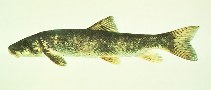 Catostomus catostomus
Photo de Scarola, J.F.
Images | Timbres, pièces de monnaie, divers | Images Google
Photo de Scarola, J.F.
Classification / Noms Noms communs | Synonymes | Catalog of Fishes(Genre, Espèce) | ITIS | CoL | WoRMS | Cloffa
> Cypriniformes (Carps) > Catostomidae (Suckers) > Catostominae
Etymology: Catostomus: Greek, kata = down + Greek, stoma = mouth (Ref. 45335); catostomus: catostomus meaning inferior mouth, alluding to the ventral position of the mouth.
More on author: Forster.
Etymology: Catostomus: Greek, kata = down + Greek, stoma = mouth (Ref. 45335); catostomus: catostomus meaning inferior mouth, alluding to the ventral position of the mouth.
More on author: Forster.
Environnement : milieu / zone climatique / profondeur / gamme de distribution Écologie
; eau douce; saumâtre démersal; pH range: 6.5 - 7.8; dH range: 5 - 25; potamodrome (Ref. 126106); profondeur ? - 180 m (Ref. 1998). Temperate; 0°C - 15°C (Ref. 12468); 38°N - 32°N
Distribution Territoires | Zones FAO | Écosystèmes | Occurrences | Carte par point | Introductions | Faunafri
North America: throughout most of Canada and Alaska; Atlantic Slope south to Delaware River drainage in New York, USA; Great Lakes basin; upper Monongahela River drainage in Maryland and West Virginia, USA; Missouri River drainage south to Nebraska and Colorado, USA. Also in Arctic basin of Siberia in Russia. Occurs in Columbia River System (Molly Hallock, pers. comm.).
Longueur à la première maturité / Taille / Poids / Âge
Maturité: Lm ? range ? - ? cm
Max length : 64.0 cm TL mâle / non sexé; (Ref. 5723); common length : 22.5 cm TL mâle / non sexé; (Ref. 12193); poids max. publié: 3.3 kg (Ref. 28924); âge max. reporté: 20 années (Ref. 12193)
Max length : 64.0 cm TL mâle / non sexé; (Ref. 5723); common length : 22.5 cm TL mâle / non sexé; (Ref. 12193); poids max. publié: 3.3 kg (Ref. 28924); âge max. reporté: 20 années (Ref. 12193)
Description synthétique Clés d'identification | Morphologie | Morphométrie
Épines dorsales (Total) : 0; Rayons mous dorsaux (Total) : 9 - 11; Épines anales: 0; Rayons mous anaux: 7; Vertèbres: 45 - 47. Distinguished by the sucking mouth located on the ventral sides of the head and thick papillose lips (Ref. 27547). Gill rakers short; lateral line complete, inconspicuous; caudal tips slightly rounded (Ref. 27547). Adults may be reddish brown, dark brassy green or black above, paler on the lower sides, with the ventral parts white; young fish are usually dark gray with small black spots; breeding males are usually dark above with a brilliant reddish stripe along each side, while females are greenish gold to copper, with a less brilliant red stripe; breeding males show prominent tubercles on the rays of the anal and caudal fins and also on the head (Ref. 27547).
Body shape (shape guide): fusiform / normal.
Body shape (shape guide): fusiform / normal.
Found in clear, cold, deep water of lakes and tributary streams; occasionally found in brackish water in the Arctic (Ref. 5723). Adults move from lakes into inlet streams or from slow, deep pools into shallow, gravel-bottomed portions of streams to spawn (Ref. 27547). They feed on benthic invertebrates (Ref. 1998). Young are preyed upon by other fishes and fish-eating birds; while adults in spawning streams are taken by mammals, osprey and eagles (Ref. 1998). Utilized as a food fish or as dog food (Ref. 27547).
Cycle de vie et comportement reproducteur Maturité | Reproduction | Frai | Œufs | Fécondité | Larves
Spawns only during daytime (Ref. 27547). At spawning, males lie close to the bottom in the current of the spawning area while females stay along the banks and in still water (Ref. 27547). A female moves from the bank of the stream usually escorted by 2-4 males to the spawning area at the center of the stream. The males crowd beside her; egg deposition occurs as the males try to clasp the female with their pelvic fins or vibrate against her with their anal fins. This spawning act lasts for 3-5 seconds and may occur as often as 6-40 times per hour. After the eggs are deposited, the sexes separate and return to their previous stream positions (Ref.1998). Fish that moved out of a lake to spawn generally return to the lake a few days after spawning. However, river-resident fish may stay on or near the spawning area for much of the summer (Ref. 27547). Many spawn in two or even three consecutive years but others may skip one or two years between spawning (Ref. 10928).
Référence principale
Téléchargez vos références | Références | Coordinateur | Collaborateurs
Page, L.M. and B.M. Burr, 1991. A field guide to freshwater fishes of North America north of Mexico. Houghton Mifflin Company, Boston. 432 p. (Ref. 5723)
Statut dans la liste rouge de l'IUCN (Ref. 130435: Version 2025-2 (Global))
Préoccupation mineure (LC) ; Date assessed: 21 February 2020
CITES
Not Evaluated
Menace pour l'homme
Harmless
Utilisations par l'homme
Pêcheries: intérêt commercial mineur; pêche sportive: oui; Aquarium: Aquariums publics
FAO - Publication: search | FishSource |
Plus d'informations
Écologie trophique
Aliments (proies)
Composition du régime alimentaire
Consommation alimentaire
Rations alimentaires
Prédateurs
Aliments (proies)
Composition du régime alimentaire
Consommation alimentaire
Rations alimentaires
Prédateurs
Dynamique des populations
Paramètres de croissance
Âges / tailles maximales
Longueur-poids rel.
Rel. longueur-longueur.
Fréquences de longueurs
Conversion de masse
Recrutement
Abondance
Paramètres de croissance
Âges / tailles maximales
Longueur-poids rel.
Rel. longueur-longueur.
Fréquences de longueurs
Conversion de masse
Recrutement
Abondance
Anatomie
Surface branchiale
Cerveau
Otolithe
Surface branchiale
Cerveau
Otolithe
Physiologie
Composition corporelle
Nutriments
Consommation d'oxygène
Type de natation
Vitesse de nage
Pigments visuels
Son de poisson
Maladies et parasites
Toxicité (CL50)
Composition corporelle
Nutriments
Consommation d'oxygène
Type de natation
Vitesse de nage
Pigments visuels
Son de poisson
Maladies et parasites
Toxicité (CL50)
Liées à l'homme
Systèmes d'aquaculture
Profils d'aquaculture
Souches
Cas de ciguatera
Timbres, pièces de monnaie, divers
Systèmes d'aquaculture
Profils d'aquaculture
Souches
Cas de ciguatera
Timbres, pièces de monnaie, divers
Outils
Quiz bio | E-book | Guide de terrain | Clés d'identification | Générateur de fréquences de longueur | Outil de dynamique de population | Carte par point |
Capture-MSY |
Articles particuliers
Télécharger en XML
Sources Internet
AFORO (otoliths) | Alien/Invasive Species database | Aquatic Commons | BHL | Cloffa | Websites from users | FishWatcher | CISTI | Catalog of Fishes: Genre, Espèce | DiscoverLife | ECOTOX | FAO - Publication: search | Faunafri | Fishipedia | Fishtrace | GloBI | Google Books | Google Scholar | Google | IGFA World Record | OneZoom | Open Tree of Life | Otolith Atlas of Taiwan Fishes | Aquariums publics | PubMed | Reef Life Survey | Socotra Atlas | TreeBase | Arbre de Vie | Wikipedia: aller à, chercher | World Records Freshwater Fishing | Zoological Record
Estimations basées sur des modèles
Indice de diversité phylogénétique (Réf. 82804): PD50 = 0.5000 [Uniqueness, from 0.5 = low to 2.0 = high].
Bayesian length-weight: a=0.01259 (0.00746 - 0.02125), b=3.01 (2.86 - 3.16), in cm total length, based on LWR estimates for this species & (Sub)family-body (Ref. 93245).
Niveau trophique (Réf. 69278): 2.5 ±0.3 se; based on diet studies.
Résilience (Réf. 120179): Faible, temps minimum de doublement de population : 4,5 à 14 années (tm=2-10; tm=20).