



Lägg till din observation i Fish Watcher
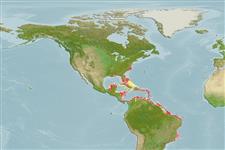
| Native range | All suitable habitat | Point map | Year 2050 |
|
| This map was computer-generated and has not yet been reviewed. |
| Hypanus say AquaMaps Data sources: GBIF OBIS |
Ladda upp din foton och Videor
Bilder | Google image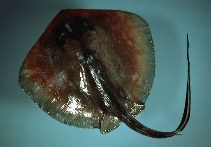 Hypanus say
Bild av Flescher, D.
Bilder | Google image
Bild av Flescher, D.
Klassificering / Namn Populärnamn | synonymer | Catalog of Fishes(Släkte, Arter) | ITIS | CoL | WoRMS | Cloffa
Elasmobranchii (hajar och rockor) (sharks and rays) > Myliobatiformes (Stingrays) > Dasyatidae (Stingrays) > Dasyatinae
Eponymy: Thomas Say (1787–1834) was a self-taught American naturalist whose primary interest was entomology. [...] (Ref. 128868), visit book page.
More on author: Lesueur.
Eponymy: Thomas Say (1787–1834) was a self-taught American naturalist whose primary interest was entomology. [...] (Ref. 128868), visit book page.
More on author: Lesueur.
Miljö: miljö / Klimatzon / djupintervall / distributionsområde Ekologi
marina; brackvatten bottenlevande; djupintervall 1 - 10 m (Ref. 55208), usually 1 - ? m (Ref. 55208). Subtropical; 45°N - 28°S, 95°W - 33°W (Ref. 55208)
Utbredning Territorier | FAO områden | Ekosystem | Förekomster | Prickkarta | Utplanteringar | Faunafri
Western Atlantic: New Jersey (rarely in Massachusetts), USA and northern Gulf of Mexico to Argentina; widespread in the West Indies. Throughout Antilles (Ref. 26938).
Längd vid första mognad / Storlek / Vikt / Ålder
Kort beskrivning Bestämningsnycklar | Morfologi | Morfometri
Moderate size, with a short blunt snout. Disk has rounded corners, few tubercles and spines along midline (Ref. 26938). Well developed fold on the upper surface and lower surface of tail. Yellowish or light brown above. Lower surface whitish or pure white (Ref. 6902).
Body shape (shape guide): other.
Body shape (shape guide): other.
Inhabits coastal waters (Ref. 7251). Generally found near shore, to depths of 10 m. Both adults and juveniles frequent estuaries and surf zones (Ref. 27549). Bottom feeder with fish, clams, worms and shrimps. It causes a number of injuries to bathers and waders (Ref. 26938). Ovoviviparous (Ref. 50449). Litters of 2-4 pups; gestation 10-11 months, including a period of embryonic diapause (Ref. 114953).
Livscykel och parningsbeteende Könsmognad | Reproduktion | Lek | Ägg | Fekunditet | Larver
Exhibit ovoviparity (aplacental viviparity), with embryos feeding initially on yolk, then receiving additional nourishment from the mother by indirect absorption of uterine fluid enriched with mucus, fat or protein through specialised structures (Ref. 50449). Distinct pairing with embrace (Ref. 205).
Huvudreferens
Ladda upp dina referenser | referenser | Koordinator : McEachran, John | Medarbetare
Compagno, L.J.V., 1999. Checklist of living elasmobranchs. p. 471-498. In W.C. Hamlett (ed.) Sharks, skates, and rays: the biology of elasmobranch fishes. Johns Hopkins University Press, Maryland. (Ref. 35766)
Status på IUCN:s rödlista (Ref. 130435: Version 2025-2 (Global))
Near Threatened (NT) (A2bd); Date assessed: 21 June 2019
CITES
Not Evaluated
Hot mot människor
Traumatogenic (Ref. 4716)
Mänskliga användningsområden
Sportfisk: ja
FAO - Publication: search | FishSource | Havet omkring oss
Ytterligare information
Populationsdynamik
Tillväxtparametrar
Max. åldrar / storlekar
Längd-vikt rel.
Längd-längd rel.
Längd-frekvenser
Massakonvertering
Rekrytering
Abundans
Tillväxtparametrar
Max. åldrar / storlekar
Längd-vikt rel.
Längd-längd rel.
Längd-frekvenser
Massakonvertering
Rekrytering
Abundans
Livscykel
Reproduktion
Könsmognad
Mognad/Gills rel.
Fekunditet
Lek
Lekande aggregat
Ägg
Utveckling av ägg
Larver
Larvdynamik
Reproduktion
Könsmognad
Mognad/Gills rel.
Fekunditet
Lek
Lekande aggregat
Ägg
Utveckling av ägg
Larver
Larvdynamik
Anatomi
Gälyta
Hjärna
Otolit
Gälyta
Hjärna
Otolit
Fysiologi
Kroppssammansättning
Näringsämnen
Syreförbrukning
Typ av simning
Simhastighet
Visuella pigment
Ljud från fisk
Sjukdomar & Parasiter
Toxicitet (LC50)
Kroppssammansättning
Näringsämnen
Syreförbrukning
Typ av simning
Simhastighet
Visuella pigment
Ljud från fisk
Sjukdomar & Parasiter
Toxicitet (LC50)
Människorelaterad
Vattenbrukssystem
Vattenbruksprofiler
Avelslinjer
Ciguatera-fall
Frimärken, mynt, diverse.
Vattenbrukssystem
Vattenbruksprofiler
Avelslinjer
Ciguatera-fall
Frimärken, mynt, diverse.
Verktyg
E-bok | Fälthandbok | Bestämningsnycklar | Längdfördelnings-verktyg | Livshistorie-verktyg | Prickkarta |
Fångst-MSY |
Särskilda rapporter
Kontrollera för underhåll av akvarium | Kontrollera om det finns faktablad om arter | Kontrollera om det finns faktablad om vattenbruk
Ladda ner XML
Internet-källor
AFORO (otoliths) | Aquatic Commons | BHL | Cloffa | Websites from users | Check FishWatcher | CISTI | Catalog of Fishes: Släkte, Arter | DiscoverLife | ECOTOX | FAO - Publication: search | Faunafri | Fishipedia | Fishtrace | GloBI | Google Books | Google Scholar | Google | IGFA World Record | Nationella databaser | OceanAdapt | OneZoom | Open Tree of Life | Otolith Atlas of Taiwan Fishes | PubMed | Reef Life Survey | Socotra Atlas | TreeBase | Tree of Life | Wikipedia: Go, sök | World Records Freshwater Fishing | Zoologiskt register
Uppskattningar baserade på modeller
Önskad temperatur (Ref. 123201): 23.1 - 28.1, mean 27.1 °C (based on 760 cells).
Index för fylogenetisk mångfald (Ref. 82804): PD50 = 0.5010 [Uniqueness, from 0.5 = low to 2.0 = high].
Bayesian length-weight: a=0.00447 (0.00189 - 0.01058), b=3.12 (2.92 - 3.32), in cm total length, based on LWR estimates for this (Sub)family-body shape (Ref. 93245).
Trofisk nivå (Ref. 69278): 3.7 ±0.2 se; based on diet studies.
Resiliens (Ref. 120179): Låg, lägsta populationsfördubblingstid 4,5-14 år (Assuming fecundity<100).
Näringsämnen (Ref. 124155): Calcium = 26.4 [3.6, 122.6] mg/100g; Iron = 0.744 [0.197, 2.068] mg/100g; Protein = 23.9 [21.1, 26.5] %; Omega3 = 0.23 [0.06, 0.69] g/100g; Selenium = 12.5 [3.8, 37.8] μg/100g; VitaminA = 9.03 [3.46, 23.49] μg/100g; Zinc = 0.738 [0.357, 1.351] mg/100g (wet weight);