



Ladda upp din foton och Videor
Bilder | Google image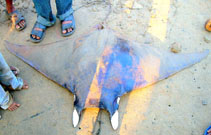 Mobula eregoodoo
Bild av Devarapalli, P.
Bilder | Google image
Bild av Devarapalli, P.
Klassificering / Namn Populärnamn | synonymer | Catalog of Fishes(Släkte, Arter) | ITIS | CoL | WoRMS | Cloffa
Elasmobranchii (hajar och rockor) (sharks and rays) > Myliobatiformes (Stingrays) > Mobulidae (Devilrays)
Etymology: eregoodoo: According to Russell (1803), derived from a vernacular name used in the region of Coromandel (south-east India), designating a mobulid ray (Ref. 132274).
Etymology: eregoodoo: According to Russell (1803), derived from a vernacular name used in the region of Coromandel (south-east India), designating a mobulid ray (Ref. 132274).
Miljö: miljö / Klimatzon / djupintervall / distributionsområde Ekologi
marina pelagic-oceanic; djupintervall 0 - 50 m (Ref. 106604). Tropical; 30°N - 21°S
Utbredning Territorier | FAO områden | Ekosystem | Förekomster | Prickkarta | Utplanteringar | Faunafri
Indo-West Pacific: tropical-subtropical; from the northern Red Sea (26ºN; Egypt) to South Africa (29ºS; Durban); eastward into the Arabian–Persian Gulf, Arabian Sea, Pakistan, southern India, Bangladesh, Malaysia, West and North Australia, to western Pacific, including Sarawak and parts of Indonesia, north to Taiwan (22ºN; Kaohsiung), western Papua New Guinea, and eastern Australia (26ºS; New South Wales).
Storlek / Vikt / Ålder
Könsmognad: Lm ? range ? - ? cm
Max length : 123 cm WD hane/ej könsbestämd; (Ref. 132274); 130.0 cm WD (female)
Max length : 123 cm WD hane/ej könsbestämd; (Ref. 132274); 130.0 cm WD (female)
Kort beskrivning Bestämningsnycklar | Morfologi | Morfometri
This small mobulid is distinguished by the following characters: pectoral fins very short and with one of the lowest aspect ratios of the genus (i.e. the ratio of DW to disc length, 1:0.578, n = 50), with high relative values of longitudinal metrics (e.g. disc length and anterior projection); head and cephalic fins very elongated with tip of cephalic fin to spiracle 16.5% of DW (n = 50); pre-oral length 5.9% of DW (n = 50); no caudal spine; base of tail quadrangular in section; spiracle very small, subcircular, ventral to plane of pectoral fins; a distinct dark blotch on ventral side of pectoral fins at the midpoint along the leading edge; branchial filter plates distinctively reduced, with four (rarely five) lateral lobes; terminal lobe also distinctively elongated and leaf shaped, pointed terminal lobe (its length almost one-quarter of the plate); colour of plates whitish pink; tooth bands on average 73% of mouth width; most teeth in adult males with multiple long lingual cusps (Ref. 132274).
Cross section: oval.
Cross section: oval.
Found in coastal and oceanic waters (Ref. 30573); solitary or aggregations, sometimes with 50 or more individuals (Ref. 90102). Not known to penetrate the epipelagic zone (Ref. 9911). Ovoviviparous (Ref. 50449).
Livscykel och parningsbeteende Könsmognad | Reproduktion | Lek | Ägg | Fekunditet | Larver
Exhibit ovoviparity (aplacental viviparity), with embryos feeding initially on yolk, then receiving additional nourishment from the mother by indirect absorption of uterine fluid enriched with mucus, fat or protein through specialised structures (Ref. 50449).
Huvudreferens
Ladda upp dina referenser | referenser | Koordinator | Medarbetare
Notarbartolo di Sciara, G., S. Adnet, M. Bennett, M.K. Broadhurst, D. Fernando, R.W. Jabado, B.J.L. Laglbauer and G.
Jabado, R. ( Stevens, 2019. Taxonomic status, biological notes, and conservation of the longhorned pygmy devil ray Mobula eregoodoo Cantor, 1849). Aquatic Conserv: Mar Freshw Ecosyst. 2019;1-19. (Ref. 132274)
Status på IUCN:s rödlista (Ref. 130435: Version 2025-2 (Global))
Endangered (EN) (A2bd+3d); Date assessed: 20 January 2020
Hot mot människor
Harmless
Mänskliga användningsområden
Fiskeri: husbehovsfiske
FAO - Publication: search | FishSource |
Ytterligare information
Populationsdynamik
Tillväxtparametrar
Max. åldrar / storlekar
Längd-vikt rel.
Längd-längd rel.
Längd-frekvenser
Massakonvertering
Rekrytering
Abundans
Tillväxtparametrar
Max. åldrar / storlekar
Längd-vikt rel.
Längd-längd rel.
Längd-frekvenser
Massakonvertering
Rekrytering
Abundans
Livscykel
Reproduktion
Könsmognad
Mognad/Gills rel.
Fekunditet
Lek
Lekande aggregat
Ägg
Utveckling av ägg
Larver
Larvdynamik
Reproduktion
Könsmognad
Mognad/Gills rel.
Fekunditet
Lek
Lekande aggregat
Ägg
Utveckling av ägg
Larver
Larvdynamik
Anatomi
Gälyta
Hjärna
Otolit
Gälyta
Hjärna
Otolit
Fysiologi
Kroppssammansättning
Näringsämnen
Syreförbrukning
Typ av simning
Simhastighet
Visuella pigment
Ljud från fisk
Sjukdomar & Parasiter
Toxicitet (LC50)
Kroppssammansättning
Näringsämnen
Syreförbrukning
Typ av simning
Simhastighet
Visuella pigment
Ljud från fisk
Sjukdomar & Parasiter
Toxicitet (LC50)
Genetik
Genom
Genetik
Heterozygositet
Ärftlighet
Genetisk mångfald
Genom
Genetik
Heterozygositet
Ärftlighet
Genetisk mångfald
Människorelaterad
Vattenbrukssystem
Vattenbruksprofiler
Avelslinjer
Ciguatera-fall
Frimärken, mynt, diverse.
Vattenbrukssystem
Vattenbruksprofiler
Avelslinjer
Ciguatera-fall
Frimärken, mynt, diverse.
Verktyg
Särskilda rapporter
Kontrollera för underhåll av akvarium | Kontrollera om det finns faktablad om arter | Kontrollera om det finns faktablad om vattenbruk
Ladda ner XML
Internet-källor
AFORO (otoliths) | Aquatic Commons | BHL | Cloffa | Websites from users | Check FishWatcher | CISTI | Catalog of Fishes: Släkte, Arter | DiscoverLife | ECOTOX | FAO - Publication: search | Faunafri | Fishipedia | Fishtrace | GloBI | Google Books | Google Scholar | Google | IGFA World Record | OneZoom | Open Tree of Life | Otolith Atlas of Taiwan Fishes | PubMed | Reef Life Survey | Socotra Atlas | TreeBase | Tree of Life | Wikipedia: Go, sök | World Records Freshwater Fishing | Zoologiskt register
Uppskattningar baserade på modeller
Önskad temperatur (Ref. 123201): 25.6 - 29.1, mean 28.2 °C (based on 2136 cells).
Index för fylogenetisk mångfald (Ref. 82804): PD50 = 0.5020 [Uniqueness, from 0.5 = low to 2.0 = high].
Bayesian length-weight: a=0.01000 (0.00244 - 0.04107), b=3.04 (2.81 - 3.27), in cm total length, based on all LWR estimates for this body shape (Ref. 93245).
Trofisk nivå (Ref. 69278): 3.4 ±0.45 se; based on food items.
Resiliens (Ref. 120179): Låg, lägsta populationsfördubblingstid 4,5-14 år (Fec assumed to be <100).
Näringsämnen (Ref. 124155): Calcium = 26.5 [7.6, 139.1] mg/100g; Iron = 0.962 [0.235, 2.819] mg/100g; Protein = 21 [16, 26] %; Omega3 = 0.184 [0.050, 0.609] g/100g; Selenium = 50.2 [13.3, 160.3] μg/100g; VitaminA = 23.1 [7.7, 73.7] μg/100g; Zinc = 0.942 [0.449, 1.798] mg/100g (wet weight);