



Carica il tuo foto e Video
Immagini | Google image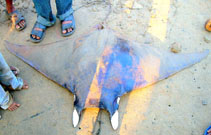 Mobula eregoodoo
Immagine di Devarapalli, P.
Immagini | Google image
Immagine di Devarapalli, P.
Classificazione / Nomi Nomi Comuni | Sinonimi | Catalog of Fishes(Genere, Specie) | ITIS | CoL | WoRMS | Cloffa
Elasmobranchi (squali e razze) (sharks and rays) > Myliobatiformes (Stingrays) > Mobulidae (Devilrays)
Etymology: eregoodoo: According to Russell (1803), derived from a vernacular name used in the region of Coromandel (south-east India), designating a mobulid ray (Ref. 132274).
Etymology: eregoodoo: According to Russell (1803), derived from a vernacular name used in the region of Coromandel (south-east India), designating a mobulid ray (Ref. 132274).
Ambiente: milieu / zona climatica / distribuzione batimetrica / gamma di distribuzione Ecologia
marino pelagic-oceanic; distribuzione batimetrica 0 - 50 m (Ref. 106604). Tropical; 30°N - 21°S
Distribuzione Territories | Aree FAO | Ecosistemi | Presenze | Mappa dei ritrovamenti | Introduzioni | Faunafri
Indo-West Pacific: tropical-subtropical; from the northern Red Sea (26ºN; Egypt) to South Africa (29ºS; Durban); eastward into the Arabian–Persian Gulf, Arabian Sea, Pakistan, southern India, Bangladesh, Malaysia, West and North Australia, to western Pacific, including Sarawak and parts of Indonesia, north to Taiwan (22ºN; Kaohsiung), western Papua New Guinea, and eastern Australia (26ºS; New South Wales).
Dimensione / Peso / Età
Maturità: Lm ? range ? - ? cm
Max length : 123 cm WD maschio/sesso non determinato; (Ref. 132274); 130.0 cm WD (female)
Max length : 123 cm WD maschio/sesso non determinato; (Ref. 132274); 130.0 cm WD (female)
Breve descrizione Chiavi di identificazione | Morfologia | Morfometria
This small mobulid is distinguished by the following characters: pectoral fins very short and with one of the lowest aspect ratios of the genus (i.e. the ratio of DW to disc length, 1:0.578, n = 50), with high relative values of longitudinal metrics (e.g. disc length and anterior projection); head and cephalic fins very elongated with tip of cephalic fin to spiracle 16.5% of DW (n = 50); pre-oral length 5.9% of DW (n = 50); no caudal spine; base of tail quadrangular in section; spiracle very small, subcircular, ventral to plane of pectoral fins; a distinct dark blotch on ventral side of pectoral fins at the midpoint along the leading edge; branchial filter plates distinctively reduced, with four (rarely five) lateral lobes; terminal lobe also distinctively elongated and leaf shaped, pointed terminal lobe (its length almost one-quarter of the plate); colour of plates whitish pink; tooth bands on average 73% of mouth width; most teeth in adult males with multiple long lingual cusps (Ref. 132274).
Cross section: oval.
Cross section: oval.
Found in coastal and oceanic waters (Ref. 30573); solitary or aggregations, sometimes with 50 or more individuals (Ref. 90102). Not known to penetrate the epipelagic zone (Ref. 9911). Ovoviviparous (Ref. 50449).
Ciclo vitale e comportamento di accoppiamento Maturità | Riproduzione | Deposizione | Uova | Fecondità | Larve
Exhibit ovoviparity (aplacental viviparity), with embryos feeding initially on yolk, then receiving additional nourishment from the mother by indirect absorption of uterine fluid enriched with mucus, fat or protein through specialised structures (Ref. 50449).
Riferimento principale
Caricare le referenze | Bibliografia | Coordinatore | Collaboratori
Notarbartolo di Sciara, G., S. Adnet, M. Bennett, M.K. Broadhurst, D. Fernando, R.W. Jabado, B.J.L. Laglbauer and G.
Jabado, R. ( Stevens, 2019. Taxonomic status, biological notes, and conservation of the longhorned pygmy devil ray Mobula eregoodoo Cantor, 1849). Aquatic Conserv: Mar Freshw Ecosyst. 2019;1-19. (Ref. 132274)
Stato della Lista Rossa IUCN (Ref. 130435: Version 2025-2 (Global))
Endangered (EN) (A2bd+3d); Date assessed: 20 January 2020
Minaccia per l'uomo
Harmless
Usi umani
Pesca: pesca di sussistenza
FAO - Publication: search | FishSource |
Informazioni ulteriori
Ecologia trofica
Articoli alimentari (prede)
Alimentazione
Consumo di cibo
Razioni alimentari
Predatori
Articoli alimentari (prede)
Alimentazione
Consumo di cibo
Razioni alimentari
Predatori
Dinamica della popolazione
Parametri di crescita
Età massima / dimensioni massime
Rapporto lunghezza-peso.
Lunghezza-lunghezza rel.
Lunghezza-frequenze
Conversione di massa
Reclutamento
Abbondanza
Parametri di crescita
Età massima / dimensioni massime
Rapporto lunghezza-peso.
Lunghezza-lunghezza rel.
Lunghezza-frequenze
Conversione di massa
Reclutamento
Abbondanza
Ciclo di vita
Riproduzione
Maturità
Maturità/Gli occhielli sono relativi.
Fecondità
Deposizione
Aggregazioni riproduttive
Uova
Sviluppo delle uova
Larve
Dinamica popolazioni larvali
Riproduzione
Maturità
Maturità/Gli occhielli sono relativi.
Fecondità
Deposizione
Aggregazioni riproduttive
Uova
Sviluppo delle uova
Larve
Dinamica popolazioni larvali
Anatomia
Area branchiale
Cervello
Otolite
Area branchiale
Cervello
Otolite
Fisiologia
Composizione corporea
Nutrienti
Consumo di ossigeno
Tipo di nuoto
Velocità di nuoto
Pigmenti visivi
Suono del pesce
Malattie e parassiti
Tossicità (LC50)
Composizione corporea
Nutrienti
Consumo di ossigeno
Tipo di nuoto
Velocità di nuoto
Pigmenti visivi
Suono del pesce
Malattie e parassiti
Tossicità (LC50)
Genetica
Genome
Genetica
Eterozigosi
Ereditarietà
Diversità genetica
Genome
Genetica
Eterozigosi
Ereditarietà
Diversità genetica
Legato all'uomo
Sistemi di acquacoltura
Profili di acquacoltura
Varietà
Casi di Ciguatera
Francobolli, monete, materiale vario.
Sistemi di acquacoltura
Profili di acquacoltura
Varietà
Casi di Ciguatera
Francobolli, monete, materiale vario.
Strumenti
Libro elettronico | Giuda pratica | Generatore frequenze di lunghezza | Strumento Parametri Biologici | Mappa dei ritrovamenti |
Cattura-MSY |
Rapporti speciali
Controllo della manutenzione dell'acquario | Verificare la presenza di schede informative sulle specie | Verifica delle schede informative sull'acquacoltura
Scarica XML
Fonti Internet
AFORO (otoliths) | Aquatic Commons | BHL | Cloffa | Websites from users | Check FishWatcher | CISTI | Catalog of Fishes: Genere, Specie | DiscoverLife | ECOTOX | FAO - Publication: search | Faunafri | Fishipedia | Fishtrace | GloBI | Google Books | Google Scholar | Google | IGFA World Record | OneZoom | Open Tree of Life | Otolith Atlas of Taiwan Fishes | PubMed | Reef Life Survey | Socotra Atlas | TreeBase | Tree of Life | Wikipedia: Go, ricerca | World Records Freshwater Fishing | Record zoologico
Stime basate su modelli
Temperatura preferita (Fonte Biblio. 123201): 25.6 - 29.1, mean 28.2 °C (based on 2136 cells).
Indice di diversità filogenetica (Fonte Biblio. 82804): PD50 = 0.5020 [Uniqueness, from 0.5 = low to 2.0 = high].
Bayesian length-weight: a=0.01000 (0.00244 - 0.04107), b=3.04 (2.81 - 3.27), in cm total length, based on all LWR estimates for this body shape (Ref. 93245).
Livello trofico (Fonte Biblio. 69278): 3.4 ±0.45 se; based on food items.
Resilienza (Fonte Biblio. 120179): Basso, tempo minimo di raddoppiamento della popolazione 4.5 - 14 anni (Fec assumed to be <100).
Nutrienti (Ref. 124155): Calcium = 26.5 [7.6, 139.1] mg/100g; Iron = 0.962 [0.235, 2.819] mg/100g; Protein = 21 [16, 26] %; Omega3 = 0.184 [0.050, 0.609] g/100g; Selenium = 50.2 [13.3, 160.3] μg/100g; VitaminA = 23.1 [7.7, 73.7] μg/100g; Zinc = 0.942 [0.449, 1.798] mg/100g (wet weight);