



Oreochromis lidole (Trewavas, 1941)
Lidole
Sube tu fotos y Vídeos
Imágenes | Google image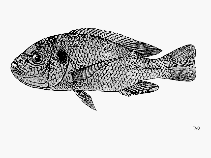 Oreochromis lidole
Foto de FAO
Imágenes | Google image
Foto de FAO
Clasificación / Nombres Nombres comunes | Sinónimos | Catalog of Fishes(Género, Especie) | ITIS | CoL | WoRMS | Cloffa
> Cichliformes (Cichlids, convict blennies) > Cichlidae (Cichlids) > Pseudocrenilabrinae
Etymology: Oreochromis: Latin, aurum = gold + Greek, chromis = a fish, perhaps a perch (Ref. 45335).
More on author: Trewavas.
Etymology: Oreochromis: Latin, aurum = gold + Greek, chromis = a fish, perhaps a perch (Ref. 45335).
More on author: Trewavas.
Entorno: milieu / zona climática / rango de profundidad / gama de distribución Ecología
; agua dulce bentopelágico; rango de profundidad 30 - 100 m (Ref. 4967). Tropical; 8°S - 15°S
Distribución Territorios | Áreas FAO | Ecosistemas | Ocurrencias, apariciones | Mapa de puntos | Introducciones | Faunafri
Africa: Lake Malawi (Ref. 2, 5166, 118630). Reports from Lake Chungruru (Ref. 2, 54852) and Lake Kingiri (Ref. 2, 54852) are misidentifications of Oreochromis chungruruensis and juvenile Oreochromis squamipinnis respectively (Ref. 118638).
Longitud en la primera madurez / Tamaño / Peso / Edad
Descripción breve Claves de identificación | Morfología | Morfometría
Espinas dorsales (total) : 14 - 17; Radios blandos dorsales (total) : 10 - 11; Espinas anales: 3; Radios blandos anales: 8 - 10; Vértebra: 30 - 32. Diagnosis: breeding male black; length of head 34.4-42.4% SL; length of lower jaw 31.3-40.0% head length (Ref. 2). Teeth of jaw in 3-4, rarely 5 rows (Ref. 2,6150). Lower pharyngeal bone with restricted toothed area; median length of bone 33.0-40.7 % length of head and 1.3-1.5 times its own width; blade 1.9-3.9 times median length of toothed area (Ref. 2).
Body shape (shape guide): fusiform / normal; Cross section: compressed.
Body shape (shape guide): fusiform / normal; Cross section: compressed.
Occurs in all kinds of habitats but is mainly found in open water away from the coast (Ref. 5595). The most pelagic of the Lake Malawi Oreochromis species (Ref. 2, 87, 4364, 4916, 4967). Forms schools (Ref. 2, 2781). Feeds on phytoplankton (Ref. 2, 87, 5595, 10402, 42295, 52161). Female mouthbrooder (Ref. 2). It is suspected that Oreochromis lidole is now globally extinct, as it has not been positively recorded since 2007 (Ref. 118638).
Ciclo vital y comportamiento de apareamiento Madurez | Reproducción | Puesta | Huevos | Fecundidad | Larva
Seems to be sexually mature at a smaller size in Lakes Chungruru and Kingiri than in Lake Malawi (Ref. 2, 54852). Spawns off clean sandy or rocky shores (Ref. 2, 87, 2781) in deeper water (Ref. 2, 87, 2781, 5595, 6150, 40193). Territorial males build a large (Ref. 5595, 40193, 55079) sand-castle nest, with a characteristic spawning cone in its center (Ref. 2, 5595). Females congregate in schools that may number hundreds of individuals (Ref. 2, 2781, 5595). The male genital tassel, which develops together with the breeding dress and imitates a clutch of eggs, is dragged through the nest after the females has deposited some eggs, which are picked up immediately; the female probably mistakes the tassel for eggs that have been forgotten and tries to collect them as well, which results in the eggs being fertilized (Ref. 5595). Females carrying eggs in the mouth move into open, more eutrophic waters, and stay there until the young have almost lost the yolk sac; they feed little during this time (Ref. 2781). Females brood eggs/young, guarding their fry until about 52(-58)mm (Ref. 2, 2781). Females move inshore with their young for at least part of the day; the young are spat out to feed, and food (small phytoplankton) is found in the foregut before the involuted yolk-sac is fully absorbed (Ref. 2781).
Referencia principal
Suba sus referencias | Referencias | Coordinador : Kullander, Sven O. | Colaboradores
Trewavas, E. and G.G. Teugels, 1991. Oreochromis. p. 307-346. In J. Daget, J.-P. Gosse, G.G. Teugels and D.F.E. Thys van den Audenaerde (eds.) Checklist of the freshwater fishes of Africa (CLOFFA). ISNB, Brussels; MRAC, Tervuren; and ORSTOM, Paris. Vol. 4. (Ref. 5166)
Situación en la Lista Roja de la UICN (Ref. 130435: Version 2025-2 (Global))
Critically Endangered (CR) (A2d); Date assessed: 20 June 2018
CITES
Not Evaluated
Amenaza para el ser humano
Harmless
Usos humanos
Pesquerías: comercial; Acuario: Comercial
FAO - Publication: search | FishSource |
Más información
Ecología Trófica
Alimentos (presas)
Composición de la dieta
consumo de alimento
Raciones de comida
Despredadores
Alimentos (presas)
Composición de la dieta
consumo de alimento
Raciones de comida
Despredadores
Dinámica de la población
Coeficiente del crecimiento para
Edades / tallas máximas
Longitud-peso rel.
Longitud-longitud rel.
Longitud-frecuencias
Conversión de masas
Reclutamiento
Abundancia
Coeficiente del crecimiento para
Edades / tallas máximas
Longitud-peso rel.
Longitud-longitud rel.
Longitud-frecuencias
Conversión de masas
Reclutamiento
Abundancia
Ciclo de vida
Reproducción
Madurez
Madurez/Gills rel.
Fecundidad
Puesta
Agregaciones de desove
Huevos
Desarrollo de los huevos
Larva
Dinámica larvaria
Reproducción
Madurez
Madurez/Gills rel.
Fecundidad
Puesta
Agregaciones de desove
Huevos
Desarrollo de los huevos
Larva
Dinámica larvaria
Distribución
Territorios
Áreas FAO
Ecosistemas
Ocurrencias, apariciones
Introducciones
BRUVS - Vídeos
Territorios
Áreas FAO
Ecosistemas
Ocurrencias, apariciones
Introducciones
BRUVS - Vídeos
Anatomía
Superficie branquial
Cerebro
Otolito
Superficie branquial
Cerebro
Otolito
Fisiología
Composición corporal
Nutrientes
Consumo del oxígeno
Tipo de natación
Velocidad de natación
Pigmentos visuales
Sonido de peces
Enfermedades y parásitos
Toxicidad (CL50)
Composición corporal
Nutrientes
Consumo del oxígeno
Tipo de natación
Velocidad de natación
Pigmentos visuales
Sonido de peces
Enfermedades y parásitos
Toxicidad (CL50)
Genética
Genoma
Genética
Heterocigosidad
heritabilidad
Diversidad genética
Genoma
Genética
Heterocigosidad
heritabilidad
Diversidad genética
Relacionados con el ser humano
Sistemas de acuicultura
Perfiles de acuicultura
Razas
Ciguatera cases
Sellos, monedas, varios
Sistemas de acuicultura
Perfiles de acuicultura
Razas
Ciguatera cases
Sellos, monedas, varios
Herramientas
Libro electrónico | Guía de campo | Asistente para frecuencias de tallas | Herramienta de ciclo de vida | Mapa de puntos |
Catch-MSY |
Informes especiales
Comprobar el mantenimiento del acuario | Buscar fichas sobre especies | Consulte las hojas informativas sobre acuicultura
Descargar XML
Fuentes de Internet
AFORO (otoliths) | Aquatic Commons | BHL | Cloffa | Websites from users | Check FishWatcher | CISTI | Catalog of Fishes: Género, Especie | DiscoverLife | ECOTOX | FAO - Publication: search | Faunafri | Fishipedia | Fishtrace | GloBI | Google Books | Google Scholar | Google | IGFA World Record | OneZoom | Open Tree of Life | Otolith Atlas of Taiwan Fishes | PubMed | Reef Life Survey | Socotra Atlas | TreeBase | Árbol de la vida | Wikipedia: Go, búsqueda | World Records Freshwater Fishing | Expediente Zoológico
Estimaciones basadas en modelos
Índice de diversidad filogenética (Referencia 82804): PD50 = 0.5000 [Uniqueness, from 0.5 = low to 2.0 = high].
Bayesian length-weight: a=0.01349 (0.00685 - 0.02655), b=2.98 (2.82 - 3.14), in cm total length, based on LWR estimates for this species & Genus-body shape (Ref. 93245).
Nivel trófico (Referencia 69278): 2.3 ±0.22 se; based on food items.
Resiliencia (Referencia 120179): Medio, población duplicada en un tiempo mínimo de 1.4-4.4 años (K=0.18-0.52; tm=3).
Nutrientes (Ref. 124155): Calcium = 13.5 [5.8, 74.3] mg/100g; Iron = 1.2 [0.5, 2.9] mg/100g; Protein = 17.9 [16.2, 19.7] %; Omega3 = 0.432 [0.150, 1.200] g/100g; Selenium = 95.6 [35.2, 222.7] μg/100g; VitaminA = 21.7 [4.8, 87.9] μg/100g; Zinc = 1.99 [1.08, 4.62] mg/100g (wet weight); based on nutrient studies.