



Oreochromis lidole (Trewavas, 1941)
Lidole
Uploaden van uw Foto's en video's
Afbeeldingen | Google afbeelding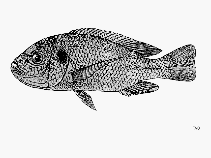 Oreochromis lidole
Afbeelding van FAO
Afbeeldingen | Google afbeelding
Afbeelding van FAO
Classificatie / Namen Lokale namen | Synoniemen | Catalog of Fishes(Genus, Soort(en)) | ITIS | CoL | WoRMS | Cloffa
> Cichliformes (Cichlids, convict blennies) > Cichlidae (Cichlids) > Pseudocrenilabrinae
Etymology: Oreochromis: Latin, aurum = gold + Greek, chromis = a fish, perhaps a perch (Ref. 45335).
More on author: Trewavas.
Etymology: Oreochromis: Latin, aurum = gold + Greek, chromis = a fish, perhaps a perch (Ref. 45335).
More on author: Trewavas.
Milieu: milieu / Klimaatzone / Diepte / verspreidingsgebied Ecologie
; zoet water benthopelagisch; diepte 30 - 100 m (Ref. 4967). Tropical; 8°S - 15°S
Verspreiding Gebieden | FAO regio's | Ecosystemen | Voorkomen | Verspreidingskaart | Introducties | Faunafri
Africa: Lake Malawi (Ref. 2, 5166, 118630). Reports from Lake Chungruru (Ref. 2, 54852) and Lake Kingiri (Ref. 2, 54852) are misidentifications of Oreochromis chungruruensis and juvenile Oreochromis squamipinnis respectively (Ref. 118638).
Lengte bij maturiteit / Grootte / Gewicht / Leeftijd
Maturiteit: Lm 29.9, range 24 - 37 cm
Max length : 38.0 cm SL mannelijk / geslacht onbekend; (Ref. 4967)
Max length : 38.0 cm SL mannelijk / geslacht onbekend; (Ref. 4967)
Korte beschrijving Determinatiesleutels | Morfologie | Morfometrie
Dorsale stekels (totaal) : 14 - 17; Dorsale zachte stralen (totaal) : 10 - 11; Anale stekels: 3; Anale zachte stralen: 8 - 10; Wervels: 30 - 32. Diagnosis: breeding male black; length of head 34.4-42.4% SL; length of lower jaw 31.3-40.0% head length (Ref. 2). Teeth of jaw in 3-4, rarely 5 rows (Ref. 2,6150). Lower pharyngeal bone with restricted toothed area; median length of bone 33.0-40.7 % length of head and 1.3-1.5 times its own width; blade 1.9-3.9 times median length of toothed area (Ref. 2).
Body shape (shape guide): fusiform / normal; Cross section: compressed.
Body shape (shape guide): fusiform / normal; Cross section: compressed.
Occurs in all kinds of habitats but is mainly found in open water away from the coast (Ref. 5595). The most pelagic of the Lake Malawi Oreochromis species (Ref. 2, 87, 4364, 4916, 4967). Forms schools (Ref. 2, 2781). Feeds on phytoplankton (Ref. 2, 87, 5595, 10402, 42295, 52161). Female mouthbrooder (Ref. 2). It is suspected that Oreochromis lidole is now globally extinct, as it has not been positively recorded since 2007 (Ref. 118638).
Levenscyclus en paargedrag Maturiteit | Voortplanting | Paaien | Eieren | Fecunditeit | Larven
Seems to be sexually mature at a smaller size in Lakes Chungruru and Kingiri than in Lake Malawi (Ref. 2, 54852). Spawns off clean sandy or rocky shores (Ref. 2, 87, 2781) in deeper water (Ref. 2, 87, 2781, 5595, 6150, 40193). Territorial males build a large (Ref. 5595, 40193, 55079) sand-castle nest, with a characteristic spawning cone in its center (Ref. 2, 5595). Females congregate in schools that may number hundreds of individuals (Ref. 2, 2781, 5595). The male genital tassel, which develops together with the breeding dress and imitates a clutch of eggs, is dragged through the nest after the females has deposited some eggs, which are picked up immediately; the female probably mistakes the tassel for eggs that have been forgotten and tries to collect them as well, which results in the eggs being fertilized (Ref. 5595). Females carrying eggs in the mouth move into open, more eutrophic waters, and stay there until the young have almost lost the yolk sac; they feed little during this time (Ref. 2781). Females brood eggs/young, guarding their fry until about 52(-58)mm (Ref. 2, 2781). Females move inshore with their young for at least part of the day; the young are spat out to feed, and food (small phytoplankton) is found in the foregut before the involuted yolk-sac is fully absorbed (Ref. 2781).
Hoofdreferentie
Upload uw referenties | Referenties | Coördinator : Kullander, Sven O. | Medewerkers
Trewavas, E. and G.G. Teugels, 1991. Oreochromis. p. 307-346. In J. Daget, J.-P. Gosse, G.G. Teugels and D.F.E. Thys van den Audenaerde (eds.) Checklist of the freshwater fishes of Africa (CLOFFA). ISNB, Brussels; MRAC, Tervuren; and ORSTOM, Paris. Vol. 4. (Ref. 5166)
Status op de Rode Lijst van het IUCN (Ref. 130435: Version 2025-2 (Global))
Ernstig bedreigd (CR) (A2d); Date assessed: 20 June 2018
CITES
Not Evaluated
Gevaar voor de mens
Harmless
Gebruik door de mens
Visserij: commercieel; Aquarium: Commercieel
FAO - Publication: search | FishSource |
Meer informatie
Trofische ecologie
Voedsel (prooien)
Dieetsamenstelling
Voedselconsumptie
Voedselrantsoenen
Predatoren
Voedsel (prooien)
Dieetsamenstelling
Voedselconsumptie
Voedselrantsoenen
Predatoren
Populatiedynamica
Groeiparameters
Max. leeftijden / maten
Lengte-gewicht rel.
Lengte-lengte rel.
Lengtefrequenties
Massaconversie
Rekrutering
Abundantie
Groeiparameters
Max. leeftijden / maten
Lengte-gewicht rel.
Lengte-lengte rel.
Lengtefrequenties
Massaconversie
Rekrutering
Abundantie
Levenscyclus
Voortplanting
Maturiteit
Rijpheid/kieuwen rel.
Fecunditeit
Paaien
Paaibestanden
Eieren
Ontwikkeling van de eieren
Larven
Larvale populatiedynamiek
Voortplanting
Maturiteit
Rijpheid/kieuwen rel.
Fecunditeit
Paaien
Paaibestanden
Eieren
Ontwikkeling van de eieren
Larven
Larvale populatiedynamiek
Anatomie
Kieuwoppervlak
Hersenen
Otoliet
Kieuwoppervlak
Hersenen
Otoliet
Fysiologie
Lichaamssamenstelling
Voedingsstoffen
Zuurstofverbruik
Type zwemmen
Zwemsnelheid
Visuele pigmenten
Vis geluid
Ziekten en parasieten
Toxiciteit (LC50)
Lichaamssamenstelling
Voedingsstoffen
Zuurstofverbruik
Type zwemmen
Zwemsnelheid
Visuele pigmenten
Vis geluid
Ziekten en parasieten
Toxiciteit (LC50)
Genetica
genoom
Genetica
Heterozygositeit
Erfelijkheid
Genetische diversiteit
genoom
Genetica
Heterozygositeit
Erfelijkheid
Genetische diversiteit
Menselijk gerelateerd
Aquacultuursystemen
Aquacultuurprofielen
Kweeklijnen
Ciguatera gevallen
Postzegels, munten, diversen.
Aquacultuursystemen
Aquacultuurprofielen
Kweeklijnen
Ciguatera gevallen
Postzegels, munten, diversen.
Tools
Speciale rapporten
Bekijk gegevens voor het houden in een aquarium | Bekijk Fact Sheets voor de soort | Bekijk Aquacultuur Fact Sheets
Download XML
Internetbronnen
AFORO (otoliths) | Aquatic Commons | BHL | Cloffa | Websites from users | Bekijk FishWatcher | CISTI | Catalog of Fishes: Genus, Soort(en) | DiscoverLife | ECOTOX | FAO - Publication: search | Faunafri | Fishipedia | Fishtrace | GloBI | Google Books | Google Scholar | Google | IGFA World Record | OneZoom | Open Tree of Life | Otolith Atlas of Taiwan Fishes | PubMed | Reef Life Survey | Socotra Atlas | TreeBase | Tree of Life | Wikipedia: ga naar, zoek | World Records Freshwater Fishing | Zoological Record
Schattingen op basis van modellen
Fylogenetische diversiteitsindex (Ref. 82804): PD50 = 0.5000 [Uniqueness, from 0.5 = low to 2.0 = high].
Bayesian length-weight: a=0.01349 (0.00685 - 0.02655), b=2.98 (2.82 - 3.14), in cm total length, based on LWR estimates for this species & Genus-body shape (Ref. 93245).
Trofisch niveau (Ref. 69278): 2.3 ±0.22 se; based on food items.
Weerstandsvermogen (Ref. 120179): Gemiddeld, minimale populatieverdubbelingstijd 1,4-4,4 jaar (K=0.18-0.52; tm=3).
Voedingsstoffen (Ref. 124155): Calcium = 13.5 [5.8, 74.3] mg/100g; Iron = 1.2 [0.5, 2.9] mg/100g; Protein = 17.9 [16.2, 19.7] %; Omega3 = 0.432 [0.150, 1.200] g/100g; Selenium = 95.6 [35.2, 222.7] μg/100g; VitaminA = 21.7 [4.8, 87.9] μg/100g; Zinc = 1.99 [1.08, 4.62] mg/100g (wet weight); based on nutrient studies.