Lutjanus malabaricus, Malabar blood snapper : fisheries, gamefish, aquarium

Lutjanus malabaricus (Bloch & Schneider, 1801)

Malabar blood snapper
เพิ่มการสังเกตของคุณใน Fish Watcher
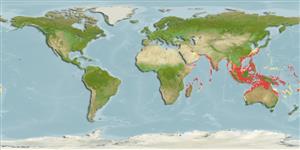
Native range | All suitable habitat | Point map | Year 2050
This map was computer-generated and has not yet been reviewed.
Lutjanus malabaricus   AquaMaps   Data sources: GBIF OBIS
อัพโหลดของคุณ ภาพถ่าย และ วิดีโอ
รูปภาพหลายรูป | Google image

การจำแนกประเภท / ชื่อ ชื่อสามัญ | ชื่อพ้อง | Catalog of Fishes(สกุล, ชนิด) | ITIS | CoL | WoRMS | Cloffa

> Eupercaria/misc (Various families in series Eupercaria) > Lutjanidae (Snappers) > Lutjaninae
Etymology: Lutjanus: Malay, ikan lutjan, name of a fish.
More on authors: Bloch & Schneider.

สิ่งแวดล้อม : สิ่งแวดล้อม / เขตภูมิอากาศ / ระดับความลึก / ระยะการกระจายสินค้า นิเวศวิทยา

เกี่ยวกับทะเล,น้ำเค็ม; กร่อย เกี่ยวกับหินโสโครก; ระดับความลึก 12 - 100 m (Ref. 55). Tropical; 33°N - 33°S, 43°E - 178°W

การแพร่กระจาย อาณาเขต | พื้นที่จำแนกตาม FAO | ระบบนิเวศหลายระบบ | การปรากฏขึ้น,การเกิดขึ้น,พบ | ตำแหน่งบนแผนที่ | การแนะนำ | Faunafri

Indo-West Pacific: Persian Gulf and Arabian Sea to Fiji, north to southern Japan, south to Australia. This species has been frequently misidentified as Lutjanus sanguineus (Ref. 55). There are unsubstantiated reports of this species from off East Africa.

ความยาวเมื่อครบกำหนดครั้งแรก / ขนาด / น้ำหนัก / อายุ

วัยเจริญพันธุ์: Lm 57.6, range 54 - ? cm
Max length : 100.0 cm TL เพศผู้/กระเทย; (Ref. 55); common length : 50.0 cm TL เพศผู้/กระเทย; (Ref. 55); น้ำหนักสูงสุดที่มีการรายงาน: 7.9 kg (Ref. 4699); อายุสูงสุดที่ได้รายงาน: 48 ปี (Ref. 116872)

คำอธิบายสั้นๆ เครื่องมือที่ใช้ในการแยกชนิดสัตว์,สิ่งมีชีวิตออกจากกัน | สัณฐานวิทยา | ความยาวต่างๆ

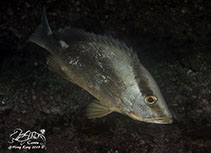
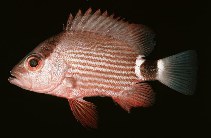
เงี่ยงครีบหลัง (รวม) : 11; ก้านครีบอ่อนที่หาง (รวม) : 12 - 14; เงี่ยงครีบก้น: 3; ก้านครีบอ่อนที่ก้น: 8 - 9. This species is distinguished by the following characters: body relatively deep; greatest depth 2.2-2.8 in SL; mouth large, maxilla length about equal to distance between bases of last dorsal- and anal-fin rays; preopercular notch and knob poorly developed; vomerine tooth patch crescentic or triangular, without a medial posterior extension; gill rakers of first gill arch 4-7 + 12-14 = 18-20 (including rudiments); caudal fin truncate. Colour of back and sides red or red-orange, lighter on lower parts; fins reddish; juveniles with a broad, oblique band of brown or black from upper jaw to beginning of dorsal fin, and a prominent black band across caudal peduncle with a pearly white anterior border, similar to L. timorensis but without the black pectoral-fin axil; young also with a series of narrow reddish horizontal lines (sometimes absent) on sides (Ref. 9821, 90102).


Body shape (shape guide): fusiform / normal; Cross section: oval.

ชีววิทยา     ภาคผนวก (เช่น epibenthic)

Adults inhabit both coastal and offshore reefs. They tend to be associated with sponge and gorgonian-dominated habitats on the North West Shelf (Ref. 28006), and hard mud areas of the Arafura Sea. In Australia, they frequently form mixed shoals with L. erythropterus. Juveniles tend to inhabit shallow inshore waters and larger fish live in deeper waters (Ref. 27260, 27264). Juveniles also occur in mangrove areas and seagrass beds (Ref. 128523). Feed mainly on fishes, with small amounts of benthic crustaceans, cephalopods and other benthic invertebrates (Ref. 6390). They forage mostly at night (Ref. 6390). Caught mainly with handlines, bottom longlines, and bottom trawls (Ref. 9821). Marketed fresh, dried-salted (Ref. 55) and frozen (Ref. 9987).

วงจรชีวิตและพฤติกรรมการผสมพันธุ์ วัยเจริญพันธุ์ | การสืบพันธุ์ | การวางไข่ | เซลสืบพันธ์ของเพศเมีย(ไข่) | ความดกของไข่ | ตัวอ่อน

Are batch or serial spawners (Ref. 28009).

อ้างอิงหลัก อัพโหลดข้อมูลอ้างอิงของคุณ | อ้างอิง | ผู้ประสานงาน | ผู้ร่วมมือ

Allen, G.R., 1985. FAO Species Catalogue. Vol. 6. Snappers of the world. An annotated and illustrated catalogue of lutjanid species known to date. FAO Fish. Synop. 125(6):208 p. Rome: FAO. (Ref. 55)

สถานะบัญชีแดงของ IUCN (Ref. 130435: Version 2025-2 (Global))

  Least Concern (LC) ; Date assessed: 28 June 2018

CITES

Not Evaluated

CMS (Ref. 116361)

Not Evaluated

ภัยคุกคามต่อมนุษย์

  Harmless


การใช้ของมนุษย์

การประมง: เน้นการพาณิชย์; การตกปลาเป็นกีฬา: ใช่; สถานที่แสดงสัตว์และพืชน้ำ: การค้า
FAO - การประมง: การลงจอด; Publication: search | FishSource | ทะเลรอบๆเรา

ข้อมูลเพิ่มเติม

นิเวศวิทยาเขตร้อน
รายการอาหาร (เหยื่อ)
องค์ประอบของอาหาร
การบริโภคอาหาร
การจัดสรรอาหาร
ผู้ล่า
นิเวศวิทยา
นิเวศวิทยา
กายวิภาคศาสตร์
พื้นที่เหงือก
สมอง
หินโสต
สรีรวิทยา
องค์ประกอบของร่างกาย
สารอาหาร
การใช้ออกซิเจน
ประเภทการว่ายน้ำ
ระดับความเร็วในการว่ายน้ำ
เม็ดสีที่มองเห็นได้
เสียงปลา
โรคและปรสิต
ความเป็นพิษ (LC50s)
พันธุศาสตร์
จีโนม
พันธุศาสตร์
ความไม่สมดุลทางเชื้อชาติ
อัตราพันธุกรรม
ความหลากหลายทางพันธุกรรม
เกี่ยวข้องกับมนุษย์
ระบบการเพาะเลี้ยงสัตว์น้ำ
ประวัติการเพาะเลี้ยงสัตว์น้ำ
สายพันธุ์
กรณีซิเกวเทอรา
แสตมป์ เหรียญ อื่นๆ
การเข้าถึง
ผู้ร่วมมือ
อ้างอิง
อ้างอิง

เครื่องมือ

รายงานพิเศษ

ดาวน์โหลด XML

แหล่งที่มาจากอินเตอร์เน็ต

การประมาณค่าตามแบบจำลอง

อุณหภูมิที่ต้องการ (อ้างอิง 123201): 23.8 - 28.6, mean 27.5 °C (based on 745 cells).
ดัชนีความหลากหลายทางวิวัฒนาการ (อ้างอิง 82804):  PD50 = 0.5000   [Uniqueness, from 0.5 = low to 2.0 = high].
Bayesian length-weight: a=0.01585 (0.01418 - 0.01771), b=2.97 (2.95 - 2.99), in cm total length, based on LWR estimates for this species (Ref. 93245).
ระดับชั้นอาหาร (อ้างอิง 69278):  4.5   ±0.5 se; based on diet studies.
Generation time: 6.1 (4.2 - 8.7) years. Estimated as median ln(3)/K based on 24 growth studies.
ความสามารถในการกลับคืนสู่ปกติ (อ้างอิง 120179):  ต่ำมาก, เวลาต่ำสุดที่จะทำให้ประชากรเพิ่มขึ้นเป็น 2 เท่าใช้เวลามากกว่า 14 ปี (K=0.12-0.18; tmax=48; Fec=5,000,000).
Prior r = 0.17, 95% CL = 0.11 - 0.25, Based on 1 full stock assessment.
ความเสี่ยงต่อการตกปลา (Ref. 59153):  High vulnerability (60 of 100). 🛈
ความเสี่ยงต่อสภาพภูมิอากาศ (Ref. 125649):  Very high vulnerability (88 of 100). 🛈
หมวดหมู่ราคา (Ref. 80766):   High.
สารอาหาร (Ref. 124155):  Calcium = 18.9 [11.4, 28.8] mg/100g; Iron = 0.279 [0.178, 0.460] mg/100g; Protein = 18.8 [17.3, 20.2] %; Omega3 = 0.134 [0.092, 0.196] g/100g; Selenium = 69.5 [40.5, 114.1] μg/100g; VitaminA = 179 [31, 733] μg/100g; Zinc = 0.374 [0.285, 0.518] mg/100g (wet weight); based on nutrient studies.