



Adicionar sua observação em Fish Watcher
| Native range | All suitable habitat | Point map | Year 2050 |

|
| This map was computer-generated and has not yet been reviewed. |
| Pellonula leonensis AquaMaps Data sources: GBIF OBIS |
Carregue seu(sua) Fotos e vídeos
Fotos | Imagem do Google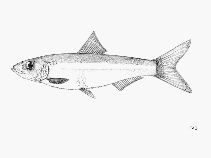 Pellonula leonensis
Foto de FAO
Fotos | Imagem do Google
Foto de FAO
Classificação / Nomes Nomes comuns | Sinônimos | Catalog of Fishes(Gênero, Espécies) | ITIS | CoL | WoRMS | Cloffa
> Clupeiformes (Herrings) > Dorosomatidae (Gizzard shads and sardinellas)
Etymology: Pellonula: Latin, pellis = skin + Latin, nullus = no one (Ref. 45335).
More on author: Boulenger.
Etymology: Pellonula: Latin, pellis = skin + Latin, nullus = no one (Ref. 45335).
More on author: Boulenger.
Meio ambiente: milieu / Zona climática / intervalo de profundidade / faixa de distribuição Ecologia
marinhas; Água doce; estuarina pelágico(a,os,as); anádromo (Ref. 138280). Tropical; 17°N - 5°S, 18°W - 24°E (Ref. 26213)
Distribuição Territórios | Áreas da FAO | Ecossistemas | Ocorrências | Mapa de pontos | Introduções | Faunafri
Africa: freshwater rivers of West Africa (Ref. 188, 2244), in lagoons, lakes, lower and upper courses of rivers from Senegal to Cross River (Ref. 81269), including upper reaches of Niger and lower parts of Benue River (Ref. 188); and lagoons and lower and middle courses of coastal rivers from Cameroon to Democratic Republic of Congo (Ref. 2244, 81631). Reported from the Léfini River (Ref. 88782), but apparently not in upper parts of Congo system (Ref. 188). Also reported from Atlantic Ocean, including beaches at Hann near Dakar in Senegal and near Pointe Noire in Congo Republic (Ref. 188).
Comprimento de primeira maturação / Tamanho / Peso / Idade
Maturidade: Lm ?, range 3 - ? cm
Max length : 12.1 cm TL macho/indeterminado; (Ref. 1989); peso máx. publicado: 13.50 g (Ref. 2247)
Max length : 12.1 cm TL macho/indeterminado; (Ref. 1989); peso máx. publicado: 13.50 g (Ref. 2247)
Descrição suscinta Chaves de identificação | Morfologia | Morfometria
Espinhos dorsais (total) : 0; Raios dorsais (total) : 13 - 19; Espinhos anais: 0; Raios anais : 16 - 22; Vértebras: 39 - 44. Diagnosis: Body slender to moderately deep, its depth 17-30% of standard length; scutes beginning behind base of first pectoral finray, with 8-15 pre-pelvic and 6-10 post-pelvic scutes, and a total of 17-23 scutes, first pre-pelvic scute as long as following scutes lacking ascending arms; lower jaw very slightly projecting, teeth at symphysis only slightly enlarged; pre-maxillary teeth small and inward pointing, only the tips usually apparent, no strongly marked indentation at centre of jaw; lower gillrakers 20-35, equal to or longer than corresponding gill filaments; silver stripe along flank (Ref. 188, 2244, 81269, 81631). It resembles Pellonula vorax, which has larger and straighter teeth, often pointing forward, and scutes before pectoral fin bases (Ref. 188, 2244, 81269, 81631). The absence of large canine teeth in upper jaw distinguishes it from Odaxothrissa; Microthrissa species are deep-bodied and have a much more slender maxilla compared to Pellonula leonensis (Ref. 188).
Body shape (shape guide): fusiform / normal; Cross section: compressed.
Body shape (shape guide): fusiform / normal; Cross section: compressed.
Adults are found chiefly in rivers and streams, also man-made and natural lakes (Ref. 188); also in estuaries and lagoons (Ref. 188, 2683). Apparently able to tolerate moderate or even quite high salinities (Ref. 188). They form enormous shoals in both inshore and offshore regions of Lake Kainji (Ref. 3034). Adults feed on terrestrial and aquatic insects, but also ostracods and entomostracans; stomachs containing clupeid fish scales may represent cannibalism (Ref. 188). Reproduction occurs in rivers and lakes, and may be also in estuaries and coastal lagoons (Ref. 2683). Mature individuals breed from July to September in Lake Volta (Ref. 188).
Ciclo de vida ou comportamento de acasalamento Maturidade | Reprodução | Desova | Ovos | Fecundidade | Larvas
Reproduction occurs in rivers and lakes, and may be also in estuaries and coastal lagoons (Ref. 2683).
Referência principal
Carregar suas referências | Referências | Coordenador | Colaboradores
Gourène, G. and G.G. Teugels, 1991. Révision du genre Pellonula des eaux douces africaines (Pisces: Clupeidae). Ichthyol. Explor. Freshwat. 2(3):213-225. (Ref. 2244)
Status na Lista Vermelha da UICN (Ref. 130435: Version 2025-2 (Global))
Segura ou pouco preocupante (LC) ; Date assessed: 30 April 2019
CITES
Not Evaluated
Ameaça para os humanos
Harmless
Uso pelos humanos
Pescarias: pouco comercial; isca: occasionally
FAO - Publication: search | FishSource | Sea Around Us
Mais informação
Ecologia Trófica
Itens alimentares (presas)
Composição da dieta
Consumo alimentar
Rações alimentares
Predadores
Itens alimentares (presas)
Composição da dieta
Consumo alimentar
Rações alimentares
Predadores
Dinâmica populacional
Parâmetros de crescimento
Idade máxima / tamanhos
Relação comprimento-peso.
Relação comprimento-comprimento.
Frequências de comprimento
Conversão de massa
Recrutamento
Abundância
Parâmetros de crescimento
Idade máxima / tamanhos
Relação comprimento-peso.
Relação comprimento-comprimento.
Frequências de comprimento
Conversão de massa
Recrutamento
Abundância
Ciclo de vida
Reprodução
Maturidade
Maturidade/Rel. das guelras
Fecundidade
Desova
Agregações de desova
Ovos
Desenvolvimento dos ovos
Larvas
Dinâmica larval
Reprodução
Maturidade
Maturidade/Rel. das guelras
Fecundidade
Desova
Agregações de desova
Ovos
Desenvolvimento dos ovos
Larvas
Dinâmica larval
Anatomia
Área branquial
Cérebro
Otólito
Área branquial
Cérebro
Otólito
Fisiologia
Composição corporal
Nutrientes
Consumo de oxigênio
Tipo de natação
Velocidade de natação
Pigmentos visuais
Som de peixe
Doenças e Parasitas
Toxicidade (LC50s)
Composição corporal
Nutrientes
Consumo de oxigênio
Tipo de natação
Velocidade de natação
Pigmentos visuais
Som de peixe
Doenças e Parasitas
Toxicidade (LC50s)
Genética
genoma
Genética
Heterozigosidade
Hereditariedade
Diversidade genética
genoma
Genética
Heterozigosidade
Hereditariedade
Diversidade genética
Relacionado a humanos
Sistemas de aquicultura
Perfis para aquacultura
Estirpes
Casos de Ciguatera
Selos, moedas, diversos.
Sistemas de aquicultura
Perfis para aquacultura
Estirpes
Casos de Ciguatera
Selos, moedas, diversos.
Ferramentas
Livro eletrônico | Guia de campo | Chaves de identificação | Ferramenta auxiliar de frequências de comprimento | Ferramenta sobre a história de vida | Mapa de pontos |
Catch-MSY |
Relatórios especiais
Checar Manutenção em Aquário | Checar Planilhas de Fatos sobre as Espécies | Checar Planilhas de Fatos sobre Aquicultura
Baixar XML
Fontes da internet
AFORO (otoliths) | Aquatic Commons | BHL | Cloffa | Websites from users | Checar Observador de Peixes (FishWatcher) | CISTI | Catalog of Fishes: Gênero, Espécies | DiscoverLife | ECOTOX | FAO - Publication: search | Faunafri | Fishipedia | Fishtrace | GloBI | Google Books | Google Scholar | Google | IGFA World Record | OneZoom | Open Tree of Life | Otolith Atlas of Taiwan Fishes | PubMed | Reef Life Survey | Socotra Atlas | TreeBase | Árvore da vida | Wikipedia: Ir para, procura | World Records Freshwater Fishing | Zoobank | Registro zoológico
Estimativas baseadas em modelos
Temperatura preferida (Ref. 123201): 24.4 - 27.9, mean 26.7 °C (based on 62 cells).
Índice de diversidade filogenética (Ref. 82804): PD50 = 0.7500 [Uniqueness, from 0.5 = low to 2.0 = high].
Bayesian length-weight: a=0.00851 (0.00744 - 0.00974), b=3.04 (3.00 - 3.08), in cm total length, based on LWR estimates for this species (Ref. 93245).
Nível Trófico (Ref. 69278): 3.3 ±0.39 se; based on food items.
Generation time: 1.1 ( na - na) years. Estimated as median ln(3)/K based on 1 growth studies.
Resiliência (Ref. 120179): Elevada, tempo mínimo de duplicação da população menor que 15 meses (Preliminary K or Fecundity.).
Nutrientes (Ref. 124155): Calcium = 347 [185, 684] mg/100g; Iron = 2.57 [1.57, 4.26] mg/100g; Protein = 18.8 [17.8, 19.9] %; Omega3 = 0.488 [0.262, 0.898] g/100g; Selenium = 43.5 [21.3, 87.1] μg/100g; VitaminA = 33 [15, 72] μg/100g; Zinc = 2.14 [1.51, 3.17] mg/100g (wet weight);