



Beobachtung melden im Fish Watcher
| Native range | All suitable habitat | Point map | Year 2050 |

|
| This map was computer-generated and has not yet been reviewed. |
| Pellonula leonensis AquaMaps Data sources: GBIF OBIS |
Hochladen Photos und videos
Bilder | Google Bild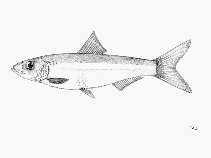 Pellonula leonensis
Photo von FAO
Bilder | Google Bild
Photo von FAO
Klassifizierung / Names Namen | Synonyme | Catalog of Fishes(Gattung, Arten) | ITIS | CoL | WoRMS | Cloffa
> Clupeiformes (Herrings) > Dorosomatidae (Gizzard shads and sardinellas)
Etymology: Pellonula: Latin, pellis = skin + Latin, nullus = no one (Ref. 45335).
More on author: Boulenger.
Etymology: Pellonula: Latin, pellis = skin + Latin, nullus = no one (Ref. 45335).
More on author: Boulenger.
Umwelt: Milieu / Klimazone / Tiefenbereich / Verbreitungsgebiet Ökologie
seewasser; süßwasser; brackwasser pelagisch; anadrom (Ref. 138280). Tropical; 17°N - 5°S, 18°W - 24°E (Ref. 26213)
Verbreitung Territorien | FAO Gebiete | Ökosysteme | Vorkommen | Punkt Karte | Einführungen | Faunafri
Africa: freshwater rivers of West Africa (Ref. 188, 2244), in lagoons, lakes, lower and upper courses of rivers from Senegal to Cross River (Ref. 81269), including upper reaches of Niger and lower parts of Benue River (Ref. 188); and lagoons and lower and middle courses of coastal rivers from Cameroon to Democratic Republic of Congo (Ref. 2244, 81631). Reported from the Léfini River (Ref. 88782), but apparently not in upper parts of Congo system (Ref. 188). Also reported from Atlantic Ocean, including beaches at Hann near Dakar in Senegal and near Pointe Noire in Congo Republic (Ref. 188).
Länge bei der ersten Reifung / Größe / Gewicht / Alter
Geschlechtsreife: Lm ?, range 3 - ? cm
Max length : 12.1 cm TL Männchen/unbestimmt; (Ref. 1989); max. veröff. Gewicht: 13.50 g (Ref. 2247)
Max length : 12.1 cm TL Männchen/unbestimmt; (Ref. 1989); max. veröff. Gewicht: 13.50 g (Ref. 2247)
Kurzbeschreibung Bestimmungsschlüssel | Morphologie | Morphometrie
Rückenflossenstacheln (insgesamt) : 0; Rückenflossenweichstrahlen (insgesamt) : 13 - 19; Afterflossenstacheln: 0; Afterflossenweichstrahlen: 16 - 22; Wirbelzahl: 39 - 44. Diagnosis: Body slender to moderately deep, its depth 17-30% of standard length; scutes beginning behind base of first pectoral finray, with 8-15 pre-pelvic and 6-10 post-pelvic scutes, and a total of 17-23 scutes, first pre-pelvic scute as long as following scutes lacking ascending arms; lower jaw very slightly projecting, teeth at symphysis only slightly enlarged; pre-maxillary teeth small and inward pointing, only the tips usually apparent, no strongly marked indentation at centre of jaw; lower gillrakers 20-35, equal to or longer than corresponding gill filaments; silver stripe along flank (Ref. 188, 2244, 81269, 81631). It resembles Pellonula vorax, which has larger and straighter teeth, often pointing forward, and scutes before pectoral fin bases (Ref. 188, 2244, 81269, 81631). The absence of large canine teeth in upper jaw distinguishes it from Odaxothrissa; Microthrissa species are deep-bodied and have a much more slender maxilla compared to Pellonula leonensis (Ref. 188).
Body shape (shape guide): fusiform / normal; Cross section: compressed.
Body shape (shape guide): fusiform / normal; Cross section: compressed.
Adults are found chiefly in rivers and streams, also man-made and natural lakes (Ref. 188); also in estuaries and lagoons (Ref. 188, 2683). Apparently able to tolerate moderate or even quite high salinities (Ref. 188). They form enormous shoals in both inshore and offshore regions of Lake Kainji (Ref. 3034). Adults feed on terrestrial and aquatic insects, but also ostracods and entomostracans; stomachs containing clupeid fish scales may represent cannibalism (Ref. 188). Reproduction occurs in rivers and lakes, and may be also in estuaries and coastal lagoons (Ref. 2683). Mature individuals breed from July to September in Lake Volta (Ref. 188).
Lebenszyklus und Paarungsverhalten Geschlechtsreife | Fortpflanzung | Ablaichen | Eier | Fruchtbarkeit | Larven
Reproduction occurs in rivers and lakes, and may be also in estuaries and coastal lagoons (Ref. 2683).
Hauptreferenz
Laden Sie Ihre Referenzen hoch | Referenzen | Koordinator | Partner
Gourène, G. and G.G. Teugels, 1991. Révision du genre Pellonula des eaux douces africaines (Pisces: Clupeidae). Ichthyol. Explor. Freshwat. 2(3):213-225. (Ref. 2244)
IUCN Rote Liste Status (Ref. 130435: Version 2025-2 (Global))
nicht bedroht (LC) ; Date assessed: 30 April 2019
CITES
Not Evaluated
Bedrohung für Menschen
Harmless
Nutzung durch Menschen
Fischereien: weniger kommerziell; Köder: occasionally
FAO - Publication: search | FishSource | Das Meer um uns herum
Mehr Information
Trophische Ökologie
Lebensmittel (Beutetiere)
Nahrungszusammensetzung
Nahrungsaufnahme
Lebensmittelrationen
Räuber
Lebensmittel (Beutetiere)
Nahrungszusammensetzung
Nahrungsaufnahme
Lebensmittelrationen
Räuber
Populationsdynamik
Wachstumsparameter
Max. Alter/Größen
Länge-Gewicht-Rel.
Länge-Länge-Verhältnis.
Längenhäufigkeiten
Massenkonvertierung
Rekrutierung
Dichte
Wachstumsparameter
Max. Alter/Größen
Länge-Gewicht-Rel.
Länge-Länge-Verhältnis.
Längenhäufigkeiten
Massenkonvertierung
Rekrutierung
Dichte
Lebenszyklus
Fortpflanzung
Geschlechtsreife
Reifung/Kiemen rel.
Fruchtbarkeit
Ablaichen
Laichaggregationen
Eier
Eientwicklung
Larven
Larven Pop.Dyn.
Fortpflanzung
Geschlechtsreife
Reifung/Kiemen rel.
Fruchtbarkeit
Ablaichen
Laichaggregationen
Eier
Eientwicklung
Larven
Larven Pop.Dyn.
Anatomie
Kiemenoberfläche
Gehirn
Otolith
Kiemenoberfläche
Gehirn
Otolith
Physiologie
Körperliche Zusammensetzung
Nährstoffe
Sauerstoffverbrauch
Schwimmart
Schwimmgeschwindigkeit
Visuelle Pigmente
Fischgeräusche
Krankheiten und Parasiten
Toxizität (LC50s)
Körperliche Zusammensetzung
Nährstoffe
Sauerstoffverbrauch
Schwimmart
Schwimmgeschwindigkeit
Visuelle Pigmente
Fischgeräusche
Krankheiten und Parasiten
Toxizität (LC50s)
Genetik
Genom
Genetik
Heterozygotie
Vererbbarkeit
Genetische Vielfalt
Genom
Genetik
Heterozygotie
Vererbbarkeit
Genetische Vielfalt
Menschenbezogen
Aquakultur-Systeme
Aquakultur Profile
Zuchtlinien
Ciguatera-Fälle
Briefmarken, Münzen, Verschiedenes.
Aquakultur-Systeme
Aquakultur Profile
Zuchtlinien
Ciguatera-Fälle
Briefmarken, Münzen, Verschiedenes.
Tools
E-Book | Feldführer | Bestimmungsschlüssel | Längenhäufigkeits Tool | Lebensdaten Tool | Punkt Karte |
Catch-MSY |
Zusatzinformationen
Download XML
Zusammenfassung | Punktdaten | Namen | Photos
Internet Quellen
AFORO (otoliths) | Aquatic Commons | BHL | Cloffa | Websites from users | FishWatcher Einträge suchen | CISTI | Catalog of Fishes: Gattung, Arten | DiscoverLife | ECOTOX | FAO - Publication: search | Faunafri | Fishipedia | Fishtrace | GloBI | Google Books | Google Scholar | Google | IGFA World Record | OneZoom | Open Tree of Life | Otolith Atlas of Taiwan Fishes | PubMed | Reef Life Survey | Socotra Atlas | TreeBase | Tree of Life | Wikipedia: Gehe zu, Suchen | World Records Freshwater Fishing | Zoobank | Zoologischer Rekord
Schätzungen auf der Grundlage von Modellen
Bevorzugte Temperatur (Ref. 123201): 24.4 - 27.9, mean 26.7 °C (based on 62 cells).
Phylogenetischer Diversitätsindex (Ref. 82804): PD50 = 0.7500 [Uniqueness, from 0.5 = low to 2.0 = high].
Bayesian length-weight: a=0.00851 (0.00744 - 0.00974), b=3.04 (3.00 - 3.08), in cm total length, based on LWR estimates for this species (Ref. 93245).
Trophische Ebene (Ref. 69278): 3.3 ±0.39 se; based on food items.
Generation time: 1.1 ( na - na) years. Estimated as median ln(3)/K based on 1 growth studies.
Widerstandsfähigkeit (Ref. 120179): hoch, Verdopplung der Population dauert weniger als 15 Monate. (Preliminary K or Fecundity.).
Nährstoffe (Ref. 124155): Calcium = 347 [185, 684] mg/100g; Iron = 2.57 [1.57, 4.26] mg/100g; Protein = 18.8 [17.8, 19.9] %; Omega3 = 0.488 [0.262, 0.898] g/100g; Selenium = 43.5 [21.3, 87.1] μg/100g; VitaminA = 33 [15, 72] μg/100g; Zinc = 2.14 [1.51, 3.17] mg/100g (wet weight);