



Waarneming toevoegen in Fish Watcher
| Native range | All suitable habitat | Point map | Year 2050 |

|
| This map was computer-generated and has not yet been reviewed. |
| Pellonula leonensis AquaMaps Data sources: GBIF OBIS |
Uploaden van uw Foto's en video's
Afbeeldingen | Google afbeelding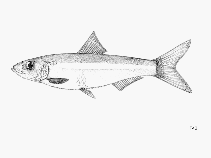 Pellonula leonensis
Afbeelding van FAO
Afbeeldingen | Google afbeelding
Afbeelding van FAO
Classificatie / Namen Lokale namen | Synoniemen | Catalog of Fishes(Genus, Soort(en)) | ITIS | CoL | WoRMS | Cloffa
> Clupeiformes (Herrings) > Dorosomatidae (Gizzard shads and sardinellas)
Etymology: Pellonula: Latin, pellis = skin + Latin, nullus = no one (Ref. 45335).
More on author: Boulenger.
Etymology: Pellonula: Latin, pellis = skin + Latin, nullus = no one (Ref. 45335).
More on author: Boulenger.
Milieu: milieu / Klimaatzone / Diepte / verspreidingsgebied Ecologie
marien; zoet water; brak water pelagisch; anadroom (Ref. 138280). Tropical; 17°N - 5°S, 18°W - 24°E (Ref. 26213)
Verspreiding Gebieden | FAO regio's | Ecosystemen | Voorkomen | Verspreidingskaart | Introducties | Faunafri
Africa: freshwater rivers of West Africa (Ref. 188, 2244), in lagoons, lakes, lower and upper courses of rivers from Senegal to Cross River (Ref. 81269), including upper reaches of Niger and lower parts of Benue River (Ref. 188); and lagoons and lower and middle courses of coastal rivers from Cameroon to Democratic Republic of Congo (Ref. 2244, 81631). Reported from the Léfini River (Ref. 88782), but apparently not in upper parts of Congo system (Ref. 188). Also reported from Atlantic Ocean, including beaches at Hann near Dakar in Senegal and near Pointe Noire in Congo Republic (Ref. 188).
Lengte bij maturiteit / Grootte / Gewicht / Leeftijd
Maturiteit: Lm ?, range 3 - ? cm
Max length : 12.1 cm TL mannelijk / geslacht onbekend; (Ref. 1989); max. gepubliceerd gewicht: 13.50 g (Ref. 2247)
Max length : 12.1 cm TL mannelijk / geslacht onbekend; (Ref. 1989); max. gepubliceerd gewicht: 13.50 g (Ref. 2247)
Korte beschrijving Determinatiesleutels | Morfologie | Morfometrie
Dorsale stekels (totaal) : 0; Dorsale zachte stralen (totaal) : 13 - 19; Anale stekels: 0; Anale zachte stralen: 16 - 22; Wervels: 39 - 44. Diagnosis: Body slender to moderately deep, its depth 17-30% of standard length; scutes beginning behind base of first pectoral finray, with 8-15 pre-pelvic and 6-10 post-pelvic scutes, and a total of 17-23 scutes, first pre-pelvic scute as long as following scutes lacking ascending arms; lower jaw very slightly projecting, teeth at symphysis only slightly enlarged; pre-maxillary teeth small and inward pointing, only the tips usually apparent, no strongly marked indentation at centre of jaw; lower gillrakers 20-35, equal to or longer than corresponding gill filaments; silver stripe along flank (Ref. 188, 2244, 81269, 81631). It resembles Pellonula vorax, which has larger and straighter teeth, often pointing forward, and scutes before pectoral fin bases (Ref. 188, 2244, 81269, 81631). The absence of large canine teeth in upper jaw distinguishes it from Odaxothrissa; Microthrissa species are deep-bodied and have a much more slender maxilla compared to Pellonula leonensis (Ref. 188).
Body shape (shape guide): fusiform / normal; Cross section: compressed.
Body shape (shape guide): fusiform / normal; Cross section: compressed.
Adults are found chiefly in rivers and streams, also man-made and natural lakes (Ref. 188); also in estuaries and lagoons (Ref. 188, 2683). Apparently able to tolerate moderate or even quite high salinities (Ref. 188). They form enormous shoals in both inshore and offshore regions of Lake Kainji (Ref. 3034). Adults feed on terrestrial and aquatic insects, but also ostracods and entomostracans; stomachs containing clupeid fish scales may represent cannibalism (Ref. 188). Reproduction occurs in rivers and lakes, and may be also in estuaries and coastal lagoons (Ref. 2683). Mature individuals breed from July to September in Lake Volta (Ref. 188).
Levenscyclus en paargedrag Maturiteit | Voortplanting | Paaien | Eieren | Fecunditeit | Larven
Reproduction occurs in rivers and lakes, and may be also in estuaries and coastal lagoons (Ref. 2683).
Hoofdreferentie
Upload uw referenties | Referenties | Coördinator | Medewerkers
Gourène, G. and G.G. Teugels, 1991. Révision du genre Pellonula des eaux douces africaines (Pisces: Clupeidae). Ichthyol. Explor. Freshwat. 2(3):213-225. (Ref. 2244)
Status op de Rode Lijst van het IUCN (Ref. 130435: Version 2025-2 (Global))
Niet bedreigd (LC) ; Date assessed: 30 April 2019
CITES
Not Evaluated
Gevaar voor de mens
Harmless
Gebruik door de mens
Visserij: van minder commercieel belang; aas: occasionally
FAO - Publication: search | FishSource | Sea Around Us
Meer informatie
Trofische ecologie
Voedsel (prooien)
Dieetsamenstelling
Voedselconsumptie
Voedselrantsoenen
Predatoren
Voedsel (prooien)
Dieetsamenstelling
Voedselconsumptie
Voedselrantsoenen
Predatoren
Populatiedynamica
Groeiparameters
Max. leeftijden / maten
Lengte-gewicht rel.
Lengte-lengte rel.
Lengtefrequenties
Massaconversie
Rekrutering
Abundantie
Groeiparameters
Max. leeftijden / maten
Lengte-gewicht rel.
Lengte-lengte rel.
Lengtefrequenties
Massaconversie
Rekrutering
Abundantie
Levenscyclus
Voortplanting
Maturiteit
Rijpheid/kieuwen rel.
Fecunditeit
Paaien
Paaibestanden
Eieren
Ontwikkeling van de eieren
Larven
Larvale populatiedynamiek
Voortplanting
Maturiteit
Rijpheid/kieuwen rel.
Fecunditeit
Paaien
Paaibestanden
Eieren
Ontwikkeling van de eieren
Larven
Larvale populatiedynamiek
Anatomie
Kieuwoppervlak
Hersenen
Otoliet
Kieuwoppervlak
Hersenen
Otoliet
Fysiologie
Lichaamssamenstelling
Voedingsstoffen
Zuurstofverbruik
Type zwemmen
Zwemsnelheid
Visuele pigmenten
Vis geluid
Ziekten en parasieten
Toxiciteit (LC50)
Lichaamssamenstelling
Voedingsstoffen
Zuurstofverbruik
Type zwemmen
Zwemsnelheid
Visuele pigmenten
Vis geluid
Ziekten en parasieten
Toxiciteit (LC50)
Genetica
genoom
Genetica
Heterozygositeit
Erfelijkheid
Genetische diversiteit
genoom
Genetica
Heterozygositeit
Erfelijkheid
Genetische diversiteit
Menselijk gerelateerd
Aquacultuursystemen
Aquacultuurprofielen
Kweeklijnen
Ciguatera gevallen
Postzegels, munten, diversen.
Aquacultuursystemen
Aquacultuurprofielen
Kweeklijnen
Ciguatera gevallen
Postzegels, munten, diversen.
Tools
E-boek | Veldgids | Determinatiesleutels | Lengtefrequentie Tool | Levenscyclus tool | Verspreidingskaart |
Vangst-MSY |
Speciale rapporten
Bekijk gegevens voor het houden in een aquarium | Bekijk Fact Sheets voor de soort | Bekijk Aquacultuur Fact Sheets
Download XML
Internetbronnen
AFORO (otoliths) | Aquatic Commons | BHL | Cloffa | Websites from users | Bekijk FishWatcher | CISTI | Catalog of Fishes: Genus, Soort(en) | DiscoverLife | ECOTOX | FAO - Publication: search | Faunafri | Fishipedia | Fishtrace | GloBI | Google Books | Google Scholar | Google | IGFA World Record | OneZoom | Open Tree of Life | Otolith Atlas of Taiwan Fishes | PubMed | Reef Life Survey | Socotra Atlas | TreeBase | Tree of Life | Wikipedia: ga naar, zoek | World Records Freshwater Fishing | Zoobank | Zoological Record
Schattingen op basis van modellen
Gewenste temperatuur (Ref. 123201): 24.4 - 27.9, mean 26.7 °C (based on 62 cells).
Fylogenetische diversiteitsindex (Ref. 82804): PD50 = 0.7500 [Uniqueness, from 0.5 = low to 2.0 = high].
Bayesian length-weight: a=0.00851 (0.00744 - 0.00974), b=3.04 (3.00 - 3.08), in cm total length, based on LWR estimates for this species (Ref. 93245).
Trofisch niveau (Ref. 69278): 3.3 ±0.39 se; based on food items.
Generation time: 1.1 ( na - na) years. Estimated as median ln(3)/K based on 1 growth studies.
Weerstandsvermogen (Ref. 120179): Hoog, minimale populatieverdubbelingstijd minder dan 15 maanden (Preliminary K or Fecundity.).
Voedingsstoffen (Ref. 124155): Calcium = 347 [185, 684] mg/100g; Iron = 2.57 [1.57, 4.26] mg/100g; Protein = 18.8 [17.8, 19.9] %; Omega3 = 0.488 [0.262, 0.898] g/100g; Selenium = 43.5 [21.3, 87.1] μg/100g; VitaminA = 33 [15, 72] μg/100g; Zinc = 2.14 [1.51, 3.17] mg/100g (wet weight);