



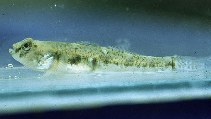
Pomatoschistus microps (Krøyer, 1838)
Common goby
Lägg till din observation i Fish Watcher
| Native range | All suitable habitat | Point map | Year 2050 |

|
| This map was computer-generated and has not yet been reviewed. |
| Pomatoschistus microps AquaMaps Data sources: GBIF OBIS |
Klassificering / Namn Populärnamn | synonymer | Catalog of Fishes(Släkte, Arter) | ITIS | CoL | WoRMS | Cloffa
> Gobiiformes (Gobies) > Gobiidae (Gobies) > Gobionellinae
Etymology: Pomatoschistus: Greek, poma, -atos = cover, operculum + Greek, schistos = divided (Ref. 45335).
Etymology: Pomatoschistus: Greek, poma, -atos = cover, operculum + Greek, schistos = divided (Ref. 45335).
Miljö: miljö / Klimatzon / djupintervall / distributionsområde Ekologi
marina; sötvatten; brackvatten bottenlevande; anadrom (Ref. 138297); djupintervall 0 - 12 m (Ref. 35388). Temperate; 8°C - 24°C (Ref. 4944); 64°N - 20°N, 19°W - 31°E
Utbredning Territorier | FAO områden | Ekosystem | Förekomster | Prickkarta | Utplanteringar | Faunafri
Eastern Atlantic: Norway to Morocco, including Baltic Sea (to southern Portugal) (Ref. 4696) and western Mediterranean. Also in Mauritania and the Canary Islands.
Längd vid första mognad / Storlek / Vikt / Ålder
Könsmognad: Lm ?, range 3 - ? cm
Max length : 9.0 cm TL hane/ej könsbestämd; (Ref. 6303); rapporterad maxålder: 2.60 år (Ref. 40230)
Max length : 9.0 cm TL hane/ej könsbestämd; (Ref. 6303); rapporterad maxålder: 2.60 år (Ref. 40230)
Kort beskrivning Bestämningsnycklar | Morfologi | Morfometri
Taggstrålar i ryggfenan (totalt) : 6 - 8; Mjukstrålar i ryggfenan (totalt) : 8 - 11; Taggstrålar i analfenan: 1; Mjukstrålar i analfenan: 7 - 10; Ryggkotor: 30 - 32. This species is distinguished from other gobies in European freshwaters by the following characters: males with conspicuous dark proximal posterior spot on first dorsal; with cephalic lateral line canals; anterior oculoscapular canal extending to snout; branched rays in second dorsal 8-10.5; anal origin below simple of first branched ray of D2; total scales in midlateral series 39-52; completely scaled postdorsal body; caudal rounded (Ref. 59043). No scales in front of the first dorsal fin (Ref. 35388); body shape is terete, slightly depressed; eyes situated dorso-laterally; reduced swim bladders (Ref. 92840).
Body shape (shape guide): elongated.
Body shape (shape guide): elongated.
Adullts enter estuaries, salt marshes and pools (Ref. 4343); usually on sand or mud (Ref. 59043). They live in sea as well as brackish waters and migrates into limnetic sections of rivers (Ref. 92840). Also in rock pools where they feed mainly on epibenthic meiofauna like harpacticoids and small amphipods (Ref. 92840); small crustaceans, worms, chironomid larvae and mites (Ref. 4696). They burrow to survive low water levels and to avoid predators (Ref. 30508). Mature individuals spawn after first winter, at sea, in February - September, depending on latitude; individual females spawn several times during a season. Adhesive eggs (0.9 x 0.7 mm) are deposited under or between stones, shells and aquatic plants and males guard the eggs until hatching. Juveniles enter freshwater habitats in late summer to forage (Ref. 59043). Males defend and aerate the eggs for about 9 days.
Livscykel och parningsbeteende Könsmognad | Reproduktion | Lek | Ägg | Fekunditet | Larver
Benthic spawner (Ref. 32023).
Huvudreferens
Ladda upp dina referenser | referenser | Koordinator | Medarbetare
Maugé, L.A., 1986. Gobiidae. p. 358-388. In J. Daget, J.-P. Gosse and D.F.E. Thys van den Audenaerde (eds.) Check-list of the freshwater fishes of Africa (CLOFFA). ISNB, Brussels; MRAC, Tervuren; and ORSTOM, Paris. Vol. 2. (Ref. 4343)
Status på IUCN:s rödlista (Ref. 130435: Version 2025-2 (Global))
Least Concern (LC) ; Date assessed: 18 January 2023
CITES
Not Evaluated
Hot mot människor
Harmless
Mänskliga användningsområden
Fiskeri: saknar intresse; Akvarium: Kommersiell
FAO - Publication: search | FishSource |
Ytterligare information
Populationsdynamik
Tillväxtparametrar
Max. åldrar / storlekar
Längd-vikt rel.
Längd-längd rel.
Längd-frekvenser
Massakonvertering
Rekrytering
Abundans
Tillväxtparametrar
Max. åldrar / storlekar
Längd-vikt rel.
Längd-längd rel.
Längd-frekvenser
Massakonvertering
Rekrytering
Abundans
Livscykel
Reproduktion
Könsmognad
Mognad/Gills rel.
Fekunditet
Lek
Lekande aggregat
Ägg
Utveckling av ägg
Larver
Larvdynamik
Reproduktion
Könsmognad
Mognad/Gills rel.
Fekunditet
Lek
Lekande aggregat
Ägg
Utveckling av ägg
Larver
Larvdynamik
Fysiologi
Kroppssammansättning
Näringsämnen
Syreförbrukning
Typ av simning
Simhastighet
Visuella pigment
Ljud från fisk
Sjukdomar & Parasiter
Toxicitet (LC50)
Kroppssammansättning
Näringsämnen
Syreförbrukning
Typ av simning
Simhastighet
Visuella pigment
Ljud från fisk
Sjukdomar & Parasiter
Toxicitet (LC50)
Människorelaterad
Vattenbrukssystem
Vattenbruksprofiler
Avelslinjer
Ciguatera-fall
Frimärken, mynt, diverse.
Vattenbrukssystem
Vattenbruksprofiler
Avelslinjer
Ciguatera-fall
Frimärken, mynt, diverse.
Verktyg
Organisk frågesport | E-bok | Fälthandbok | Bestämningsnycklar | Längdfördelnings-verktyg | Livshistorie-verktyg | Prickkarta |
Fångst-MSY |
Särskilda rapporter
Kontrollera för underhåll av akvarium | Kontrollera om det finns faktablad om arter | Kontrollera om det finns faktablad om vattenbruk
Ladda ner XML
Internet-källor
AFORO (otoliths) | Aquatic Commons | BHL | Cloffa | Websites from users | Check FishWatcher | CISTI | Catalog of Fishes: Släkte, Arter | DiscoverLife | DORIS | ECOTOX | FAO - Publication: search | Faunafri | Fishipedia | Fishtrace | GloBI | Google Books | Google Scholar | Google | IGFA World Record | Nationella databaser | OneZoom | Open Tree of Life | Otolith Atlas of Taiwan Fishes | Offentliga akvarier | PubMed | Reef Life Survey | Socotra Atlas | TreeBase | Tree of Life | Wikipedia: Go, sök | World Records Freshwater Fishing | Zoologiskt register
Uppskattningar baserade på modeller
Önskad temperatur (Ref. 123201): 9 - 16.1, mean 10.8 °C (based on 450 cells).
Index för fylogenetisk mångfald (Ref. 82804): PD50 = 0.5001 [Uniqueness, from 0.5 = low to 2.0 = high].
Bayesian length-weight: a=0.00776 (0.00409 - 0.01473), b=3.09 (2.93 - 3.25), in cm total length, based on LWR estimates for this species & Genus-body shape (Ref. 93245).
Trofisk nivå (Ref. 69278): 3.3 ±0.3 se; based on diet studies.
Generation time: 3.7 ( na - na) years. Estimated as median ln(3)/K based on 1 growth studies.
Resiliens (Ref. 120179): Mellan, lägsta populationsfördubblingstid 1,4-4,4 år (K=0.29; tm=0.8; tmax=2.6; Assuming fec < 10,000).
Näringsämnen (Ref. 124155): Calcium = 97.2 [44.2, 272.7] mg/100g; Iron = 0.439 [0.228, 0.911] mg/100g; Protein = 18.1 [16.1, 19.7] %; Omega3 = 0.61 [0.23, 1.37] g/100g; Selenium = 4.9 [2.0, 12.3] μg/100g; VitaminA = 38.6 [9.8, 137.2] μg/100g; Zinc = 1.18 [0.76, 1.86] mg/100g (wet weight);