



Pomatoschistus microps (Krøyer, 1838)
Common goby
Ajouter votre observation dans Fish Watcher
| Native range | All suitable habitat | Point map | Year 2050 |

|
| This map was computer-generated and has not yet been reviewed. |
| Pomatoschistus microps AquaMaps Data sources: GBIF OBIS |
Classification / Noms Noms communs | Synonymes | Catalog of Fishes(Genre, Espèce) | ITIS | CoL | WoRMS | Cloffa
> Gobiiformes (Gobies) > Gobiidae (Gobies) > Gobionellinae
Etymology: Pomatoschistus: Greek, poma, -atos = cover, operculum + Greek, schistos = divided (Ref. 45335).
Etymology: Pomatoschistus: Greek, poma, -atos = cover, operculum + Greek, schistos = divided (Ref. 45335).
Environnement : milieu / zone climatique / profondeur / gamme de distribution Écologie
marin; eau douce; saumâtre démersal; anadrome (Ref. 138297); profondeur 0 - 12 m (Ref. 35388). Temperate; 8°C - 24°C (Ref. 4944); 64°N - 20°N, 19°W - 31°E
Distribution Territoires | Zones FAO | Écosystèmes | Occurrences | Carte par point | Introductions | Faunafri
Eastern Atlantic: Norway to Morocco, including Baltic Sea (to southern Portugal) (Ref. 4696) and western Mediterranean. Also in Mauritania and the Canary Islands.
Longueur à la première maturité / Taille / Poids / Âge
Maturité: Lm ?, range 3 - ? cm
Max length : 9.0 cm TL mâle / non sexé; (Ref. 6303); âge max. reporté: 2.60 années (Ref. 40230)
Max length : 9.0 cm TL mâle / non sexé; (Ref. 6303); âge max. reporté: 2.60 années (Ref. 40230)
Description synthétique Clés d'identification | Morphologie | Morphométrie
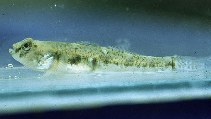
Épines dorsales (Total) : 6 - 8; Rayons mous dorsaux (Total) : 8 - 11; Épines anales: 1; Rayons mous anaux: 7 - 10; Vertèbres: 30 - 32. This species is distinguished from other gobies in European freshwaters by the following characters: males with conspicuous dark proximal posterior spot on first dorsal; with cephalic lateral line canals; anterior oculoscapular canal extending to snout; branched rays in second dorsal 8-10.5; anal origin below simple of first branched ray of D2; total scales in midlateral series 39-52; completely scaled postdorsal body; caudal rounded (Ref. 59043). No scales in front of the first dorsal fin (Ref. 35388); body shape is terete, slightly depressed; eyes situated dorso-laterally; reduced swim bladders (Ref. 92840).
Body shape (shape guide): elongated.
Body shape (shape guide): elongated.
Adullts enter estuaries, salt marshes and pools (Ref. 4343); usually on sand or mud (Ref. 59043). They live in sea as well as brackish waters and migrates into limnetic sections of rivers (Ref. 92840). Also in rock pools where they feed mainly on epibenthic meiofauna like harpacticoids and small amphipods (Ref. 92840); small crustaceans, worms, chironomid larvae and mites (Ref. 4696). They burrow to survive low water levels and to avoid predators (Ref. 30508). Mature individuals spawn after first winter, at sea, in February - September, depending on latitude; individual females spawn several times during a season. Adhesive eggs (0.9 x 0.7 mm) are deposited under or between stones, shells and aquatic plants and males guard the eggs until hatching. Juveniles enter freshwater habitats in late summer to forage (Ref. 59043). Males defend and aerate the eggs for about 9 days.
Cycle de vie et comportement reproducteur Maturité | Reproduction | Frai | Œufs | Fécondité | Larves
Benthic spawner (Ref. 32023).
Référence principale
Téléchargez vos références | Références | Coordinateur | Collaborateurs
Maugé, L.A., 1986. Gobiidae. p. 358-388. In J. Daget, J.-P. Gosse and D.F.E. Thys van den Audenaerde (eds.) Check-list of the freshwater fishes of Africa (CLOFFA). ISNB, Brussels; MRAC, Tervuren; and ORSTOM, Paris. Vol. 2. (Ref. 4343)
Statut dans la liste rouge de l'IUCN (Ref. 130435: Version 2025-2 (Global))
Préoccupation mineure (LC) ; Date assessed: 18 January 2023
CITES
Not Evaluated
Menace pour l'homme
Harmless
Utilisations par l'homme
Pêcheries: sans intérêt; Aquarium: Commercial
FAO - Publication: search | FishSource |
Plus d'informations
Écologie trophique
Aliments (proies)
Composition du régime alimentaire
Consommation alimentaire
Rations alimentaires
Prédateurs
Aliments (proies)
Composition du régime alimentaire
Consommation alimentaire
Rations alimentaires
Prédateurs
Dynamique des populations
Paramètres de croissance
Âges / tailles maximales
Longueur-poids rel.
Rel. longueur-longueur.
Fréquences de longueurs
Conversion de masse
Recrutement
Abondance
Paramètres de croissance
Âges / tailles maximales
Longueur-poids rel.
Rel. longueur-longueur.
Fréquences de longueurs
Conversion de masse
Recrutement
Abondance
Physiologie
Composition corporelle
Nutriments
Consommation d'oxygène
Type de natation
Vitesse de nage
Pigments visuels
Son de poisson
Maladies et parasites
Toxicité (CL50)
Composition corporelle
Nutriments
Consommation d'oxygène
Type de natation
Vitesse de nage
Pigments visuels
Son de poisson
Maladies et parasites
Toxicité (CL50)
Liées à l'homme
Systèmes d'aquaculture
Profils d'aquaculture
Souches
Cas de ciguatera
Timbres, pièces de monnaie, divers
Systèmes d'aquaculture
Profils d'aquaculture
Souches
Cas de ciguatera
Timbres, pièces de monnaie, divers
Outils
Quiz bio | E-book | Guide de terrain | Clés d'identification | Générateur de fréquences de longueur | Outil de dynamique de population | Carte par point |
Capture-MSY |
Articles particuliers
Télécharger en XML
Sources Internet
AFORO (otoliths) | Aquatic Commons | BHL | Cloffa | Websites from users | FishWatcher | CISTI | Catalog of Fishes: Genre, Espèce | DiscoverLife | DORIS | ECOTOX | FAO - Publication: search | Faunafri | Fishipedia | Fishtrace | GloBI | Google Books | Google Scholar | Google | IGFA World Record | Bases de données nationales | OneZoom | Open Tree of Life | Otolith Atlas of Taiwan Fishes | Aquariums publics | PubMed | Reef Life Survey | Socotra Atlas | TreeBase | Arbre de Vie | Wikipedia: aller à, chercher | World Records Freshwater Fishing | Zoological Record
Estimations basées sur des modèles
Température préférée (Réf. 123201): 9 - 16.1, mean 10.8 °C (based on 450 cells).
Indice de diversité phylogénétique (Réf. 82804): PD50 = 0.5001 [Uniqueness, from 0.5 = low to 2.0 = high].
Bayesian length-weight: a=0.00776 (0.00409 - 0.01473), b=3.09 (2.93 - 3.25), in cm total length, based on LWR estimates for this species & Genus-body shape (Ref. 93245).
Niveau trophique (Réf. 69278): 3.3 ±0.3 se; based on diet studies.
Generation time: 3.7 ( na - na) years. Estimated as median ln(3)/K based on 1 growth studies.
Résilience (Réf. 120179): Milieu, temps minimum de doublement de population : 1,4 à 4,4 années (K=0.29; tm=0.8; tmax=2.6; Assuming fec < 10,000).
Nutriments (Ref. 124155): Calcium = 97.2 [44.2, 272.7] mg/100g; Iron = 0.439 [0.228, 0.911] mg/100g; Protein = 18.1 [16.1, 19.7] %; Omega3 = 0.61 [0.23, 1.37] g/100g; Selenium = 4.9 [2.0, 12.3] μg/100g; VitaminA = 38.6 [9.8, 137.2] μg/100g; Zinc = 1.18 [0.76, 1.86] mg/100g (wet weight);