



Mycteroperca bonaci (Poey, 1860)
Black grouper
Uploaden van uw Foto's en video's
Afbeeldingen | video's | Geluiden | Google afbeelding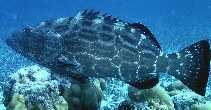 Mycteroperca bonaci
Afbeelding van Randall, J.E.
Afbeeldingen | video's | Geluiden | Google afbeelding
Afbeelding van Randall, J.E.
Classificatie / Namen Lokale namen | Synoniemen | Catalog of Fishes(Genus, Soort(en)) | ITIS | CoL | WoRMS | Cloffa
> Perciformes/Serranoidei (Groupers) > Epinephelidae (Groupers)
Etymology: Mycteroperca: Greek, mykter, -eros = nose + Greek, perke = perch (Ref. 45335).
More on author: Poey.
Etymology: Mycteroperca: Greek, mykter, -eros = nose + Greek, perke = perch (Ref. 45335).
More on author: Poey.
Milieu: milieu / Klimaatzone / Diepte / verspreidingsgebied Ecologie
marien rifbewoner; diepte 60 - 250 m (Ref. 89707). Subtropical; 33°N - 27°S, 95°W - 33°W (Ref. 5222)
Verspreiding Gebieden | FAO regio's | Ecosystemen | Voorkomen | Verspreidingskaart | Introducties | Faunafri
Western Atlantic: Bermuda and Massachusetts, USA to southern Brazil, including the southern Gulf of Mexico and the Caribbean. Adults are unknown from the northeastern coast of the USA.
Lengte bij maturiteit / Grootte / Gewicht / Leeftijd
Maturiteit: Lm 67.7, range 47 - 95.1 cm
Max length : 150 cm TL mannelijk / geslacht onbekend; (Ref. 40637); common length : 70.0 cm TL mannelijk / geslacht onbekend; (Ref. 5217); max. gepubliceerd gewicht: 100.0 kg (Ref. 26340)
Max length : 150 cm TL mannelijk / geslacht onbekend; (Ref. 40637); common length : 70.0 cm TL mannelijk / geslacht onbekend; (Ref. 5217); max. gepubliceerd gewicht: 100.0 kg (Ref. 26340)
Korte beschrijving Determinatiesleutels | Morfologie | Morfometrie
Dorsale stekels (totaal) : 11; Dorsale zachte stralen (totaal) : 15 - 17; Anale stekels: 3; Anale zachte stralen: 11 - 13. Distinguished by the following characteristics: Side body has rectangular dark gray blotches. Outer third of second dorsal, anal and caudal fins black. Edge of preopercle smooth, without pronounced lobe at angle; 17-24 total gill rakers (Ref. 26938); depth of body 3.3-3.5 times in SL; head length 2.5-2.8 times in SL; evenly rounded preopercle, without distinct notch or lobe at the angle; subequal sizes of anterior and posterior nostrils (Ref. 89707).
Body shape (shape guide): fusiform / normal; Cross section: oval.
Body shape (shape guide): fusiform / normal; Cross section: oval.
Minimum depth from Ref. 126840. A solitary species (Ref. 26340) inhabiting rocky and coral reefs (Ref. 9710). Adults feed primarily on fishes; juveniles mainly on crustaceans. Oviparous (Ref. 205). A protogynous hermaphrodite (Ref. 55367). Forms spawning aggregations (Ref. 55367). Common but difficult to approach (Ref. 9710). Marketed fresh and its flesh is of excellent quality.
Levenscyclus en paargedrag Maturiteit | Voortplanting | Paaien | Eieren | Fecunditeit | Larven
A monandric species (Ref. 55367). According to a study in Campeche Bank, females changed sex between 85.5 and 125.0 cm FL, with median length of 103.3 cm FL. At 114.5 cm FL, 50% of the females in the sample had transformed into males. Age at sex change = 15.5 years (Ref. 55367).
Hoofdreferentie
Upload uw referenties | Referenties | Coördinator | Medewerkers
Heemstra, P.C. and J.E. Randall, 1993. FAO Species Catalogue. Vol. 16. Groupers of the world (family Serranidae, subfamily Epinephelinae). An annotated and illustrated catalogue of the grouper, rockcod, hind, coral grouper and lyretail species known to date. Rome: FAO. FAO Fish. Synop. 125(16):382 p. (Ref. 5222)
Status op de Rode Lijst van het IUCN (Ref. 130435: Version 2025-2 (Global))
Gevoelig (NT) (A4bd); Date assessed: 20 November 2016
CITES
Not Evaluated
Gevaar voor de mens
Reports of ciguatera poisoning (Ref. 31172)
Gebruik door de mens
Visserij: van groot commercieel belang; sportvis: ja; Aquarium: Publieke aquaria
FAO - visserij: aanvoer; Publication: search | FishSource | Sea Around Us
Meer informatie
Trofische ecologie
Voedsel (prooien)
Dieetsamenstelling
Voedselconsumptie
Voedselrantsoenen
Predatoren
Voedsel (prooien)
Dieetsamenstelling
Voedselconsumptie
Voedselrantsoenen
Predatoren
Populatiedynamica
Groeiparameters
Max. leeftijden / maten
Lengte-gewicht rel.
Lengte-lengte rel.
Lengtefrequenties
Massaconversie
Rekrutering
Abundantie
Groeiparameters
Max. leeftijden / maten
Lengte-gewicht rel.
Lengte-lengte rel.
Lengtefrequenties
Massaconversie
Rekrutering
Abundantie
Levenscyclus
Voortplanting
Maturiteit
Rijpheid/kieuwen rel.
Fecunditeit
Paaien
Paaibestanden
Eieren
Ontwikkeling van de eieren
Larven
Larvale populatiedynamiek
Voortplanting
Maturiteit
Rijpheid/kieuwen rel.
Fecunditeit
Paaien
Paaibestanden
Eieren
Ontwikkeling van de eieren
Larven
Larvale populatiedynamiek
Fysiologie
Lichaamssamenstelling
Voedingsstoffen
Zuurstofverbruik
Type zwemmen
Zwemsnelheid
Visuele pigmenten
Vis geluid
Ziekten en parasieten
Toxiciteit (LC50)
Lichaamssamenstelling
Voedingsstoffen
Zuurstofverbruik
Type zwemmen
Zwemsnelheid
Visuele pigmenten
Vis geluid
Ziekten en parasieten
Toxiciteit (LC50)
Genetica
genoom
Genetica
Heterozygositeit
Erfelijkheid
Genetische diversiteit
genoom
Genetica
Heterozygositeit
Erfelijkheid
Genetische diversiteit
Menselijk gerelateerd
Aquacultuursystemen
Aquacultuurprofielen
Kweeklijnen
Ciguatera gevallen
Postzegels, munten, diversen.
Aquacultuursystemen
Aquacultuurprofielen
Kweeklijnen
Ciguatera gevallen
Postzegels, munten, diversen.
Tools
Biologische quiz | E-boek | Veldgids | Determinatiesleutels | Lengtefrequentie Tool | Levenscyclus tool | Verspreidingskaart |
Vangst-MSY |
Speciale rapporten
Bekijk gegevens voor het houden in een aquarium | Bekijk Fact Sheets voor de soort | Bekijk Aquacultuur Fact Sheets
Download XML
Internetbronnen
AFORO (otoliths) | Aquatic Commons | BHL | Cloffa | Websites from users | Bekijk FishWatcher | CISTI | Catalog of Fishes: Genus, Soort(en) | DiscoverLife | ECOTOX | FAO - visserij: aanvoer; Publication: search | Faunafri | Fishipedia | Fishtrace | GloBI | GoMexSI (interaction data) | Google Books | Google Scholar | Google | IGFA World Record | Nationale databanken | OneZoom | Open Tree of Life | Otolith Atlas of Taiwan Fishes | Publieke aquaria | PubMed | Reef Life Survey | Socotra Atlas | TreeBase | Tree of Life | Wikipedia: ga naar, zoek | World Records Freshwater Fishing | Zoological Record
Schattingen op basis van modellen
Fylogenetische diversiteitsindex (Ref. 82804): PD50 = 0.5000 [Uniqueness, from 0.5 = low to 2.0 = high].
Bayesian length-weight: a=0.01047 (0.00845 - 0.01298), b=3.05 (3.02 - 3.08), in cm total length, based on LWR estimates for this species (Ref. 93245).
Trofisch niveau (Ref. 69278): 4.3 ±0.5 se; based on diet studies.
Weerstandsvermogen (Ref. 120179): Gemiddeld, minimale populatieverdubbelingstijd 1,4-4,4 jaar (K=0.16; tmax=14; Fec=500,000).
Prior r = 0.49, 95% CL = 0.33 - 0.74, Based on 1 data-limited stock assessment.
Voedingsstoffen (Ref. 124155): Calcium = 10.6 [6.2, 22.4] mg/100g; Iron = 0.455 [0.225, 0.794] mg/100g; Protein = 19.5 [17.6, 21.1] %; Omega3 = 0.222 [0.129, 0.386] g/100g; Selenium = 27.9 [14.5, 53.2] μg/100g; VitaminA = 43.2 [14.9, 149.7] μg/100g; Zinc = 0.414 [0.279, 0.638] mg/100g (wet weight); based on nutrient studies.