



Enteromius mimus (Boulenger, 1912)
Ewaso Nyiro barb
muatnaik fotos/gambar dan video
Gambar | imej Google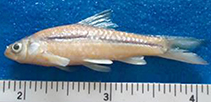 Enteromius mimus
foto/gambar oleh NMK
Gambar | imej Google
foto/gambar oleh NMK
klasifikasi / Nama Nama-nama umum | Sinonim (persamaan) | Catalog of Fishes(Marga, Jenis) | ITIS | CoL | WoRMS | Cloffa
> Cypriniformes (Carps) > Cyprinidae (Minnows or carps) > Smiliogastrinae
Etymology: Enteromius: Greek, enteron = intestine + Greek, myo, mys = muscle (Ref. 45335); mimus: The specific epithet 'mimus' means 'imitator', a reference to the 'striking resemblance' to Enteromius neglectus (Ref. 127947).
More on author: Boulenger.
Etymology: Enteromius: Greek, enteron = intestine + Greek, myo, mys = muscle (Ref. 45335); mimus: The specific epithet 'mimus' means 'imitator', a reference to the 'striking resemblance' to Enteromius neglectus (Ref. 127947).
More on author: Boulenger.
Lingkungan: lingkungan / zona iklim / kisaran kedalaman / jangkauan distribusi Ekologi
; air tawar bentopelagis. Tropical; 5°N - 5°S
Penyebaran Wilayah | Daerah-daerah FAO | Ekosistem | Kemunculan | peta titik | Introduksi | Faunafri
Ukuran / Berat / umur
deskripsi pendek Kunci identifiaksi (pengenalan) | Morfologi | Morfometrik
Duri punggung (Keseluruhan (total)) : 0; duri punggung lunak (Keseluruhan (total)) : 10 - 11; Duri dubur: 0; Sirip dubur lunak: 8 - 9. Diagnosis: Enteromius mimus belongs to the group of species of Enteromius with a flexible last unbranched dorsal fin ray that lacks serrations along its posterior edge (Ref. 127947). Enteromius mimus can easily be distinguished from the other species of this group from the East Coast and Nilo-Sudan ichthyofaunal regions by the following combinations of characteristics: a complete lateral line vs. an incomplete lateral line in E. atkinsoni, E. pumilus, E. serengetiensis, E. tongaensis and E. toppini; two pairs of barbels vs. one pair in E. pseudotoppini, and no barbels in E. anema and E. profundus; one to three dark spots on the flanks, which sometimes fuse into a mid-lateral line in preserved specimens, starting posterior to the operculum vs. a dark line running from the tip of the snout to the caudal fin base in E. bifrenatus and E. yongei, and a thin dark line from the beginning of the operculum to the caudal fin base in E. viviparus; 11-12 scales around the caudal peduncle vs. 8 in E. leonensis, 9-10 in E. venustus, and 10 in E. magdalenae and E. yeiensis; 24-27 lateral line scales vs. 30 in E. lineomaculatus, and 31 in E. innocens; 3.5-4.5 scales between the dorsal fin base and the lateral line vs. 5.5 in E. unitaeniatus and 6 in E. usambarae; 3-4 scales between the lateral line and the pelvic fin vs. 2 in E. trispilopleura, and 2-2.5 in E. neglectus; 7-8 branched dorsal fin rays vs. 9 in E. quadripunctatus; a body depth which is larger than the head length vs. a body depth which is equal to the head length in E. nigeriensis; a smaller snout length, 4.1-7.1% of standard length vs. 7.1-10.1% in E. radiatus (Ref. 127947). It differs from E. perince by a combination of a lower number of lateral line scales, 24-27 vs. 29-30, a lower number of scales between the dorsal fin base and lateral line, 3.5-4.5 vs. 5.5, a lower number of scales around the caudal peduncle, 11-12 vs. 14, a smaller interorbital width, 6.3-8.3% of standard length vs. 9.8-10.2%, a larger pre-pectoral distance, 26.0-29.0% of standard length vs. 23.1-24.5%, a lower minimum caudal peduncle depth, 11.1-14.0% of standard length vs. 15.0-16.4%, a lower maximum caudal peduncle depth, 12.9-16.5% of standard length vs. 17.7-19.4%, and a smaller anal fin base length, 7.3-8.7% of standard length vs. 8.5-9.6% (Ref. 127947). It differs from E. stigmatopygus by a combination of a smaller pre-pectoral distance, 26.0-29.0% of standard length vs. 29.1-33.1%, and a larger anal fin length, 18.0-19.7% of standard length vs. 12.6-17.4% (Ref. 127947). Enteromius mimus differs from E. alberti by a lower number of lateral line scales, 24-27 vs. 27-34, a larger pre-anal distance, 68.4-74.8% of standard length vs. 65.1-73.0%, a smaller post-anal distance, 16.3-19.3% of standard length vs. 16.3-24.2%, a larger body depth, 26.5-34.3% of standard length vs. 21.7-31.2%, a larger head depth, 17.8-21.8% of standard length vs. 15.1-19.0%, and a larger pelvic fin length, 18.2-22.4% of standard length vs. 15.0-20.9% (Ref. 127947). Specimens from E. mimus differ from the specimens of the population of E. cf. mimus from the Lake Edward system by a lower number of scales between the origin of the dorsal fin and the lateral line, 3.5-4.5 vs. 3.5-4.5, a larger pelvic fin length, 18.2-22.4% of standard length vs. 14.4-21.3%, a smaller snout length, 4.1-7.1% of standard length vs. 4.6-8.3%, a smaller interorbital width, 6.3-8.3% of standard length vs. 6.9-9.9%, a larger post-dorsal distance, 34.8-40.4% of standard length vs. 31.0-39.9%, and a larger anal fin length, 18.0-19.7% of standard length vs. 14.4-21.8% (Ref. 127947).
Siklus hidup dan perilaku kawin Kematangan | Reproduksi, perkembang biakan | Pemijahan | telur-telur | Fekunditas | Larva
rujukan utama
Unggah referensi Anda | Acuan | Koordinator | mitra
Maetens, H., M. Van Steenberge, J. Snoeks and E. Decru, 2020. Revalidation of Enteromius alberti and presence of Enteromius cf. mimus (Cypriniformes: Cyprinidae) in the Lake Edward system, East Africa. Eur. J. Taxon. 700:1-28. (Ref. 127947)
Status IUCN Red List (Ref. 130435: Version 2025-2 (Global))
kurang bimbang (LC) ; Date assessed: 31 January 2006
CITES
Not Evaluated
ancaman kepada manusia
Harmless
penggunaan manusia
Perikanan: tidak ada kepentingan
FAO - Publication: search | FishSource |
informasi lanjut
Ekologi trofik
Item makanan (mangsa)
Komposisi makanan
Konsumsi makanan
Ransum makanan
Pemangsa
Item makanan (mangsa)
Komposisi makanan
Konsumsi makanan
Ransum makanan
Pemangsa
Ekologi
Ekologi
Ekologi
Dinamika populasi
Parameter pertumbuhan
Maks. usia / ukuran
Panjang-berat rel.
Panjang-panjang rel.
ukuran frekuensi
Konversi massa
pemulihan
Kelimpahan
Parameter pertumbuhan
Maks. usia / ukuran
Panjang-berat rel.
Panjang-panjang rel.
ukuran frekuensi
Konversi massa
pemulihan
Kelimpahan
Siklus hidup
Reproduksi, perkembang biakan
Kematangan
Kedewasaan / insang rel.
Fekunditas
Pemijahan
Agregasi pemijahan
telur-telur
pekembangan telor
Larva
Dinamika larva
Reproduksi, perkembang biakan
Kematangan
Kedewasaan / insang rel.
Fekunditas
Pemijahan
Agregasi pemijahan
telur-telur
pekembangan telor
Larva
Dinamika larva
Anatomi
Area insang
Otak
Otolith
Area insang
Otak
Otolith
Fisiologi
Komposisi tubuh
Nutrisi
Konsumsi oksigen
Jenis renang
Kecepatan berenang
Pigmen visual
Suara ikan
Penyakit & Parasit
Toksisitas (LC50)
Komposisi tubuh
Nutrisi
Konsumsi oksigen
Jenis renang
Kecepatan berenang
Pigmen visual
Suara ikan
Penyakit & Parasit
Toksisitas (LC50)
Genetika
genom
Genetika
Heterozigositas
Diturunkan
Keanekaragaman Genetik
genom
Genetika
Heterozigositas
Diturunkan
Keanekaragaman Genetik
Yang berhubungan dengan manusia
Sistem akuakultur
profil budidaya air
Strain
Kasus Ciguatera
Perangko, koin, dll.
Sistem akuakultur
profil budidaya air
Strain
Kasus Ciguatera
Perangko, koin, dll.
Alat, peralatan
E-book | Penuntun lapangan | tanda freqkuenci panjang | peringkat sejarah hidup | peta titik |
Tangkap-MSY |
laporan khas
muat turun XML
Sumber internet
AFORO (otoliths) | Aquatic Commons | BHL | Cloffa | Websites from users | semak peneliti ikan | CISTI | Catalog of Fishes: Marga, Jenis | DiscoverLife | ECOTOX | FAO - Publication: search | Faunafri | Fishipedia | Fishtrace | GloBI | Google Books | Google Scholar | Google | IGFA World Record | OneZoom | Open Tree of Life | Otolith Atlas of Taiwan Fishes | PubMed | Reef Life Survey | Socotra Atlas | TreeBase | Tree of Life | Wikipedia: pergi, Cari | World Records Freshwater Fishing | Catatan Zoologi
Estimasi berdasarkan model
Indeks keanekaragaman filogenetik (Acuan 82804): PD50 = 0.5000 [Uniqueness, from 0.5 = low to 2.0 = high].
Bayesian length-weight: a=0.00603 (0.00282 - 0.01286), b=3.06 (2.87 - 3.25), in cm total length, based on LWR estimates for this (Sub)family-body shape (Ref. 93245).
Tingkat Trofik (Acuan 69278): 3.0 ±0.3 se; based on size and trophs of closest relatives
Daya lenting (Acuan 120179): Tinggi, Waktu penggandaan populasi minimum kurang dari 15 bulan (Preliminary K or Fecundity.).