



Protopterus aethiopicus Heckel, 1851
Marbled lungfish
Sube tu fotos y Vídeos
Imágenes | Sellos, monedas, varios | Google image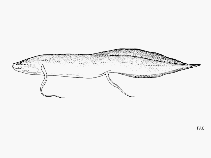 Protopterus aethiopicus
Foto de FAO
Imágenes | Sellos, monedas, varios | Google image
Foto de FAO
Clasificación / Nombres Nombres comunes | Sinónimos | Catalog of Fishes(Género, Especie) | ITIS | CoL | WoRMS | Cloffa
> Ceratodontiformes (Australian lungfishes) > Protopteridae (African lungfishes)
Etymology: Protopterus: Greek, pro = first, in front of + Greek, pteron = wing, fin (Ref. 45335).
More on author: Heckel.
Etymology: Protopterus: Greek, pro = first, in front of + Greek, pteron = wing, fin (Ref. 45335).
More on author: Heckel.
Entorno: milieu / zona climática / rango de profundidad / gama de distribución Ecología
; agua dulce demersal; rango de profundidad 0 - 60 m (Ref. 34291), usually 0 - 20 m (Ref. 34291). Tropical; 25°C - 30°C (Ref. 2059)
Distribución Territorios | Áreas FAO | Ecosistemas | Ocurrencias, apariciones | Mapa de puntos | Introducciones | Faunafri
Africa: subspecies Protopterus aethiopicus aethiopicus distributed in Nile basin and lakes Albert, Edward, Victoria, Nabugabo, Tanganyika, Kyoga and No (Ref. 3498), also in Lake Turkana (Ref. 52331). Subspecies P. a. congicus distributed in Congo basin, from Upper Lualaba to Kinshasa (Ref. 3498). Subspecies P. a. mesmaekersi distributed in Lower Congo River basin (Ref. 3498).
Longitud en la primera madurez / Tamaño / Peso / Edad
Madurez: Lm 73.0, range 70 - 76 cm
Max length : 200 cm TL macho / no sexado; (Ref. 34290); common length : 130 cm TL macho / no sexado; (Ref. 34290); peso máximo publicado: 17.0 kg (Ref. 13302)
Max length : 200 cm TL macho / no sexado; (Ref. 34290); common length : 130 cm TL macho / no sexado; (Ref. 34290); peso máximo publicado: 17.0 kg (Ref. 13302)
Descripción breve Claves de identificación | Morfología | Morfometría
Smooth, slimy, cylindrical body with deeply embedded scales (Ref. 28714). Tail pointed and confluent with the long dorsal and anal fins; dorsal fin originating at an equal distance from eye and vent, or nearer to the latter; pectoral and pelvic fins slender and filamentous (Ref. 34290). Perpendicular from dorsal fin origin closer to posterior than to anterior limbs (Bailey 1994). 55-70 scales in a longitudinal series from immediately behind head to above vent; 40-50 scales around body (Ref. 4903, 45485). 37-40 pairs of ribs (Ref. 4903). Dentition consisting of upper and lower tooth plates in the form of sharp cutting ridges (Ref. 34290). Young fish with true external gills, but usually absent in specimens above 15 cm TL (Ref. 34290). Dark slate-grey above, yellowish-grey or pinkish below, often with numerous dark spots or flecks on fins and body; some specimens bright yellow ventrally; sensory canals on head and body outlined in black (Ref. 34290).
Body shape (shape guide): elongated; Cross section: circular.
Body shape (shape guide): elongated; Cross section: circular.
Obligate air-breathing (Ref. 126274); Adults inhabit river and lake fringes, swamps and floodplains (Ref. 28714). In the Lake Victoria basin found in open lakes and marginal swamps, while in the Lake Tanganyika basin only found near rivers and deltas (Ref. 4967). Juveniles occur in matted roots of papyrus (Ref. 34291). Adults able to survive in streams and swamps that are completely dry for long periods of the year, withstanding desiccation on floodplains by aestivating in cocoons until the next rains, breathing air by a small passage leading to the outside (Ref. 45484). Obligate air-breather (Ref. 126274) under laboratory conditions (Ref. 34291), but under certain conditions lungfish in the wild may not be obligate air-breathers and the use of aerial respiration may be a function of ecological as well as physiological factors (Ref. 58531). Mature individuals breed during the flood season (Ref. 28714). One or several females spawn in burrows which are dug and cleaned by the male, who later guards the eggs and the young. Principal diet of adults and sub-adults consists of mollusks, but small fishes and insects are also eaten in small quantities; young individuals less than 35 cm TL feed almost exclusively on insects (Ref. 34291).
Ciclo vital y comportamiento de apareamiento Madurez | Reproducción | Puesta | Huevos | Fecundidad | Larva
Male parent prepares a pit or hole nest, in which more than one female may spawn; once eggs are laid, female leaves the nest and does not return; male guards eggs and young for nearly eight weeks; male not only attacks any would-be intruders but also constantly aerates the water in the nest (Ref. 4903). A multiple spawner (Ref. 41824).
Referencia principal
Suba sus referencias | Referencias | Coordinador | Colaboradores
Gosse, J.-P., 1984. Protopteridae. p. 8-17. In J. Daget, J.-P. Gosse and D.F.E. Thys van den Audenaerde (eds.) Check-list of the freshwater fishes of Africa (CLOFFA). Volume I. ORSTOM, Paris and MRAC, Tervuren. 410 p. (Ref. 3498)
Situación en la Lista Roja de la UICN (Ref. 130435: Version 2025-2 (Global))
Least Concern (LC) ; Date assessed: 02 March 2018
CITES
Not Evaluated
Amenaza para el ser humano
Harmless
Usos humanos
Pesquerías: escaso valor comercial
FAO - Publication: search | FishSource |
Más información
Ecología Trófica
Alimentos (presas)
Composición de la dieta
consumo de alimento
Raciones de comida
Despredadores
Alimentos (presas)
Composición de la dieta
consumo de alimento
Raciones de comida
Despredadores
Dinámica de la población
Coeficiente del crecimiento para
Edades / tallas máximas
Longitud-peso rel.
Longitud-longitud rel.
Longitud-frecuencias
Conversión de masas
Reclutamiento
Abundancia
Coeficiente del crecimiento para
Edades / tallas máximas
Longitud-peso rel.
Longitud-longitud rel.
Longitud-frecuencias
Conversión de masas
Reclutamiento
Abundancia
Ciclo de vida
Reproducción
Madurez
Madurez/Gills rel.
Fecundidad
Puesta
Agregaciones de desove
Huevos
Desarrollo de los huevos
Larva
Dinámica larvaria
Reproducción
Madurez
Madurez/Gills rel.
Fecundidad
Puesta
Agregaciones de desove
Huevos
Desarrollo de los huevos
Larva
Dinámica larvaria
Distribución
Territorios
Áreas FAO
Ecosistemas
Ocurrencias, apariciones
Introducciones
BRUVS - Vídeos
Territorios
Áreas FAO
Ecosistemas
Ocurrencias, apariciones
Introducciones
BRUVS - Vídeos
Anatomía
Superficie branquial
Cerebro
Otolito
Superficie branquial
Cerebro
Otolito
Fisiología
Composición corporal
Nutrientes
Consumo del oxígeno
Tipo de natación
Velocidad de natación
Pigmentos visuales
Sonido de peces
Enfermedades y parásitos
Toxicidad (CL50)
Composición corporal
Nutrientes
Consumo del oxígeno
Tipo de natación
Velocidad de natación
Pigmentos visuales
Sonido de peces
Enfermedades y parásitos
Toxicidad (CL50)
Genética
Genoma
Genética
Heterocigosidad
heritabilidad
Diversidad genética
Genoma
Genética
Heterocigosidad
heritabilidad
Diversidad genética
Relacionados con el ser humano
Sistemas de acuicultura
Perfiles de acuicultura
Razas
Ciguatera cases
Sellos, monedas, varios
Sistemas de acuicultura
Perfiles de acuicultura
Razas
Ciguatera cases
Sellos, monedas, varios
Herramientas
Libro electrónico | Guía de campo | Asistente para frecuencias de tallas | Herramienta de ciclo de vida | Mapa de puntos |
Catch-MSY |
Informes especiales
Comprobar el mantenimiento del acuario | Buscar fichas sobre especies | Consulte las hojas informativas sobre acuicultura
Descargar XML
Fuentes de Internet
AFORO (otoliths) | Alien/Invasive Species database | Aquatic Commons | BHL | Cloffa | Websites from users | Check FishWatcher | CISTI | Catalog of Fishes: Género, Especie | DiscoverLife | ECOTOX | FAO - Publication: search | Faunafri | Fishipedia | Fishtrace | GloBI | Google Books | Google Scholar | Google | IGFA World Record | OneZoom | Open Tree of Life | Otolith Atlas of Taiwan Fishes | Acuarios públicos | PubMed | Reef Life Survey | Socotra Atlas | TreeBase | Árbol de la vida | Wikipedia: Go, búsqueda | World Records Freshwater Fishing | Zoobank | Expediente Zoológico
Estimaciones basadas en modelos
Índice de diversidad filogenética (Referencia 82804): PD50 = 0.6562 [Uniqueness, from 0.5 = low to 2.0 = high].
Bayesian length-weight: a=0.00380 (0.00151 - 0.00959), b=3.10 (2.88 - 3.32), in cm total length, based on LWR estimates for this (Sub)family-body shape (Ref. 93245).
Nivel trófico (Referencia 69278): 4.4 ±0.2 se; based on diet studies.
Resiliencia (Referencia 120179): Bajo, población duplicada en un tiempo mínimo de 4.5-14 años (Fec=7,800; assumed tm<10; assumed tmax>30).
Nutrientes (Ref. 124155): Calcium = 25.8 [5.5, 74.8] mg/100g; Iron = 0.837 [0.318, 5.003] mg/100g; Protein = 3.82 [0.22, 7.64] %; Omega3 = 0.27 [0.09, 0.82] g/100g; Selenium = 80.5 [25.2, 263.4] μg/100g; VitaminA = 17.4 [6.0, 48.3] μg/100g; Zinc = 0.886 [0.435, 1.682] mg/100g (wet weight);