



Scyliorhinus torazame (Tanaka, 1908)
Cloudy catshark
Adicionar o seu Fotografias e vídeos
Fotografias | Imagem do Google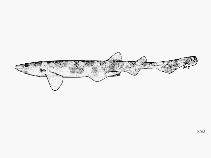 Scyliorhinus torazame
Fotografia de FAO
Fotografias | Imagem do Google
Fotografia de FAO
Classificação / Nomes Nomes comuns | Sinónimos | Catalog of Fishes(Género, Espécies) | ITIS | CoL | WoRMS | Cloffa
Elasmobranchii (tubarões e raias) (sharks and rays) > Carcharhiniformes (Ground sharks) > Scyliorhinidae (Cat sharks) > Scyliorhininae
Etymology: Scyliorhinus: skylion, Greek for dogfish or small shark; rhinus, from rhine (Gr.), rasp, alluding to a shark’s jagged, rasp-like skin (See ETYFish); torazame: Japanese vernacular, meaning “tiger shark,” referring to its markings (See ETYFish).
More on author: Tanaka.
Etymology: Scyliorhinus: skylion, Greek for dogfish or small shark; rhinus, from rhine (Gr.), rasp, alluding to a shark’s jagged, rasp-like skin (See ETYFish); torazame: Japanese vernacular, meaning “tiger shark,” referring to its markings (See ETYFish).
More on author: Tanaka.
Ambiente: milieu / zona climática / intervalo de profundidade / gama de distribuição Ecologia
marinhas demersal; intervalo de profundidade 0 - 300 m (Ref. 125694). Tropical; 44°N - 22°N, 120°E - 147°E (Ref. 120402)
Distribuição Territórios | Áreas FAO | Ecossistemas | Ocorrências | Mapa dos pontos | Introduções | Faunafri
Northwest Pacific: Japan, Korea and Taiwan.
Comprimento na primeira maturidade / Tamanho / Peso / Idade
Maturidade: Lm 39.5, range 37 - 42 cm
Max length : 77.8 cm TL macho/indeterminado; (Ref. 120402); 47.8 cm TL (female)
Max length : 77.8 cm TL macho/indeterminado; (Ref. 120402); 47.8 cm TL (female)
Descrição breve Chaves de identificação | Morfologia | Morfometria
Espinhos dorsais (total) : 0; Espinhos anais: 0. This species is distinguished from all its congeners by having specialized hooks in the clasper (vs. absent); pelvic apron extends almost entirely the length of pelvic inner margins (vs. up to 2/3 length of pelvic inner margins in S. boa, S. cabofriensis, S. cervigoni, S. comoroensis, S. haeckelii, S. hesperius, S. meadi, S. retifer, S. stellaris, S. ugoi); males with distal tips of pelvic fins straight (vs. tapered); body beige to light brown with cream to beige spots (vs. no light spots in S. cervigoni, S. garmani, S. meadi, S. retifer and yellow to golden spots in S. capensis), and spots are predominantly spiracle-sized (vs. mostly smaller than spiracles in S. boa, S. cabofriensis, S. canicula, S. duhamelii, S. stellaris, S. ugoi). Other characters, although less distinct, that also helps distinguish this species are the following: saddles darker than the background color (vs. inconspicuous in S. boa, S. cabofriensis, S. cervigoni, S. garmani, S. torrei); anterior nasal flaps not reaching the upper lip (vs. reaching upper lip, and sometimes covering it, in S. canicula, S. cervigoni, comoroensis, S. duhamelii, S. garmani, S. stellaris); interdorsal distance 0.6-1.0 times smaller than anal base (vs. greater than anal base in S. boa, S. cabofriensis, S. haeckelii, S. hesperius, S. meadi, S. retifer, S. torrei, S. ugoi); mandibular canal of lateral line system with 5-6 pores (vs. 3-4 in S. hesperius); oral canal of lateral line system with 7-10 pores (vs.10-12 in S. duhamelii; 5-6 in S. hesperius; 9-13 in S. torrei); commissural teeth with one cusplet and principal cusplet laterally situated (vs. 2 or more in other species, except in S. cervigoni, S. meadi, S. torrei); clasper with terminal dermal cover smooth (vs. rough in S. canicula, S. capensis); cover rhipidion covered by dermal denticles (vs. not covered in S. boa, S. cervigoni, S. retifer); terminal 3 cartilage present (vs. absent in S. cabofriensis, S. cervigoni, S. comoroensis, S. duhamelii, S. haeckelii, S. stellaris, S. torrei, S. ugoi); dorsal terminal 2 cartilage elongated and similar in size to dorsal terminal cartilage (vs. reduced and subtriangular in S. cabofriensis, S. capensis, S. cervigoni, S. haeckelii, S. ugoi; dorsal terminal 2 less than half length of dorsal terminal cartilage in S. boa, S. canicula, S. duhamelii, S. retifer, S. stellaris, S. torrei); counts of monospondylous vertebrae 32-37 (vs. lower in other species, except in S. canicula, S. duhamelii, S. haeckelii, S. torrei); adult males between 36.0-40.0 cm TL and adult females between 37.0-42.0 cm TL (vs. adult reach greater sizes at sexual maturity in S. capensis, S. cervigoni, S. meadi, S. stellaris, S. ugoi) (Ref. 120402).
Body shape (shape guide): elongated; Cross section: circular.
Body shape (shape guide): elongated; Cross section: circular.
A common catshark found on the continental shelf, from close inshore down to at least 100 m (Ref. 244, 11230); with records from the Tsushima Strait at 120 m and Korea Strait at 140 m depth; also known to enter shallow coastal waters (Ref. 120402). Oviparous (Ref. 50449). Adult males are between 36.0-40.0 cm TL (largest reported 77.8 cm TL) while adult female sizes at 37.0-42.0 cm TL (largest 47.8 cm TL). Egg capsules are translucent yellow with smooth surface, with anterior tip slightly concave and posterior tip truncate, with long tendrils (mean values for egg capsule dimensions: 5.5 cm length. 1.9 cm width, n = 3) (Ref. 120402). Interest to fisheries unknown (Ref. 11146).
Ciclo de vida e comportamento de acasalamento Maturidade | Reprodução | Desova | Ovos | Fecundidade | Larvas
Oviparous, with only one egg laid per oviduct at a time (Ref. 244). Embryos feed solely on yolk (Ref. 50449). Size at hatching at least 8 cm (Ref. 244).
During courtship and prior to copulation, the male bites and wraps the female's pectoral fin, body, tail, and gills (Ref. 49562, 51119). Copulation is initiated when the male inserts one of its claspers into the female's cloaca. The whole mating episode lasts from 15 seconds to 4 minutes (Ref. 49562).
Referência principal
Carregar as suas referências | Referências | Coordenador : Compagno, Leonard J.V. | Colaboradores
Soares, K.D.A. and M.R. De Carvalho, 2019. The catshark genus Scyliorhinus (Chondrichthyes: Carcharhiniformes: Scyliorhinidae): taxonomy, morphology and distribution. Zootaxa 4601(1):1-147. (Ref. 120402)
Categoria na Lista Vermelha da IUCN (Ref. 130435: Version 2025-2 (Global))
Preocupação menor (LC) ; Date assessed: 05 May 2020
CITES
Not Evaluated
Ameaça para o homem
Harmless
Utilização humana
FAO - Publication: search | FishSource |
Mais informação
Ecologia Trófica
Produtos alimentares (presas)
Composição da dieta
Consumo alimentar
Rações alimentares
Predadores
Produtos alimentares (presas)
Composição da dieta
Consumo alimentar
Rações alimentares
Predadores
Dinâmica das populações
Parâmetros de crescimento
Idades / tamanhos máximos
Comprimento-peso rel.
Comprimento-comprimento rel.
Frequência de comprimento
Conversão de massa
Recrutamento
Abundância
Parâmetros de crescimento
Idades / tamanhos máximos
Comprimento-peso rel.
Comprimento-comprimento rel.
Frequência de comprimento
Conversão de massa
Recrutamento
Abundância
Ciclo de vida
Reprodução
Maturidade
Maturidade/Rel. das guelras
Fecundidade
Desova
Agregações de desova
Ovos
Desenvolvimento dos ovos
Larvas
Dinâmica larvar
Reprodução
Maturidade
Maturidade/Rel. das guelras
Fecundidade
Desova
Agregações de desova
Ovos
Desenvolvimento dos ovos
Larvas
Dinâmica larvar
Anatomia
Área branquial
Cérebro
Otólitos
Área branquial
Cérebro
Otólitos
Fisiologia
Composição corporal
Nutrientes
Consumo de oxigénio
Tipo de natação
Velocidade de natação
Pigmentos visuais
Som de peixe
Doenças e Parasitas
Toxicidade (LC50s)
Composição corporal
Nutrientes
Consumo de oxigénio
Tipo de natação
Velocidade de natação
Pigmentos visuais
Som de peixe
Doenças e Parasitas
Toxicidade (LC50s)
Relacionado com o ser humano
Sistemas de aquacultura
Perfis para aquacultura
Estirpes
Casos de Ciguatera
Selos, moedas, diversos.
Sistemas de aquacultura
Perfis para aquacultura
Estirpes
Casos de Ciguatera
Selos, moedas, diversos.
Ferramentas
E-book | Guia de campo | Chaves de identificação | Ferramenta auxiliar de frequências de comprimento | Ferramenta sobre a história de vida | Mapa dos pontos |
Captura-MSY |
Relatórios especiais
Descarregue XML
Fontes da internet
AFORO (otoliths) | Aquatic Commons | BHL | Cloffa | Websites from users | Consultar FishWatcher | CISTI | Catalog of Fishes: Género, Espécies | DiscoverLife | ECOTOX | FAO - Publication: search | Faunafri | Fishipedia | Fishtrace | GloBI | Google Books | Google Scholar | Google | IGFA World Record | Bases de dados nacionais | OneZoom | Open Tree of Life | Otolith Atlas of Taiwan Fishes | Aquários públicos | PubMed | Reef Life Survey | Socotra Atlas | TreeBase | Árvore da vida | Wikipedia: ir para, procurar | World Records Freshwater Fishing | Registo zoológico
Estimativas baseadas em modelos
Índice de diversidade filogenética (Ref. 82804): PD50 = 0.5000 [Uniqueness, from 0.5 = low to 2.0 = high].
Bayesian length-weight: a=0.00269 (0.00140 - 0.00518), b=3.21 (3.04 - 3.38), in cm total length, based on LWR estimates for this (Sub)family-body shape (Ref. 93245).
Nível Trófico (Ref. 69278): 3.9 ±0.61 se; based on food items.
Resiliência (Ref. 120179): Muito baixo, tempo mínimo de duplicação da população maior que 14 anos (Fec = 1).